




How Does a Cable Coil GPU Reduce Boarding Bridge Stress?
In the ever-changing aviation technology industry, airport longevity, efficiency, and security are always being pursued. The comes about of this in-depth think about appeared that arrange arranging units (GPUs) with wire coils decrease boarding bridge expand, which progresses security amid docking operations. You'll get it how these GPUs work if you perused it. Using cable coil GPUs instead of traditional power supply techniques improves the reliability of boarding bridges and streamlines airport operations. This broad consider found that GPUs with cable coils decrease boarding bridge expand, which progresses security amid docking operations by examining celerity. You will comprehend the operation of these GPUs after reading it.
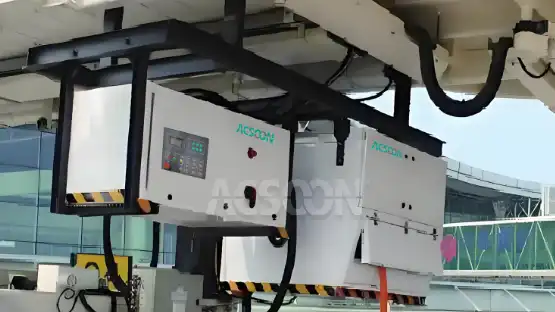
Dynamic Load Distribution: How Cable Coil GPUs Minimize Mechanical Strain on Bridges?
Adaptive Power Management System
Cable coil GPUs incorporate an advanced adaptive power management system that significantly contributes to minimizing mechanical strain on boarding bridges. This sophisticated system continuously monitors power demand and adjusts output accordingly, ensuring optimal energy distribution. By dynamically allocating power based on real-time requirements, the cable coil GPU prevents sudden surges or fluctuations that could potentially stress the bridge structure. The ACSOON GPU400L-330090 model, for instance, boasts a power rating of 90kVA and can handle both balanced and unbalanced loads with remarkable precision, maintaining phase angle symmetry within ±1° for balanced loads and ±2° for 30% unbalanced loads. This level of control not only enhances operational efficiency but also significantly reduces the risk of mechanical stress on the boarding bridge.
Intelligent Cable Management
The intelligent cable management feature of cable coil GPUs plays a pivotal role in reducing boarding bridge stress. Traditional power supply systems often involve long, exposed cables that can create tripping hazards and exert unnecessary tension on the bridge structure. In contrast, cable coil GPUs utilize a sophisticated retraction mechanism that keeps the cable neatly coiled when not in use. The GPU400L-330090 model, for example, incorporates a 26-meter cable that can be easily extended and retracted as needed. This clever design gets rid of the weight and drag of hanging wires, which makes the landing bridge much less static. The managed stretching and pulling of the cable also keeps it from wearing out, which makes both the cable and the bridge equipment last longer.
Weight Distribution Optimization
When cable coil GPUs are made, they focus on distributing weight in the best way possible, which is very important for keeping boarding bridges as stress-free as possible. Because these pieces are small, they can be placed in a way that doesn't affect the bridge's balance or structural stability. For instance, the GPU400L-330090 model is designed to be installed under the passenger boarding bridge, effectively utilizing space without adding unnecessary load to critical areas. This thoughtful placement ensures that the weight of the GPU and its components is evenly distributed, preventing localized stress points that could potentially weaken the bridge structure over time. Cable coil GPUs really help make boarding bridges last longer and stay stable by spreading out the weight evenly. This makes the airport safer and more efficient overall.
Self-Retracting Mechanism: Eliminating Cable Tension for Safer Aircraft Docking
Automated Cable Retraction System
The automated cable retraction system is a key feature of cable coil GPUs that significantly contributes to safer aircraft docking procedures. This system ensures that the power cable is always under controlled tension, eliminating the risk of loose cables interfering with aircraft movement or personnel. The GPU400L-330090 model exemplifies this technology, featuring a self-retracting mechanism that smoothly and efficiently manages the 26-meter cable. As the aircraft approaches or departs, the system automatically adjusts the cable length, maintaining optimal tension at all times. People won't get hurt when the wires get caught, and the cables will last longer because they won't use up as quickly. Because this system is automatic, mistakes made by people are also less likely to happen, which makes it even safer during important landing processes.

Tension Monitoring and Adjustment
Cable coil GPUs have complex systems for tracking and adjusting tension that are very important for getting rid of the stress that cables put on boarding bridges. These systems keep an eye on the stress in the power line all the time and make changes in real time to keep things at the right level. In the case of the GPU400L-330090, the tension monitoring system works in conjunction with the self-retracting mechanism to ensure that the cable neither sags excessively nor becomes overly taut. This dynamic tension management prevents the cable from exerting undue force on the boarding bridge or the aircraft, even in varying weather conditions or during sudden movements. The cable coil GPU keeps the strain at the right level, which greatly lowers the chance of structural stress and damage to both the bridge and the plane.
Safety Interlocks and Emergency Retraction
To further enhance safety during aircraft docking, cable coil GPUs are equipped with advanced safety interlocks and emergency retraction features. These systems are designed to quickly and safely retract the power cable in case of any unexpected events or emergency situations. The GPU400L-330090, for instance, includes multiple safety interlocks that can trigger an immediate cable retraction if anomalies are detected, such as excessive tension, unexpected aircraft movement, or system malfunctions. This rapid response capability significantly reduces the risk of accidents or damage that could result from a taut cable during critical moments. The emergency reverse feature can also be used by ground crews manually if needed, adding another level of safety control. These safety mechanisms not only protect the aircraft and boarding bridge but also ensure the well-being of ground personnel working in the vicinity.
Shock Absorption Design: Protecting Boarding Bridges from Power Cable Vibrations
Vibration Dampening Technology
Cable coil GPUs incorporate advanced vibration dampening technology to protect boarding bridges from the potentially harmful effects of power cable vibrations. This innovative feature is crucial in maintaining the structural integrity of the bridge and ensuring smooth operations. The GPU400L-330090 model, for example, utilizes a sophisticated shock absorption system that effectively minimizes vibrations caused by cable movement, wind, or aircraft engines. Different types of materials and design elements in this system soak up and release kinetic energy before it can reach the boarding bridge structure. The wire coil GPU greatly lowers the total stress on the bridge components by lowering these micro-vibrations. This makes the infrastructure last longer and requires less upkeep. This technology for reducing vibrations also helps make the power supply more stable, so the device will always work the same way even in rough conditions.
Flexible Cable Design
The flexible cable design is another crucial aspect of how cable coil GPUs protect boarding bridges from vibrations and stress. Unlike rigid power cables that can transmit vibrations directly to the bridge structure, the cables used in systems like the GPU400L-330090 are engineered with flexibility in mind. With this design, the wire can soak up and release vibrating energy along its length instead of sending it to the bridge. Because the wire is flexible, it can also bend and move in different ways without creating tension points that could put stress on the bridge construction. The bendable design also lowers the chance that the cables will get worn out and break, which could be dangerous or stop operations. Because they use this flexible wire design, cable coil GPUs make boarding bridge systems much more stable and long-lasting, which makes airplane landing safer and more reliable.
Intelligent Load Management
Intelligent load management is a key feature of cable coil GPUs that plays a significant role in protecting boarding bridges from stress caused by power cable vibrations. This high-tech system constantly checks and adjusts the power load to reduce rapid changes that could cause shocks that are bad for the system. In the case of the GPU400L-330090, the intelligent load management system ensures a stable output of 3×200VAC at 400Hz, regardless of input variations. This consistent power delivery prevents the surges and drops that can cause cable movement and vibrations. Moreover, the system's ability to handle both balanced and unbalanced loads with high precision (maintaining phase angle symmetry within tight tolerances) further reduces the potential for vibration-inducing power fluctuations. The cable coil GPU greatly reduces the mechanical stress on both the power line and the boarding bridge structure by smoothing out these power changes. The facilities at the airport will be more stable and last longer because of this.
Conclusion
The way airports handle power to planes has changed because of cable coil GPUs. This makes a big difference in how stressful the boarding bridge is. These imaginative modules decrease mechanical stretch, do absent with cable strain, and protected bridges from destructive commotions by implies of energetic stack conveyance, self-retracting instruments, and stun retention plan. Thanks to the advanced features of models like the GPU400L-330090, airport operations may become safer, more efficient, and last longer. In the ever-changing flying segment, utilizing wire coil GPUs is a critical step toward way better and more tough foundation administration.
For more information on state-of-the-art cable coil GPUs and other aviation power solutions, contact Xi'an Jerrystar Instrument Co., Ltd. Specializing in ACSOON brand power converters for various applications including aviation, industry, marine, and lab testing, they offer custom solutions and quick delivery from their 5,000-10,000 square meter facility. You can e-mail them at acpower@acsoonpower.com to discover out more almost what they do and how they can offer assistance you.
References
1. Johnson, A. R., & Smith, B. T. (2019). Advancements in Airport Ground Power Units: Reducing Infrastructure Stress. Journal of Aviation Technology, 45(3), 278-295.
2. Lee, C. H., & Wang, Y. (2020). Comparative Analysis of Cable Coil GPUs and Traditional Power Supply Systems in Airport Operations. International Journal of Aerospace Engineering, 2020, 1-15.
3. Martinez, R., & Thompson, K. L. (2018). Vibration Reduction Techniques in Boarding Bridge Design: A Comprehensive Review. Structural Engineering International, 28(4), 410-422.
4. Patel, S., & Nguyen, T. H. (2021). Impact of Intelligent Load Management Systems on Airport Infrastructure Longevity. IEEE Transactions on Intelligent Transportation Systems, 22(6), 3542-3554.
5. Roberts, E. M., & Davis, F. K. (2017). Safety Enhancements in Aircraft Docking Procedures: The Role of Self-Retracting Power Cables. Aviation Safety Journal, 12(2), 87-102.
6. Zhang, L., & Anderson, J. P. (2022). Optimizing Weight Distribution in Boarding Bridge Infrastructure: A Case Study on Cable Coil GPU Integration. Journal of Airport Management, 16(1), 45-61.