




Product Selection Guide
How Cable Length and Site Conditions Affect Aircraft Ground Power Unit Selection
A ground power unit is often introduced by its output rating: 30kVA, 60kVA or 90kVA for a 400Hz AC unit, or 200A, 400A or 800A for a 28V DC unit. Those values are necessary, but they do not describe the whole installation. The power must travel from the GPU cabinet to an aircraft connector or test load, under a defined operating environment and duty cycle. That path can change the final configuration.
For buyers, the practical lesson is simple: select the GPU as a system, not as an isolated cabinet. Cable length, conductor size, connector, reel, installation format, input supply and environmental conditions should be reviewed before the quotation is treated as technically complete.
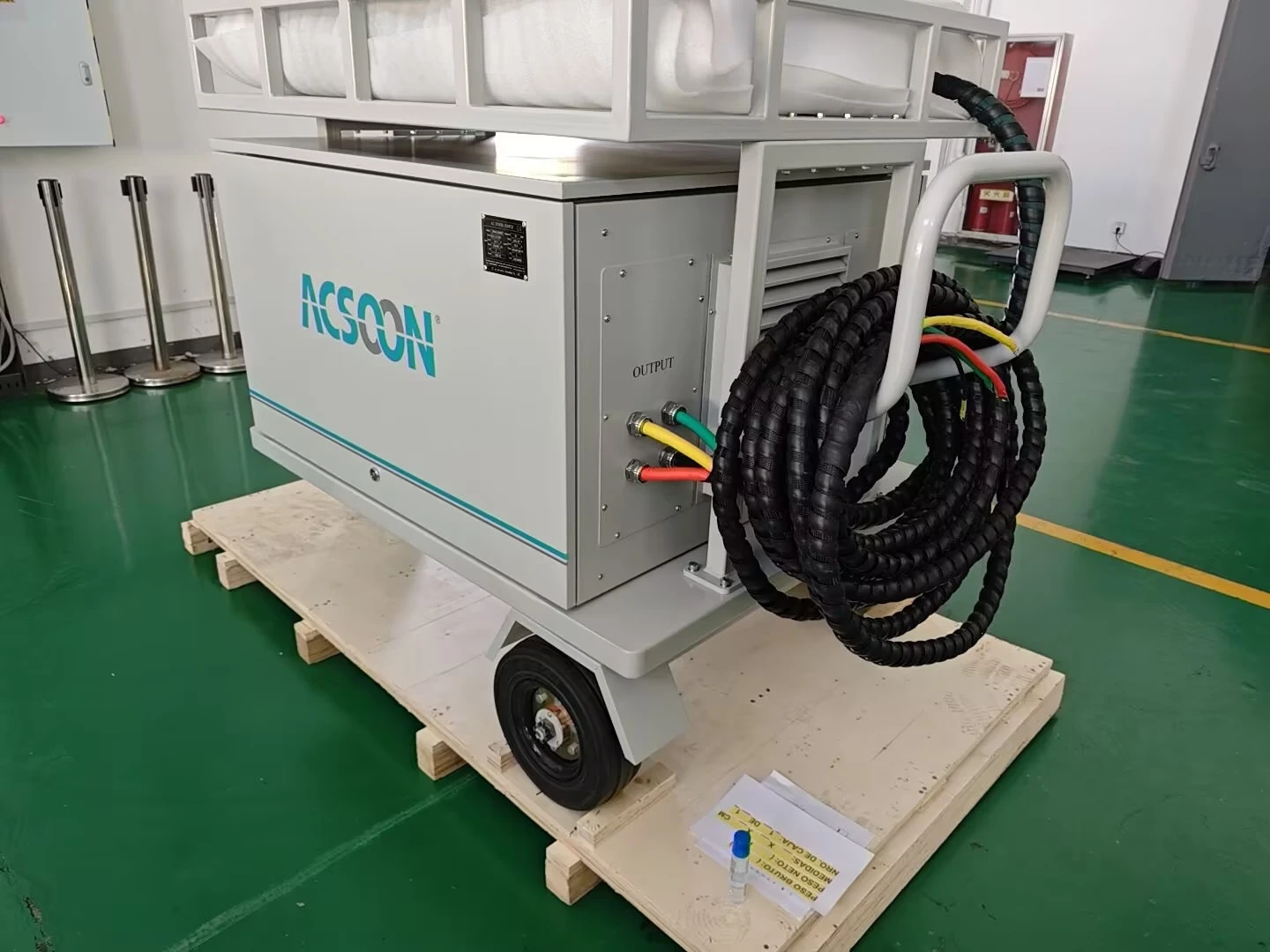
Why cable length changes the engineering review
Every conductor has resistance. When current flows through a cable, part of the source voltage is lost along the route and part of the electrical energy becomes heat. The result depends on current, conductor material, conductor cross-section, cable length, connections and operating temperature. A connector or reel can also add contact points that must be considered.
The effect deserves particular attention in low-voltage, high-current DC systems. A voltage change that appears small in absolute terms can represent a meaningful share of a 28.5V supply. In a 400Hz AC system, cable impedance, load characteristics and the complete distribution path also need review. This is why a quotation that lists only the power rating and a generic cable can leave an important assumption hidden.
The target should not be described only as the voltage at the source terminals. The engineering discussion should define the required voltage and power quality at the aircraft connector or load under the intended operating condition. Any compensation range or cable arrangement must be checked against the selected model and project data.
The basic voltage drop relationship
For a DC circuit, voltage drop increases with current and total conductor resistance. The total route includes the outgoing and return conductors, which is why the complete circuit length matters. For three-phase AC systems, resistance, reactance, power factor and current all contribute. A simple rule of thumb may help during an early conversation, but final cable sizing and protection should be completed by the responsible engineer using the actual installation data and applicable requirements.
Seven project details that change the configuration
1 Required output at the load. Confirm voltage, frequency, phase and the operating tolerance required by the aircraft or test equipment. Separate continuous operating requirements from starting or short-duration demand.
2 Continuous and peak load. A unit that supports avionics testing may see a different load profile from a unit used for engine starting or maintenance. State both continuous current or kVA and any peak demand, including duration.
3 Cable route and reel. Provide the approximate one-way distance, routing constraints, reel requirement and whether the cable will remain coiled during operation. These details influence conductor selection, thermal review and handling.
4 Connector and number of outputs. Identify the aircraft connector, plug standard or existing interface. If more than one output is required, specify whether they operate simultaneously and how the loads are distributed.
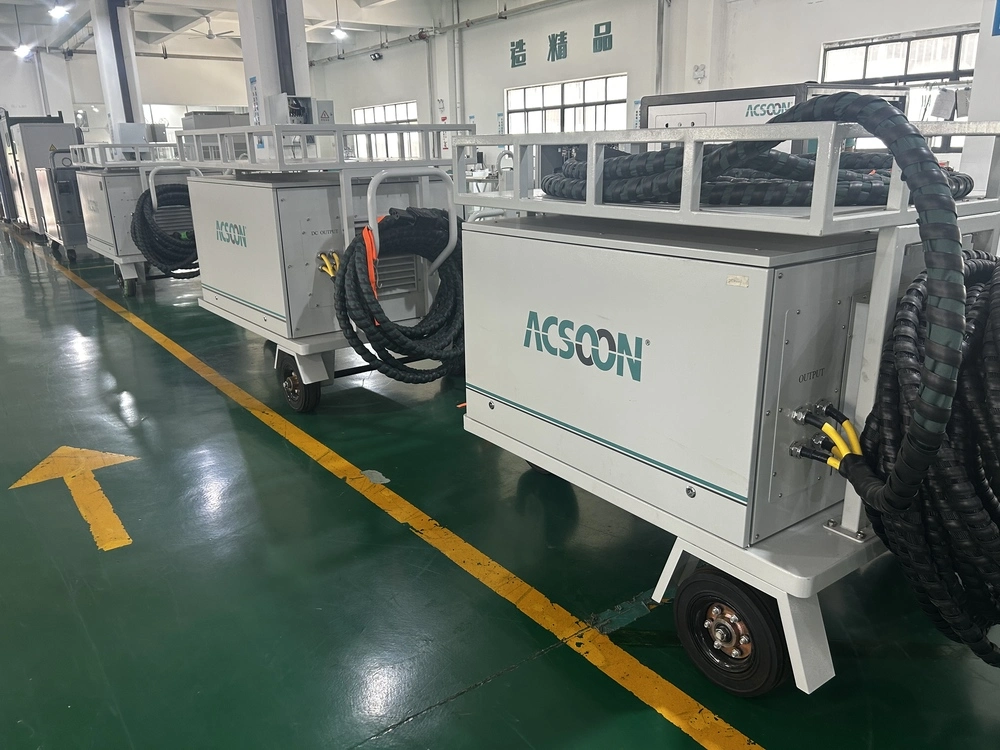
5 Installation format. A fixed hangar unit, trolley, trailer and bridge-mounted unit have different cable management, enclosure, access and mobility requirements.
6 Environment. State indoor or outdoor use, ambient temperature, humidity, altitude, dust, rain exposure and any required enclosure rating. Do not assume a standard enclosure is suitable for every apron or coastal site.
7 Site input power. Confirm available input voltage, frequency, phase, earthing arrangement and upstream capacity. The GPU output cannot be evaluated independently from the supply feeding it.
Why identical ratings can produce different quotations
Two suppliers may both quote a 90kVA 400Hz GPU, yet one quotation may include a long cable, reel, outdoor enclosure and a specific connector while the other assumes a short local cable and indoor installation. The headline rating is the same, but the scope, loss assumptions and installation work are not.
The same issue appears in 28V DC projects. A quotation for an 800A source is not directly comparable if cable length, peak-current duration, connector, ambient temperature or mobility are different. Procurement teams should normalize these items before comparing price or delivery.
RFQ checklist for a 400Hz or 28V DC GPU
RFQ field | Information to provide | Why it matters |
Site input | Voltage, frequency, phase, upstream capacity | Confirms compatibility with local power |
Required output | AC or DC, voltage, frequency, phase | Defines the power architecture |
Load | Continuous kVA/A and peak demand with duration | Supports capacity and overload review |
Cable | Length, route, reel and handling needs | Supports voltage drop and thermal review |
Connector | Type, quantity and simultaneous use | Defines the aircraft interface |
Installation | Fixed, trolley, trailer or bridge-mounted | Affects enclosure, access and mobility |
Environment | Indoor/outdoor, temperature, altitude, humidity | Supports derating and enclosure review |
Operation | Daily hours, continuous/temporary duty, starting use | Clarifies thermal and overload duty |
Evidence | Nameplate, connector and site photos | Reduces assumptions during clarification |
How ACSOON product information fits this review
The ACSOON AF400W page describes a 400Hz solid-state GPU family designed to convert 50Hz or 60Hz input power to 400Hz output. It lists multiple capacities and identifies voltage compensation, protection and fixed or mobile possibilities as model or configuration considerations. The ADCW page describes 28.5V DC and 270V DC solid-state GPU options with a broad current range and fixed or mobile formats. These are product-family references, not a substitute for reviewing the exact project.
Product references: 400Hz Solid State GPU | 28VDC Solid State GPU
Questions buyers frequently ask
Can I choose cable length after ordering the GPU?
It is better to confirm the route early. Cable length can affect conductor size, reel selection, voltage compensation and mechanical handling.
Is a higher kVA or ampere rating enough to solve voltage drop?
Not necessarily. Oversizing the source does not replace a cable and system review. The required voltage at the load, conductor, route and operating current still need to be checked.
What if the exact aircraft load is unknown?
Provide the aircraft or equipment documentation available, plus nameplate and connector photos. Mark unknown values clearly so the engineering team can identify what must be confirmed.
Can one GPU serve several aircraft types?
Possibly, but compatibility should not be assumed. Output, connector, load profile, cable and operating procedures must be checked for each intended use.
Do all projects need automatic voltage compensation?
No universal answer applies. The need and setting depend on the selected model, cable, load and required voltage at the connector. Confirm the function and range in the final technical specification.
Conclusion
A useful GPU RFQ describes the path from the site input to the aircraft connector. When the buyer provides output requirements, load profile, cable route, connector, installation format and environmental data, suppliers can compare the same technical scope. That makes the quotation easier to evaluate and reduces late changes during engineering or installation.
CTA: Send the site input, required output, continuous and peak load, cable length, connector and operating environment for a project-specific configuration review. Submit an online message