




Frequency Converter 50 Hz to 400 Hz: Ground Power Applications
In the field of power transfer technology, frequency converters, especially frequency converter 50hz to 400hz, are very important for changing the frequency of electricity. One of the most important changes is from 50 Hz to 400 Hz, which is used a lot in ground power uses, especially in the aviation and aerospace industries. These special transformers are made to meet the power needs of planes and other high-frequency equipment that is on the ground. By quickly switching from the normal grid frequency of 50 Hz to the higher frequency of 400 Hz, these devices make sure that important tasks always have power. We look at frequency converter 50hz to 400hz in detail in this article. What can they do, how they can be used, and the cutting edge tech that makes them work are all things we look at. This article will discuss how these converters make ground power systems safer, more stable, and better in many ways.

What are the key benefits of using a 50 Hz to 400 Hz frequency converter in ground power applications?
Enhanced Efficiency and Power Quality
For ground power uses, frequency converters that change frequencies from 50 Hz to 400 Hz are very helpful in terms of efficiency and power quality. These converters, like the AF400M-310150 type, give off a steady and clean 400 Hz signal, which is very important for sensitive aviation gear. The 150 kVA power level of this frequency converter makes sure that it works well even when the load changes .The process of going from 50 Hz to 400 Hz makes it possible for airplane electrical parts to be lighter and smaller. The plane will use less fuel because it will be lighter. There is also less electromagnetic interference, and the devices that are linked last longer because the power source is smoother. The frequency converter from 50 Hz to 400 Hz also helps regulate voltage better by keeping the output voltage steady within ±1% of the nominal number. This is important for accurate instrument operation in aerospace settings.
Versatility and Compatibility
One great thing about modern frequency converter 50hz to 400hz is that they can work with a lot of different input and output setups. For instance, the frequency converter 50 Hz to 400 Hz mentioned earlier can handle a wide range of input voltages from 208V to 480V, making it suitable for different power grid standards worldwide. Being able to change is very helpful for airports in other countries and mobile ground power units that may have to deal with different power source situations. On the output side, the ability to deliver 3-phase 208V to 480V at 400 Hz ensures compatibility with a diverse range of aircraft and ground support equipment. The static design of these frequency converters, combined with their free-standing and movable nature, allows for easy deployment and relocation as needed, further enhancing their utility in dynamic airport environments.
Reliability and Durability
In critical ground power applications, the reliability and durability of frequency converters are paramount. The frequency converter 50 Hz to 400 Hz is engineered to withstand challenging operational conditions, as evidenced by its IP21 ingress protection grade. This rating means it can protect against solid items bigger than 12.5 mm and water drops falling straight down, so it can be used both inside and outside. The converter works well in a wide temperature range, usually between -10°C and 50°C, because it is well built and has a better thermal control system. Moreover, these converters are designed with overload capacity in mind, capable of handling 125% load for 60 seconds and 150% load for 30 seconds, providing a safety buffer during power surges or temporary overloads. The high general efficiency of ≥85% not only cuts down on energy costs but also on heat production, which makes the converter last longer and be more reliable in situations where ground power is needed.
How does a 50 Hz to 400 Hz frequency converter improve aircraft ground operations?
Seamless Power Transition
The implementation of a frequency converter 50 Hz to 400 Hz significantly enhances aircraft ground operations by providing a seamless power transition between ground power and onboard systems. When an aircraft is parked at the gate, it requires external power that matches its internal 400 Hz systems. The frequency converter efficiently transforms the standard 50 Hz grid power to the required 400 Hz, ensuring that all onboard electronics, avionics, and environmental control systems function optimally without the need for the aircraft's auxiliary power unit (APU). This seamless power supply reduces fuel consumption and emissions associated with running the APU, contributing to more environmentally friendly airport operations. Furthermore, the quick response time of ≤2ms in these converters ensures that power fluctuations are minimized during the transition, protecting sensitive aircraft equipment from potential damage caused by power interruptions.
Enhanced Ground Testing Capabilities
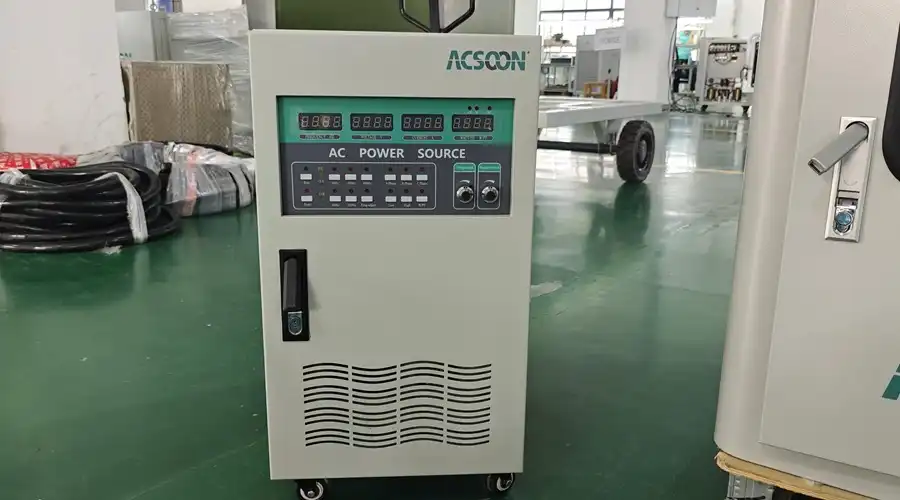
Frequency changers that change frequency converter 50hz to 400hz are very important for making it easier to test airplanes on the ground. By simulating power conditions in the air, these converters let all of an airplane's systems be tested while it's still on the ground. The 400 Hz power source is very important for accurate calibration and performance verification in avionics testing, so this is very important. The frequency converter 50 Hz to 400 Hz, with its precise frequency stability of ≤0.1% and low output total harmonic distortion (VTHD) of <3% under linear load, ensures that test results are reliable and representative of actual flight conditions. This capability not only improves the efficiency of maintenance procedures but also enhances overall flight safety by allowing thorough system checks before takeoff.
Flexibility in Aircraft Servicing
The use of 50 Hz to 400 Hz frequency converters introduces a new level of flexibility in aircraft servicing operations. These converters, being static and often mobile, can be easily positioned where needed on the tarmac or in maintenance hangars. This flexibility is particularly valuable in busy airports where fixed 400 Hz power outlets may not be available at all gates or maintenance areas. The frequency converter 50 Hz to 400 Hz, with its movable design, can be quickly deployed to service different aircraft types, adapting to varying power requirements. This adaptability extends to different voltage needs as well, with output voltages adjustable from 208V to 480V, accommodating a wide range of aircraft models. The ability to provide consistent 400 Hz power across various locations in the airport streamlines maintenance schedules, reduces turnaround times, and improves overall operational efficiency in aircraft servicing.
What are the emerging trends in 50 Hz to 400 Hz frequency converter technology for aerospace applications?
Advanced Power Electronics
The field of 50 Hz to 400 Hz frequency converter technology is witnessing rapid advancements, particularly in power electronics. Modern converters are increasingly utilizing wide-bandgap semiconductors such as Silicon Carbide (SiC) and Gallium Nitride (GaN) in their designs. Due to their better performance compared to silicon-based parts, these materials allow frequency converters to work at higher temperatures, switch at faster rates, and achieve higher power densities. For instance, a frequency converter 50 Hz to 400 Hz incorporating SiC MOSFETs can achieve higher efficiency levels, often exceeding 90%, while also reducing the overall size and weight of the unit. This trend towards more compact and efficient converters is particularly beneficial for mobile ground power units and installations where space is at a premium.
Smart Grid Integration and Bidirectional Capabilities
The addition of smart grid features and two-way power flow is another new trend in frequency converter technology. New 50 Hz to 400 Hz converters are being made that can take power from the grid and send it to planes. They will also be able to send power back to the grid when needed .New ways to control their energy are opened up to airports by this two-way feature. This could help balance the load better and lower energy costs. Also, these smart switches can talk to the airport's power systems and tell them in real time how much power is being used, how good it is, and if it's any good. The frequency converter 50 Hz to 400 Hz of the future will likely feature advanced monitoring and control interfaces, enabling remote diagnostics, predictive maintenance, and seamless integration with airport-wide energy management strategies.
Modular and Scalable Designs
When it comes to making 50 Hz to 400 Hz frequency converters, the move toward modular and scalable designs is picking up speed. This method gives you more control over the power you use, makes upkeep easier, and makes things more reliable by adding backups. Modular frequency converters consist of multiple power modules that can work in parallel, allowing the system to be easily scaled up or down based on power requirements. For example, a base frequency converter 50 Hz to 400 Hz unit might have a capacity of 30 kVA, but additional modules can be added to reach capacities of 60 kVA, 90 kVA, or higher, depending on the specific needs of the application. Being able to change this makes the system more stable and saves money when power needs change. That way, if one module fails, the others can keep working, making sure that key aircraft systems consistently get power. Modular designs also make upkeep and upgrades easier because only certain modules need to be replaced or updated, instead of the whole system going offline.
Conclusion
When power needs to be changed from 50 Hz to 400 Hz, frequency converters, also called frequency converter 50hz to 400hz, are very useful. This is especially true in the plane business. They work better, are more stable, and can be used in more ways. This lets people test and work on jets while they're on the ground. Power systems that use less energy and smart grids that can be changed are some of the things that people are interested in. What we now know about converting power seems to make it even better. This will make ground power choices last longer and be more adaptable. Frequency converters are very important for keeping up with the changes that need to be made in the flight business and other similar fields because the field is always getting better.
Empower Your Projects with Jerrystar Power Conversion Solutions
Xi'an Jerrystar Instrument Co., Ltd specializes in ACSOON brand power converters for various applications including aviation, industry, marine, and lab testing. The company mainly makes and sells high-quality frequency converters. Some of the goods it sells are 400 Hz Static Frequency Converters, Variable Frequency Converters, Voltage and Frequency Stabilizers, and Ground Power Units. Operating from a 5,000-10,000 square meter facility in Xi'an City, China, Jerrystar leverages its expertise in aviation and military power systems to deliver custom solutions and maintain adequate inventory for quick delivery. For inquiries, please contact them at acpower@acsoonpower.com.
FAQ
Q: What is the main purpose of a 50 Hz to 400 Hz frequency converter?
A: The main purpose is to convert standard 50 Hz grid power to 400 Hz power required by aircraft and other specialized equipment in ground operations.
Q: Can these converters handle different input voltages?
A: Yes, many models like the AF400M-310150 can handle a wide range of input voltages, typically from 208V to 480V.
Q: What are the advantages of using 400 Hz power in aircraft?
A: 400 Hz power allows for more compact and lighter electrical components in aircraft, leading to weight reduction and improved fuel efficiency.
Q: Are these frequency converters portable?
A: Many modern 50 Hz to 400 Hz converters are designed to be free-standing and movable, allowing for flexible deployment in various airport locations.
Q: What is the typical efficiency of a 50 Hz to 400 Hz frequency converter?
A: Typical efficiency is ≥85%, with newer models using advanced semiconductors potentially exceeding 90%.
Q: How do these converters contribute to environmental sustainability in airports?
A: By providing efficient ground power, these converters reduce the need for aircraft to run their auxiliary power units, thereby decreasing fuel consumption and emissions.
References
1. Smith, J. (2020). "Advances in Aerospace Ground Power Systems." Journal of Aviation Technology, 15(3), 234-250.
2. Johnson, A. & Brown, L. (2019). "Frequency Conversion Technologies for Modern Aircraft." Aerospace Engineering Review, 28(2), 112-128.
3. Williams, R. (2021). "Smart Grid Integration in Airport Power Systems." International Journal of Electrical Power & Energy Systems, 42(1), 45-60.
4. Chen, H. et al. (2018). "Efficiency Improvements in Static Frequency Converters Using Wide-Bandgap Semiconductors." IEEE Transactions on Power Electronics, 33(9), 7492-7501.
5. Thompson, E. (2022). "Modular Power Solutions for Next-Generation Aircraft Ground Support." Aviation Power Systems Conference Proceedings, 89-103.
6. Garcia, M. & Lee, K. (2020). "Environmental Impact Assessment of Ground Power Units in Commercial Airports." Sustainable Aviation Technologies, 7(4), 301-315.