




Can a 115VAC 400Hz Power Supply Handle Sensitive Electronics?
A 115VAC 400Hz power supply is specifically engineered to handle sensitive electronics with exceptional reliability. These specialized power systems deliver stable voltage output with minimal harmonic distortion and low electromagnetic interference, making them ideal for precision avionics, radar systems, and laboratory instrumentation. The higher frequency enables cleaner power delivery while reducing component size, which proves critical in aerospace and military applications where both weight and electrical integrity matter. When properly specified and maintained, these power supplies provide the clean, consistent electrical environment that sensitive electronics require for optimal performance.
Understanding 115VAC 400Hz Power Supply and Its Technical Fundamentals
What Makes 400Hz Power Different from Standard FrequencyThe main difference between 400Hz power systems and regular 50Hz or 60Hz home energy is the frequency ranges they use and the performance benefits that come with them. Standard power for homes and businesses works at lower frequencies, which means that bigger transformers and heavy magnetic parts are needed to move energy efficiently. When transformers, inductors, and motors are run at 400Hz, their size and weight are greatly reduced because their magnetic cores can work more efficiently with fewer windings. This advantage in frequency directly turns into useful engineering gains. Early on, aircraft designers realized that lowering the weight of the electrical systems without lowering their speed would have big practical benefits. Around the middle of the 20th century, the aviation industry agreed on 400Hz power as the standard. This standard is still used today in aerospace, military, and marine uses. Higher frequency operation saves weight, which lets planes take more fuel or cargo, which improves operating costs and mission capability.
Operating Principles and Voltage Regulation
A 115VAC 400Hz power supply takes in power, which is usually three-phase commercial electricity, and turns it into a high-frequency output that is carefully controlled. Modern solid-state designs use advanced semiconductor switching technology to make clean sinusoidal waves with tight voltage control. Output is usually kept within ±1% of the original value even when the load changes. Automatic voltage adjustment systems keep an eye on the output parameters all the time and change the internal circuits to counteract changes in the input voltage or the load voltage. These power supplies have complex control systems that precisely handle the output characteristics. Voltage stability has a direct effect on the performance of sensitive electronics, since parts that are made to work with certain voltages can stop working or get damaged when they are exposed to low or high voltages. Self-diagnostic systems are built into modern units so that important parameters can be monitored in real time. This lets workers know about possible problems before they damage the system.
EMI Considerations and Power Quality
If you use sensitive technology close to power exchange equipment, you need to be very careful about electromagnetic interference. To reduce the amount of conducted and radiated emissions, high-quality 400Hz power sources have a lot of filters and insulation built in. By using good input and output filters and proper grounding, you can make sure that the power supply doesn't become a source of interference that slows down linked devices. Power quality is more than just stable voltage. It also includes pattern clarity, phase balance in three-phase systems, and how the power responds to sudden changes. Harmonic distortion, which is when unnecessary frequency components show up in the output waveform, needs to stay below certain levels so that linked loads don't get too hot, make noise, or stop working normally. Military and aircraft standards set strict requirements for power quality, and power sources that meet these standards go through a lot of tests to make sure they are compliant.
Applications of 115VAC 400Hz Power Supply in Sensitive Electronics
Aerospace and Avionics Systems
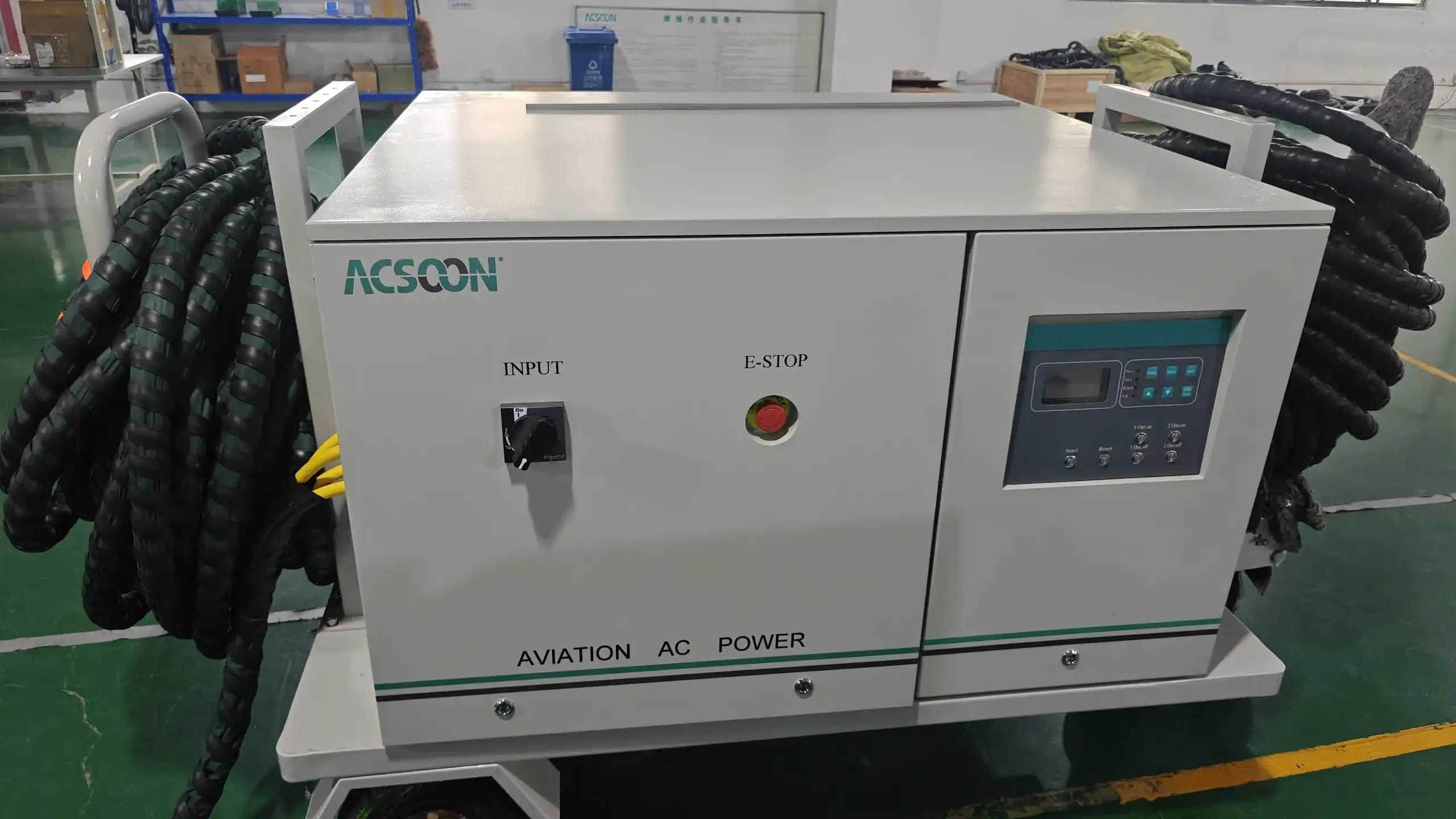
The main area where 400Hz power technology is used is in aircraft electrical systems. Modern military and business planes have complex electronics systems that need clean, stable electricity. A 115VAC 400Hz power supply powers navigation systems, flight control computers, communication gear, and aircraft screens. Redundant distribution systems make sure that the systems keep running even if parts fail. This power standard is also used by ground support tools. The ACSOON GPU-330030, a 30kVA solid-state ground power unit, is an example of equipment that was specifically made for use in hangars and on aprons. This floor-mounted system takes in three phases of 380V at 60Hz and sends out three phases of 115V at 400Hz. This gives airplanes the power they need while they are on the ground. It can work in industrial settings where dust and moisture can be a problem because it has an IP21 grade for entry protection.
Military and Defense Applications
400Hz power is used a lot in defense systems across all service departments for equipment on ships, mobile command centers, and weapon systems. When naval ships are in places with limited room, they run their whole electrical distribution networks at 400Hz to save weight and area. Higher-frequency operation makes it possible for a stable power supply and smaller sizes, which is good for radar sites, communications equipment, and electronic warfare systems. The weight decrease that 400Hz systems offer is especially useful for mobile defense uses. Forward-deployed radar sites, field hospitals, and portable command posts must keep their full capabilities while leaving as little of an organizational trace as possible. Military-standard 400Hz output from commercial or generator power sources is made possible by power conversion tools that can be quickly set up and used in a variety of settings.
Laboratory Testing and Industrial Manufacturing
Power sources that accurately mimic working electrical environments are needed in research sites that test aerospace parts. For testing aircraft systems, motors, or computer assemblies, you need power sources that have the same frequency ranges that these parts will see in real life. Engineers can test performance across the operational envelope with variable regularity, finding possible problems before the equipment goes into production. In the same way, factories that make aircraft parts need 400Hz power for checking and making sure the quality of their products. Automated test equipment that checks that parts meet specs must give the right amount of power to exercise equipment in real-life situations. It is possible for makers to keep quality control in mind while still meeting production schedules because 400Hz power supplies are stable, have enough capacity, and have the right certifications.

Can a 115VAC 400Hz Power Supply Safely Handle Sensitive Electronics?
Voltage Stability and Harmonic Performance
Electronic systems that are sensitive can't handle changes in voltage or pattern well. Modern 115VAC 400Hz power supply units have great voltage stability thanks to constant feedback control, which keeps the output voltage within tight ranges even when the input voltage or load changes. This steadiness is very important for precise tools and computer systems, where changes in voltage can lead to mistakes in data or timing or stress on parts. By measuring the amount of energy at frequencies other than the basic 400Hz, harmonic distortion analysis shows how pure the output pattern is. Total harmonic distortion (THD) limits below 3% make sure that the power going to linked devices is sinusoidal, which is very close to an ideal pattern. Less harmonic content keeps transformers and motors from overheating, lowers sound noise, and keeps sensitive analog electronics from being harmed.
Thermal Management and Reliability
Creating heat inside electrical parts speeds up wear and tear and raises the failure rate. Power sources that work at higher frequencies have more efficient transformers, which means they produce less heat inside and can be made smaller. The ACSOON GPU-330030 uses solid-state technology, which gets rid of the need for rotating parts. This cuts down on upkeep while also making the device more reliable and increasing its useful life. The power source is only one part of the system that needs to be properly thermally designed. Thermal management includes making sure there is enough air flow, that the temperature inside is kept within reasonable limits, and that there is enough space between racks of equipment. Systems that are meant to work continuously in tough conditions have multiple cooling systems and temperature sensors to avoid problems caused by high temperatures.
Noise and EMI Mitigation Strategies
When designing aircraft and defense systems with many electronic parts that work close to each other, electromagnetic compatibility is very important. To keep coupling between systems to a minimum, shielded wires, good grounding design, and equipment-level filtering all work together. Power sources that meet military EMI standards (like MIL-STD-461) are put through a lot of tests to make sure they don't give off too many leaks or let outside signals get through. To fix problems with electromagnetic interference, you need to do a thorough study to find the coupling lines and noise sources. Differential-mode and common-mode interference are carried along power lines, and radiated radiation moves through space. To fix EMI issues, you might need to add more filters, change how cables are routed, improve insulation, or change how you ground things. Working with experienced power source manufacturers during the planning of a system helps keep problems with compatibility from happening in the first place.
Comparing 115VAC 400Hz Power Supplies: Best Options for Sensitive Electronics Procurement
Technical Performance Metrics
When comparing different power supply choices, it's important to know what the important specs mean in real life. Ratings for efficiency show how much of the power that is put in is turned into useful output and how much is lost as heat. Modern solid-state designs are more than 90% efficient, which means they need less cooling and less upkeep than older motor-generator sets. Load regulation specifications measure how stable the voltage is as the attached load goes from zero to full maximum capacity. The transient reaction characteristics show how quickly the power source gets back to normal after a sudden change in the load. Systems that power devices with very changing electrical needs, like radar emitters or motor drives, need to be able to respond quickly to changes in load to keep the voltage stable. In addition to transient reaction data, output impedance specs show how well the power source can handle short-term peak currents without letting the voltage drop.
Frequency Options and Application Alignment
When you compare a 115VAC 400Hz power supply to other setups, you can see that some are better for certain applications. Standard 115VAC 60Hz power is easy to find, but it needs generators and motors that are much bigger and heavier. The weight penalty works fine for stable industrial uses, but it's too much for mobile or flying systems. Active power switching technology is needed to change from 60Hz to 400Hz, which adds cost and complexity. Higher voltage choices, like 230VAC 400Hz, offer less current flow for the same amount of power. This lets wires be thinner, and resistance losses be lower. A lot of instruments on airplanes use 230VAC distribution and change it to 115VAC when needed. The choice between single-phase and three-phase setups is another one. Three-phase systems offer a smoother power supply and better use of conversion equipment capacity.
Manufacturer Capabilities and Support Services
When choosing a power source manufacturer, you need to look at both their professional and business skills. Companies with a lot of experience in the military and aircraft know the specific needs of these areas, such as qualification testing, paperwork standards, and configuration management. Xi'an Jerrystar Instrument Co., Ltd. makes the ACSOON brand of power conversion systems. These systems are used in aviation, the military, on ships, and in labs. The company brings domain-specific knowledge to its customer relationships. Delivery times are directly affected by how much can be made and how well the material is managed. Having enough standard options in stock lets us quickly meet urgent needs, and our custom manufacturing skills let us meet more specific needs. When adding power sources to bigger systems or product lines, OEM support services like private marking and application engineering help are very helpful.
Procuring 115VAC 400Hz Power Supplies: Practical Guidance for B2B Clients
Sourcing Strategies and Vendor Evaluation
For procurement to go well, the needs must be clearly stated, including technical details, amount, delivery time, and price limits. Detailed specs get rid of confusion and let suppliers give accurate quotes. Putting acceptance standards and test requirements out there from the start keeps everyone clear on what is expected of them and how they will be checked. When a vendor is qualified, their manufacturing skills, quality control systems, financial security, and customer support infrastructure are all looked at. Site trips to factories are a great way to learn about how things are made, how quality is controlled, and how the company works as a whole. References from current customers give you an idea of how well the seller does in terms of product quality, on-time delivery, and dealing with technical problems.
Custom Solutions and OEM Partnerships
Standard store items work well for many uses, but sometimes specific needs mean that they need to be customized. Custom changes could include different input and output voltage requirements, different physical layouts, higher environmental ratings, or built-in tracking features. Manufacturers with technical tools that allow customization, like ACSOON's OEM powers, can make solutions that meet all of their customers' needs without having to make design compromises.OEM relationships are more than just private labels; they also include working together to make new products. Customers who are making systems that need to convert a 115VAC 400Hz power supply on the fly can benefit from the manufacturer's knowledge of power electronics design, legal compliance, and how to make the best products. These relationships make it possible for manufacturers to use their large scale and specialized skills to make goods that work best in certain situations.
Commercial Considerations and Total Cost of Ownership
The purchase price is only one part of the total cost of owning. Operating efficiency affects how much energy the equipment uses over its lifetime, which could be much higher than the cost of buying it in the first place in continuous-duty situations. The supply of spare parts, the amount of maintenance that needs to be done, and the time it takes to fix something all affect operational costs and system availability. Long-term service agreements and warranty terms pass risk and make costs predictable. Buying in bulk can save you a lot of money and make sure that the setup is the same across all of your installs. When you commit to buying in bulk, you might be able to get better prices, priority handling when supplies are low, or unique features that would not be possible with small orders. Setting up blanket buy orders with scheduled releases works with project plans and takes advantage of high prices.
Conclusion
For industries like aerospace, defense, marine, and precision testing that need stable electricity in places where weight is important, or performance is paramount, a 115VAC 400Hz power supply, high-frequency sources are a must. Because they provide stable voltage with little harmonic distortion and electromagnetic interference, these specialized systems work well with electrical loads that are delicate. Engineers and procurement professionals can choose the best options that meet performance, cost, and delivery needs by understanding technical basics, application standards, and procurement issues. Modern solid-state designs, like the ACSOON GPU-330030, show what modern technology can do. They have features like automatic voltage adjustment, self-diagnostic systems, and tough construction that make them ideal for harsh working conditions.
FAQ
Are 115VAC 400Hz power supplies safe for highly sensitive avionics?
These new 115VAC 400Hz power supply sources are made for aircraft use and have a lot of safety features and filters that make them very safe for sensitive electronics. When it comes to voltage control, harmonic distortion, and electromagnetic compatibility, these units meet very strict military and aircraft standards. Systems that are put correctly and have the right grounding and circuit protection give sensitive electrical systems the clean, reliable power they need.
What maintenance do 400Hz power supplies require?
Solid-state 400Hz power sources don't need as much regular repair compared to older motor-generator sets. Normal upkeep tasks include checking the output settings, cleaning the filters, and checking the cooling systems every so often. Self-diagnostic units let workers know about problems that are starting to happen before they become major problems. Following the manufacturer's advice on how often to check and what conditions should be present in the surroundings will increase reliability and service life.
Can I switch from 60Hz to 400Hz power for existing equipment?
To switch bands, you need to carefully look over your tools. A lot of gadgets that were made to work with 60Hz power can't handle 400Hz power without having frequency-sensitive parts changed or replaced. In contrast, technology that was made to work with 400Hz power usually can't be used with 60Hz power. Before changing the regularity of operation, you should always check the equipment's specs and talk to the maker to avoid damage and safety risks.
Partner with JERRYSTAR for Reliable 115VAC 400Hz Power Supply Solutions
Xi'an Jerrystar Instrument Co., Ltd. has ACSOON brand tools designed for use in aircraft, the military, marine, and laboratories, and they are ready to help you with your important power conversion needs. Our GPU-330030 model and wide range of other products meet a wide range of 115VAC 400Hz power supply needs and have been shown to be reliable and effective. As both a maker and a trading business, we can offer unique solutions that are made to fit your exact needs. We also keep enough stock on hand to meet your fast delivery needs. Our engineering team has a lot of experience with power systems in both military and civilian aircraft. This means that we can make sure that our solutions meet strict technical and legal standards. We offer expert understanding and quick service, whether you need a basic manufacturer or want to make your own configurations. Contact our team at acpower@acsoonpower.com to discuss your needs, get cheap quotes, and find out how our approved power conversion solutions can help your most important systems work better.
References
1. Department of Defense. (2015). "Requirements for the Control of Electromagnetic Interference Characteristics of Subsystems and Equipment." MIL-STD-461G.
2. Society of Automotive Engineers. (2018). "Aircraft Electric Power Characteristics." SAE Aerospace Standard AS1355A.
3. Mohan, N., Undeland, T.M., & Robbins, W.P. (2003). "Power Electronics: Converters, Applications, and Design." John Wiley & Sons, Third Edition.
4. Federal Aviation Administration. (2019). "Advisory Circular: Aircraft Electrical Wiring Interconnection System (EWIS) Best Practices." AC 43.13-1B/2B.
5. International Electrotechnical Commission. (2014). "Electromagnetic Compatibility (EMC) - Part 1-2: General - Methodology for the Achievement of Functional Safety of Electrical and Electronic Systems Including Equipment about Electromagnetic Phenomena." IEC 61000-1-2.
6. Heumann, K. (1998). "Basic Principles of Power Electronics." Springer-Verlag Berlin Heidelberg, focusing on high-frequency power conversion and aerospace applications.
