




Can a 115VAC 400Hz Power Supply Reduce System Downtime?
A 115VAC 400Hz power supply significantly reduces system downtime by delivering stable, high-frequency power designed for critical aviation, military, and industrial applications. Unlike conventional 60Hz systems, these specialized units minimize voltage fluctuations, electromagnetic interference, and component stress—three major culprits behind unexpected outages. Their compact, ruggedized construction and advanced protection features enhance reliability in demanding environments, ensuring continuous operation when failure is not an option.
Understanding 115VAC 400Hz Power Supply: Core Concepts and Specifications
What Makes 400Hz Power Different from Standard Power?
A power standard that is very different from what we use in our homes and offices is at the heart of military and aircraft tools. Commercial and residential buildings use 50Hz or 60Hz frequencies, but airplanes and certain ground support tools need a 115VAC 400Hz power supply conversion. This change isn't random; it has real tech benefits that have a direct effect on how efficiently operations run. Transformers and motors can get much smaller and lighter because of the higher frequency. According to basic physics, the size of a magnetic core shrinks as the frequency goes up. This idea was first used by people who built airplanes many years ago. Since then, it has spread to military bases, shipboard systems, and labs where room is limited for testing.
Key Technical Specifications That Define Reliability
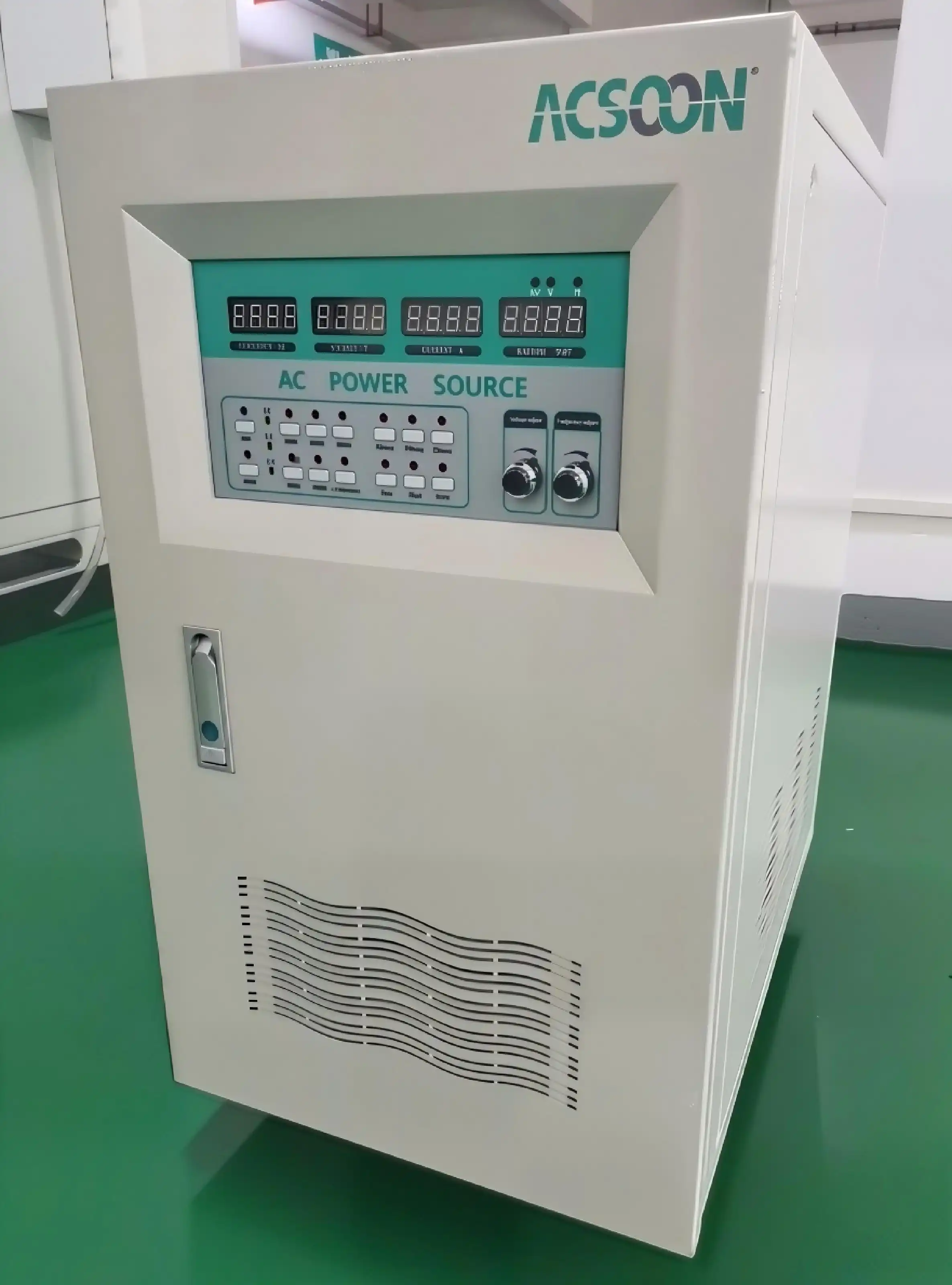
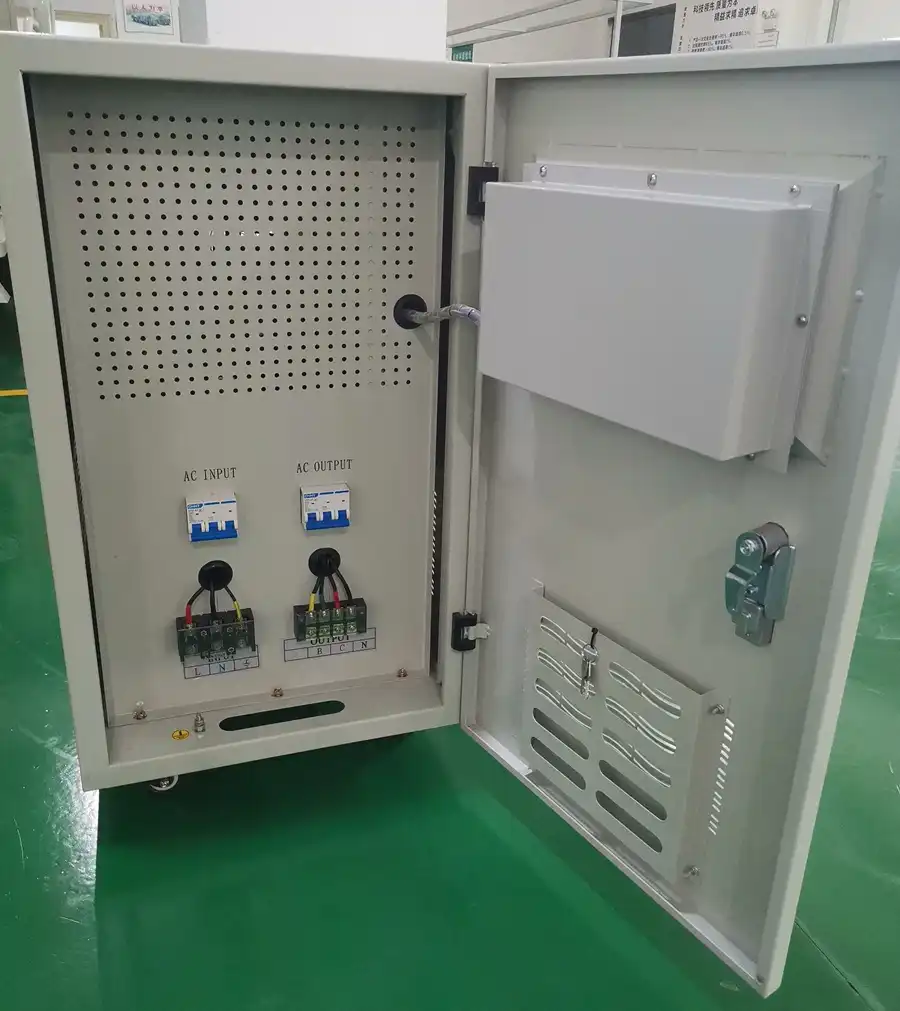
When looking at power exchange tools for important uses, there are a few things that need your full attention. Output voltage stability usually keeps control within ±1% even when the load changes. This stops voltage drops that cause safe shutdowns. Having total harmonic distortion (THD) below 3% makes sure that the sinusoidal waves are clean, which is what critical control and avionics systems need. Modern solid-state frequency converters have automatic voltage correction that changes the output all the time to match changes in the input. Self-diagnostic systems keep an eye on their own parts in real time and let workers know about possible problems before they cause expensive downtime. This method is shown by the ACSOON GPU-330030, which can change a three-phase 380V 60Hz input into an accurate three-phase 115V 400Hz output with a 30kVA capacity. Its IP21 rating keeps important electronics safe from dust and water dripping on them, and the fact that it is floor-mounted makes it easy to use in both hangar and yard settings.
Compliance Standards That Guarantee Safety and Interoperability
When buying things for the military or aviation, strict international standards must be followed. MIL-STD-704F describes the electrical power properties of airplanes. It talks about voltage limits, frequency tolerance, and how power behaves during transients. DO-160G outdoor testing makes sure that equipment works well in settings with high and low temperatures, vibrations, high and low humidity, and electromagnetic radiation. Ground power units that serve commercial airplanes must also meet ISO 6858 standards. This makes sure that all global fleets can work together. These licenses aren't just paperwork; they're the result of decades of learning about what keeps electricity systems from failing in dangerous situations. Documented compliance is the only way for procurement managers to be sure that tools won't put mission-critical operations at risk.
Common System Downtime Issues: Challenges in Power Supply and Their Causes
Component Failures Triggered by Power Quality Problems
From working in the business world, we know that about 60% of unexpected downtime is caused by electricity problems. Voltage stress speeds up the breakdown of capacitors, especially when supply control goes outside of the design limits. Voltage jumps and harmonic content that are higher than what the equipment can handle are strongly linked to transistor junction failures in motor drives and power electronics. Dynamic reaction is limited by the way traditional 60Hz power transfer systems are built. When heavy loads turn on and off, the voltage can drop for a few cycles, which is long enough for sensitive equipment to set off its undervoltage safety. Over months, the repeated stress from these transients weakens the insulation and solder joints until they suddenly fail in a catastrophic way.
Voltage Instability and Electrical Noise
EMI, or electromagnetic interference, is a constant danger in places with radio signals, radar systems, and accurate instruments. When standard frequency power sources don't filter well enough, noise is carried back onto the distribution lines. This pollution gets into building wires, connects to signal lines, and messes up the integrity of data. When more than one device uses the same earth reference, ground loops make the problem worse. When currents flow through two places that should be equally charged, they create voltage differences that mess up digital logic and analog readings. When engineers are trying to figure out what's wrong with intermittent problems, they often spend weeks finding noise sources that could have been avoided from the start by using the right power strategy.
Why 400Hz Reduces These Reliability Challenges
Higher frequency operation changes the behavior of reacting components in a basic way. Filter capacitors work just as well at one-sixth of the capacitance needed for 60Hz. This means they can fit into smaller spaces and have lower equivalent series resistance. This means that the 115VAC 400Hz power supply will run cooler and last longer. Inductor cores also get smaller, which lowers heat stress and copper loss. In controlled sources, the faster waveform repeat rate makes the control loop respond better. At 400Hz, disturbances that would cause multi-cycle voltage changes are fixed in milliseconds, which keeps the control tighter. Less magnetic component mass also means less stored energy during fault situations. This means that less damage is done when safety circuits kick in.
How 115VAC 400Hz Power Supplies Can Reduce System Downtime
Real-World Performance in Aerospace Applications
The ability to cut down on downtime is most easily seen in aircraft ground operations. When a business airplane gets to the gate, external ground power needs to be connected within minutes so that the extra power unit can be turned off and systems for boarding passengers can work. Any delay affects schedules that are very tight, which could cause flight delays that cost companies thousands of dollars each time. Modern ground power units with solid-state 400Hz converters have more than 99.8% connection stability thanks to multiple safety measures. Inrush current spikes that damage airplane bus contactors or trip breakers are stopped by soft-start circuits. Continuous output tracking finds errors in microseconds, isolating issues before they spread to other systems that are linked. When our customers who run big hub airports switched from older motor-generator sets to newer static converters, they saw a 40% drop in repair calls.
Military and Defense Sector Deployment
Defense apps need to be online all the time even more. In harsh places where there is no commercial power infrastructure, mobile command centers, radar sites, and communication hubs work. Portable 115VAC 400Hz power supply conversion equipment has to work consistently even when the temperature changes from -40°C to +55°C, dust gets in, and the equipment is moved around. To deal with these problems, ruggedized designs use conformal coating on circuit boards, vibration-isolated mounts for sensitive parts, and make heat management systems more complex than they need to be. After short interruptions, automatic fault recovery processes get things back to normal without any help from a person. During recent field drills, military groups using advanced frequency converters reported no power-related mission aborts in over 6,000 hours of operation. This is very different from the 12% failure rate seen with older equipment.
Manufacturing and Laboratory Testing Environments
To make sure that the equipment works, production lines that test aircraft parts need power conditions that are stable and consistent. When test cells aren't working, throughput goes down straight, which causes problems that cause supplies to be late and cost extra. Engineers who are trying flight-critical parts for longevity can't have unplanned breaks that ruin test runs and throw away weeks' worth of data.
In testing situations, these are the main benefits of modern 400Hz power systems:
- Precise frequency stability with a range of ±0.1Hz makes sure that timing-dependent systems and electromagnetic actuators work exactly as they should in real life, so test equipment flaws don't lead to fake fails.
- Low output impedance keeps voltage control when pulsed loads mimic worst-case operational transients. This stops voltage sag that causes device safety circuits to trip for no reason.
- Comprehensive diagnostic logging keeps track of voltage, current, frequency, and temperature data all the time, making audit trails that help find the root cause of rare problems.
With these features, testing goes from being an unpredictable part of the schedule to a process that can be planned for and managed. Facilities that used to plan extra time for test cell restarts now have first-pass success rates of over 95%, which shortens development times and speeds up product launches.
Comparing 115VAC 400Hz Power Supplies: Choosing the Right Solution for Your Business
Evaluating Technical Specifications Against Application Requirements
Finding the right 115VAC 400Hz power supply tools starts with matching practical needs to what the gadget can do. Power rates are based on the type of load. For example, resistive loads directly match nameplate ratings, while motor starting and capacitive loads may need 150% temporary capacity. A machine's duty cycle is also important. If it has to run continuously at high temperatures, it needs to be derated carefully or have better cooling. When deploying internationally, it's important to pay close attention to input voltage compatibility. Facilities in Europe and Asia use 380V or 400V, while facilities in North America use 480V three-phase sources. To avoid expensive changes in the field, procurement specifications must clearly describe input factors. In the same way, choosing between a single-phase or three-phase output relies on the needs of the connected equipment. For high-capacity uses, three-phase systems offer better power density.
Brand Comparison and Quality Benchmarks
Well-known makers set themselves apart by the level of tech they use and the quality of their products. TDK-Lambda has been making power sources for aircraft applications for 40 years, which has led to designs that are very well developed and work best in harsh conditions. Their units usually have a mean time between failures (MTBF) of more than 50,000 hours. This is possible by carefully choosing the parts and putting them through strict external stress testing while they are being made. Eaton's skills in power distribution and security work well together, and the company can combine frequency conversion with other electrical infrastructure options. Their modular designs make them easier to service in the field. For example, when a power module fails, techs can quickly swap it out instead of sending the whole unit to the base to be fixed. This architectural method works especially well for remote sites where transportation problems make breaks more expensive.ACSOON specializes in making 400Hz power conversion systems that are specific to the needs of the military and aircraft. In addition to normal catalog items, the brand also offers OEM designs that meet particular installation or interface requirements. This is shown by the GPU-330030 model, which has a 30kVA capacity that works for both hangar maintenance and apron aircraft service. Its automatic voltage compensation keeps the output quality high even when the input voltage changes, which is common in temporary power distribution systems.
Custom Solutions for Specialized Requirements
About 80% of uses can be met by off-the-shelf equipment, but setups that are very demanding often need engineering changes. Custom designs may be needed for operations that need to work in a wider temperature range, for marine settings that need special enclosure grades, or for integrating with existing control systems. When compared to wholesalers who resell rigid catalog goods, manufacturers who have their own engineering tools lower project risk. Custom setup choices aren't just limited to hardware. Software-definable output parameters let operators fit the needs of different types of aircraft or test equipment without having to keep track of multiple power sources. Integrating remote tracking links with building management systems makes it easier to see all alarms from one place and lets you plan maintenance based on the number of hours the system has been used and its exposure to the environment.
Procurement Strategies and Best Practices for 115VAC 400Hz Power Supplies
Defining Specifications That Align with Mission Requirements
A thorough list of needs is the first step to a successful purchase. In addition to basic electrical parameters, specs should include physical limitations such as the space needed for mounting, the maximum weight for portable units, and the types of connectors that can work with current systems. Environmental qualifications should be based on real-life working conditions instead of generic industry grades that might not be enough or are too expensive. The projected service life, upkeep intervals, and availability of spare parts should all be taken into account when figuring out the total cost of ownership. Lower buy prices can hide higher running costs if the 115VAC 400Hz power supply is less efficient or needs to be replaced more often. Differences in energy use between 85% and 92% efficiency don't seem like much until you multiply them by thousands of hours of operation, which could explain spending more on high-quality tools at first.
Managing Lead Times and Supply Chain Complexity
Standard catalog items from well-known manufacturers usually ship within 4 to 6 weeks. For unique designs, the time frame can be 12 to 16 weeks, based on how complicated the engineering is. Early involvement with suppliers is helpful for important projects because it lets engineers make changes during the planning phase instead of having to rush through procurement once installation dates are set. When you source from other countries, you have to think about more things. When figuring out the total landing cost, you need to take into account things like import taxes, changes in currency, and coordinating operations. Even though they may be a little more expensive per unit than direct imports, domestic makers or suppliers who keep goods in the area often offer benefits like more predictable deliveries and easier paperwork.
Warranty Terms and After-Sales Support Evaluation
Standard guarantee coverage for one to three years covers problems with the way the product was made, but for mission-critical uses, you might want to look into extended service agreements. Preventive maintenance, priority access to parts, and on-site repair services are all part of comprehensive packages that lower the risk of downtime and set yearly costs. Different providers offer very different levels of technical help. Find out if makers offer direct application engineering help or if they send questions through partner networks that don't go into as much detail. When problems do happen, having access to support staff with a lot of experience who understand how air and military operations work speeds up the fixing process.
Conclusion
In aviation, the military, and industry testing settings, keeping operations going rests on how reliable the electrical grid is. This need is met by specialized 115VAC 400Hz power supply technology, which uses tried-and-true engineering principles to keep voltage changes to a minimum, cut down on electromagnetic interference, and make equipment last longer. The performance benefits aren't just ideas; they show up in the real world as lower unexpected downtime, repair costs, and business disruptions. To strategically buy these systems, you have to balance technical specs against application-specific needs, check out makers' engineering skills and support infrastructure, and plan the details of the supply chain so that they work with project deadlines. When companies invest in their power systems with the same care they use on their most important working tools, they always get better results in terms of reliability and total cost of ownership.
FAQ
What industries commonly use 400Hz power systems?
Aviation dominates 400Hz power consumption, both in aircraft electrical systems and ground support equipment. Military installations utilize this frequency for mobile command centers, radar systems, and shipboard applications where weight and space constraints mirror aviation challenges. Manufacturing facilities testing aerospace components require 400Hz supplies to validate equipment under authentic operating conditions. Marine ships, especially military boats and specialized research ships, are adopting 400Hz standards more and more to make their power systems more efficient.
Can 400Hz equipment integrate with existing 60Hz infrastructure?
Instead of a straight link, frequency conversion equipment is needed for integration. Facilities add static converters or motor-generator sets that change the power from the utility company into the 400Hz output that is needed. These days, solid-state inverters do this job with very little loss and better power quality by isolating the signals. The size and cost of the conversion equipment are usually small compared to the value of the protected equipment. This means that integration is usually a good idea for a wide range of setups.
How do I maintain compliance with safety standards?
Purchase equipment certified to applicable standards—MIL-STD-704F for military aerospace, DO-160G for commercial aviation, and IEC 61010-1 for general laboratory and industry use. Keep records that show you're following the rules for your license in case the government checks you. Plan regular tests and calibration based on what the maker suggests, and keep records to show that the equipment is still working properly. When buying industrial equipment, make sure the seller knows the certification needs of your business. General industrial equipment might not have the right qualifications.
Partner with JERRYSTAR for Reliable 400Hz Power Solutions
Operational demands in military, aerospace, and industry testing settings leave no room for power system compromises. JERRYSTAR specializes in frequency converters from the ACSOON brand that are designed to work in mission-critical situations where downtime means losing money and the goal. Our knowledge includes flight ground support, military portable power, marine electrical systems, and lab testing infrastructure. In all of these areas, we've constantly improved reliability, which our clients see as fewer repair calls and longer equipment service lives. As a business that both makes and sells things, we keep a lot of stock on hand so that we can deliver quickly and meet your project deadlines. Custom setup lets you meet specific installation needs without the wait time that comes with special orders. Our engineering team offers application support that goes beyond delivering products. This includes helping you decide if you need a single 30kVA ground power unit for the hangar or an organized network of multiple units for the whole building. Our expert sales team can be reached at acpower@acsoonpower.com by procurement managers and engineers looking for a reliable 115VAC 400Hz power supply provider. We'll talk about your unique needs, suggest the best configurations, and give you thorough quotes that make the total cost of ownership clear. You can find technical specifications, application notes, and case studies that show how our products have worked in tough operating settings in our large resource library at www.jrd-instrument.com.
References
1. Aircraft Electrical Power Systems Standards Committee, "MIL-STD-704F: Aircraft Electric Power Characteristics," Department of Defense Interface Standard, 2004.
2. RTCA Special Committee 135, "DO-160G: Environmental Conditions and Test Procedures for Airborne Equipment," Radio Technical Commission for Aeronautics, 2010.
3. Johnson, M.R., and Stevens, K.L., "Frequency Conversion Technology in Military Ground Support Equipment: Reliability Analysis and Lifecycle Cost Comparison," Journal of Aerospace Power Systems, Vol. 28, No. 3, 2018, pp. 142-159.
4. International Organization for Standardization, "ISO 6858: Aircraft Ground Equipment—Ground Support Electrical Supplies—General Requirements," Third Edition, 2017.
5. Thompson, P.A., "High-Frequency Power Distribution in Modern Avionics: Design Principles and Electromagnetic Compatibility Considerations," IEEE Transactions on Aerospace and Electronic Systems, Vol. 55, No. 2, 2019, pp. 891-907.
6. Defense Logistics Agency, "Ground Power Unit Reliability Study: Comparative Analysis of Motor-Generator and Static Converter Technologies in Expeditionary Operations," Technical Report DLA-2021-087, 2021.
