




How to Choose the Best 60hz to 50hz Frequency Converter Easily?
Selecting the right 60 Hz to 50 Hz frequency converter doesn't have to be complicated. The key lies in matching your power capacity requirements with conversion efficiency, ensuring pure sine wave output, and choosing a supplier with proven technical support. We evaluate load characteristics, scrutinize reliability metrics like MTBF (Mean Time Between Failures), and confirm compliance certifications such as CE and UL. This approach guarantees equipment longevity while minimizing downtime in critical applications across aviation, military, marine, and industrial manufacturing sectors.
Why Frequency Conversion Matters More in Southeast Asia
Across Southeast Asia, industrial operations are increasingly globalized. Factories in Vietnam, shipyards in Singapore, and manufacturing hubs in Malaysia frequently import equipment from Japan, the United States, and Europe—each designed for different power standards.
This creates a critical operational challenge: frequency mismatch between 60 Hz and 50 Hz systems.
In real industrial environments, this issue directly impacts:
- Production stability in Vietnam’s industrial parks (Bac Ninh, Binh Duong)
- Marine and port operations in Singapore logistics hubs
- Electronics and semiconductor manufacturing in Malaysia (Penang, Johor)
A poorly selected frequency converter may cause motor overheating, automation instability, and unexpected downtime—resulting in significant financial losses in 24/7 production environments.
This guide provides a practical framework to help engineers and procurement teams select the right 60Hz to 50Hz frequency converter for long-term industrial reliability.
Understanding Frequency Conversion in Real Industrial Environments
How Does a 60Hz to 50Hz Frequency Converter Work?
Modern static frequency converters do not simply adjust voltage—they reconstruct electrical power.
The process includes:
- AC input rectification (60Hz → DC)
- DC filtering and stabilization
- IGBT inverter conversion (DC → 50Hz pure sine wave output)
This ensures stable and clean power suitable for precision industrial applications.
Why Southeast Asia Equipment Is Highly Sensitive
Many factories in Southeast Asia operate mixed equipment sources:
- Japanese machines (50Hz)
- American automation systems (60Hz)
- European testing instruments (50Hz)
This creates a hybrid power environment where frequency stability is essential.
Impacts of mismatch include:
- Motor speed deviation
- Conveyor synchronization errors
- Calibration drift in precision instruments
Key Factors When Choosing a 60Hz to 50Hz Frequency Converter
Load Type and Industrial Application Fit
Different industries require different load handling capabilities:
- Vietnam: textile, packaging, injection molding (high inrush loads)
- Malaysia: semiconductor and electronics (precision-sensitive loads)
- Singapore: port cranes and marine systems (continuous heavy-duty loads)
Inductive loads typically require 3–5 times the startup surge capacity.
Load Type Comparison for Converter Selection
| Load Type | Typical Equipment | Starting Current | Requirement | Risk if Undersized |
|---|---|---|---|---|
| Resistive Load | Heaters, lighting | Low (1x) | Standard capacity | Low |
| Inductive Load | Motors, compressors | High (3–5x) | High surge rating | Overheating, tripping |
| Mixed Load | Factories, plants | Medium-high | +20–30% margin | Instability |
| Precision Load | CNC, lab instruments | Low-medium | Pure sine wave | Calibration errors |
Efficiency and Energy Cost in Continuous Operation
In regions like Singapore and Malaysia, electricity cost is a major operational factor.
Even small efficiency improvements significantly affect long-term operating cost.
Efficiency vs Energy Cost (10kVA Example)
| Efficiency | Power Loss | Annual Energy Loss (8h/day) | Annual Cost (@$0.10/kWh) | 10-Year Cost |
|---|---|---|---|---|
| 90% | ~1000W | ~2920 kWh | $292 | $2,920 |
| 92% | ~800W | ~2336 kWh | $233 | $2,330 |
| 95% | ~500W | ~1460 kWh | $146 | $1,460 |
Reliability and MTBF Standards
For industrial infrastructure, reliability is critical.
Industry benchmark:
MTBF ≥ 100,000 hours for high-end industrial applications.
Reliability Levels Comparison
| Grade | MTBF | Application | Downtime Risk |
|---|---|---|---|
| Commercial | <30,000 hrs | Small systems | High |
| Industrial Standard | 50,000–80,000 hrs | Factories | Medium |
| High Reliability | 100,000+ hrs | Marine/aviation | Very Low |
Supplier Capability and After-Sales Support
In Southeast Asia, procurement decisions depend heavily on supplier reliability.
Key evaluation factors:
- Technical support responsiveness
- Spare parts availability
- OEM customization capability
- International certifications (CE, UL, ISO)
Why Transformers Cannot Replace Frequency Converters
Transformers only adjust voltage, not frequency.
This results in:
- Motor overspeed issues
- Timing errors in automation systems
- Equipment overheating
Only static frequency converters provide true waveform reconstruction.
Digital Static Converters vs Traditional Systems
Older motor-generator systems have largely been replaced by digital solutions.
Advantages of modern converters:
- Higher efficiency (up to 95%)
- Compact design (ideal for space-limited factories in Singapore)
- Low maintenance requirements
- Smart monitoring and diagnostics
Regional Application Scenarios in Southeast Asia
| Country | Industrial Hub | Application | Why Conversion is Needed |
|---|---|---|---|
| Vietnam | Bac Ninh / Binh Duong | Electronics, textiles | Mixed imported equipment |
| Malaysia | Penang / Johor | Semiconductor manufacturing | Precision stability |
| Singapore | Jurong / PSA Port | Marine & logistics | 24/7 continuous operation |
| Thailand | EEC zone | Automotive industry | Multi-country equipment integration |
Common Operational Issues and Solutions
Troubleshooting Guide
| Issue | Cause | Symptom | Solution |
|---|---|---|---|
| Voltage fluctuation | Poor grounding | Unstable output | Improve grounding |
| Overheating | Poor ventilation | Thermal shutdown | Enhance cooling |
| Overload trip | Miscalculated load | Shutdown | Recalculate surge |
| Harmonics | Non-pure waveform | Control errors | Use a pure sine wave |
Conclusion: Selecting the Right Converter for Long-Term Stability
Choosing a 60Hz to 50Hz frequency converter is not only a technical decision—it is a long-term operational investment.
For Southeast Asian industries such as Vietnam manufacturing, Singapore marine logistics, and Malaysia electronics production, the ideal solution must balance:
- Load adaptability
- Energy efficiency
- High reliability (MTBF standards)
- Supplier technical support
- Total cost of ownership
As industrial automation continues to expand across the region, frequency conversion systems are becoming a core infrastructure component for stable and efficient operations.
FAQ
Can voltage transformers change 60 Hz to 50 Hz?
Voltage transformers only modify electrical potential while preserving input frequency. True frequency conversion requires solid-state converters that rectify AC to DC and then reconstruct the desired output frequency through inverter technology.
Why does frequency matter for AC motors?
AC motor speed directly correlates with supply frequency. A 50Hz motor operates 20% faster on 60Hz power, generating excessive heat, mechanical stress, and potential failure. Maintaining design frequency ensures proper performance and equipment longevity.
What output waveform quality should I expect?
Professional static converters produce pure sine wave output with total harmonic distortion below 3%, typically 2% or better. This clean waveform protects sensitive electronics and prevents motor coil damage from harmonic heating.
How do I size converters for motor loads?
Motors draw startup inrush current 3 to 5 times their running amperage. Size converters for this peak demand rather than nameplate ratings to prevent nuisance trips and ensure adequate surge capacity during equipment startup sequences.
Partner with JERRYSTAR for Reliable Frequency Conversion Solutions
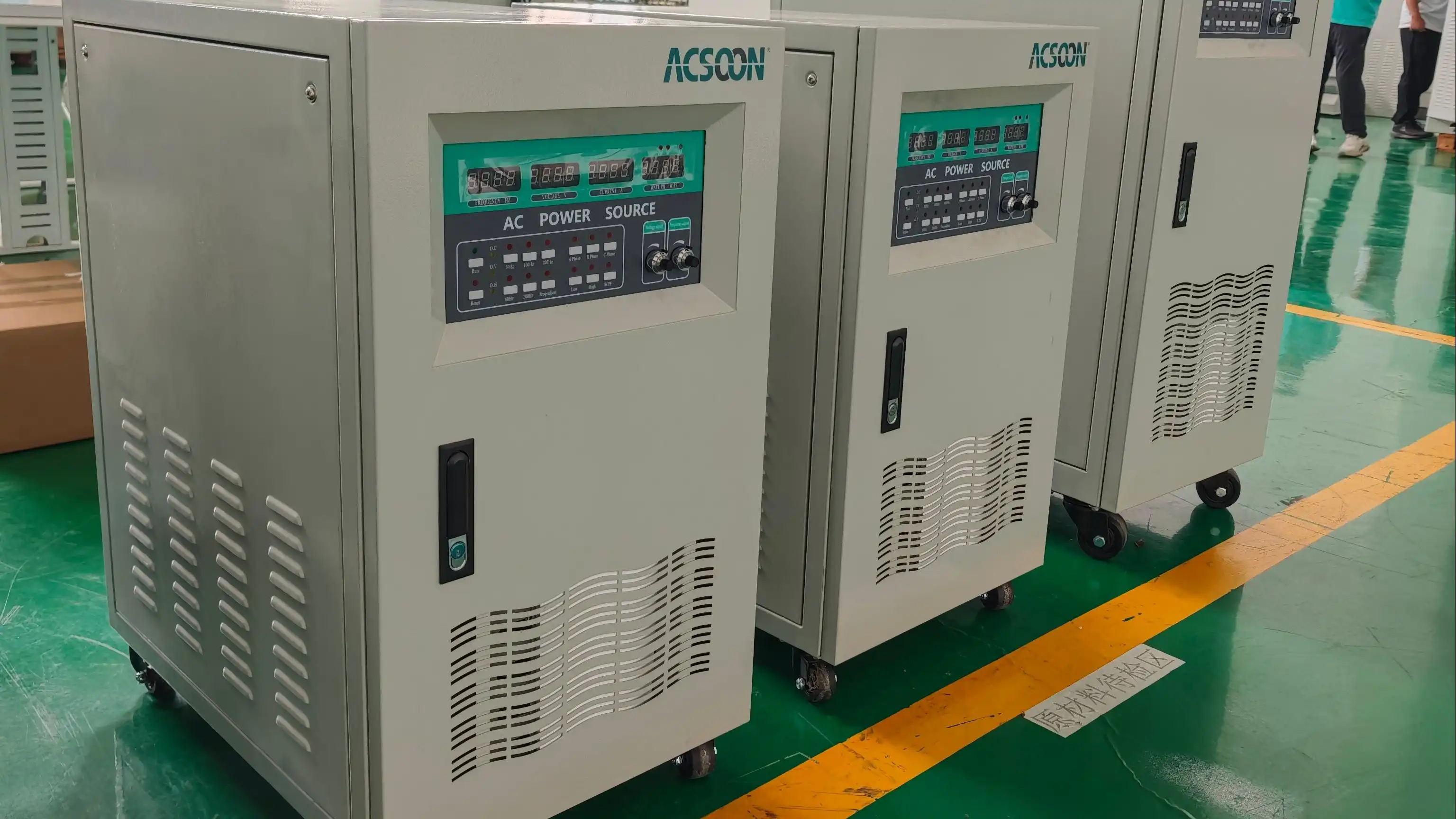
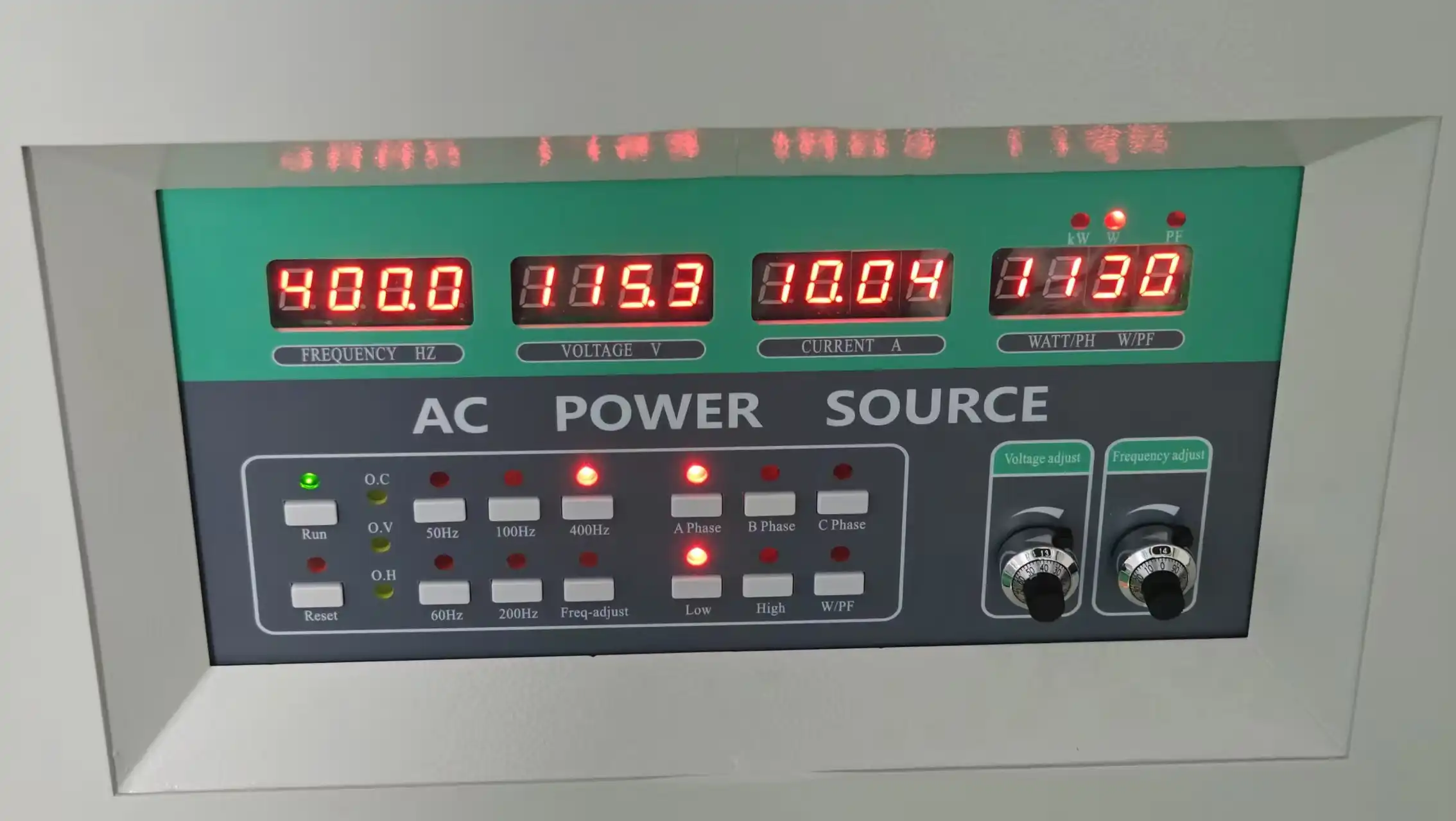
Xi'an Jerrystar Instrument Co., Ltd. stands ready to support your power conversion requirements with proven ACSOON technology backed by comprehensive technical expertise. Our ACSOON AF60W-330010 and complete product range deliver the reliability demanded by aerospace, military, marine, and industrial manufacturing applications. As a specialized 60 Hz to 50 Hz frequency converter manufacturer, we offer customization capabilities, maintain substantial inventory for rapid deployment, and provide responsive after-sales support including 24/7 technical assistance and remote diagnostics. Contact our engineering team at acpower@acsoonpower.com to discuss your specific application requirements, request detailed technical specifications, or obtain competitive quotations for single units or volume procurement. We deliver quality power conversion equipment that keeps critical operations running smoothly across international installations and diverse power environments.
References
1. International Electrotechnical Commission. (2020). IEC 61000-4-7: Electromagnetic Compatibility - Testing and Measurement Techniques - General Guide on Harmonics and Interharmonics Measurements. Geneva: IEC Publications.
2. Institute of Electrical and Electronics Engineers. (2022). IEEE 519-2022: Standard for Harmonic Control in Electric Power Systems. New York: IEEE Standards Association.
3. National Electrical Manufacturers Association. (2021). NEMA MG 1-2021: Motors and Generators - Performance Standards and Test Procedures. Rosslyn: NEMA Publications.
4. Rodríguez, J., & Cortés, P. (2023). Predictive Control of Power Converters and Electrical Drives. London: Wiley-IEEE Press.
5. Rashid, M. H. (2023). Power Electronics Handbook: Devices, Circuits, and Applications (5th ed.). Oxford: Butterworth-Heinemann.
6. Mohan, N., Undeland, T. M., & Robbins, W. P. (2022). Power Electronics: Converters, Applications, and Design (4th ed.). Hoboken: John Wiley & Sons.