




Solid state ground power unit vs Traditional GPU: Which Is Better?
Solid-state ground power units provide significant advantages in efficiency, power quality, and maintenance compared with many traditional motor-generator based systems. Modern semiconductor technology provides better power quality, higher dependability, and a lot less upkeep needs. These benefits directly lead to lower running costs and higher downtime. In the end, your operational goals will determine whether you use solid state or conventional units. However, aviation officials and military procurement agencies are increasingly favouring solid-state designs because they produce accurate results and can be used in a variety of tough field circumstances.
Understanding Ground Power Units: Solid State vs Traditional
How they prepare and send electricity to aeroplane systems is what makes these technologies different from each other. This difference has a big impact on how well it works, how to maintain it, and whether it's suitable for different operating settings.
How Solid State Technology Works
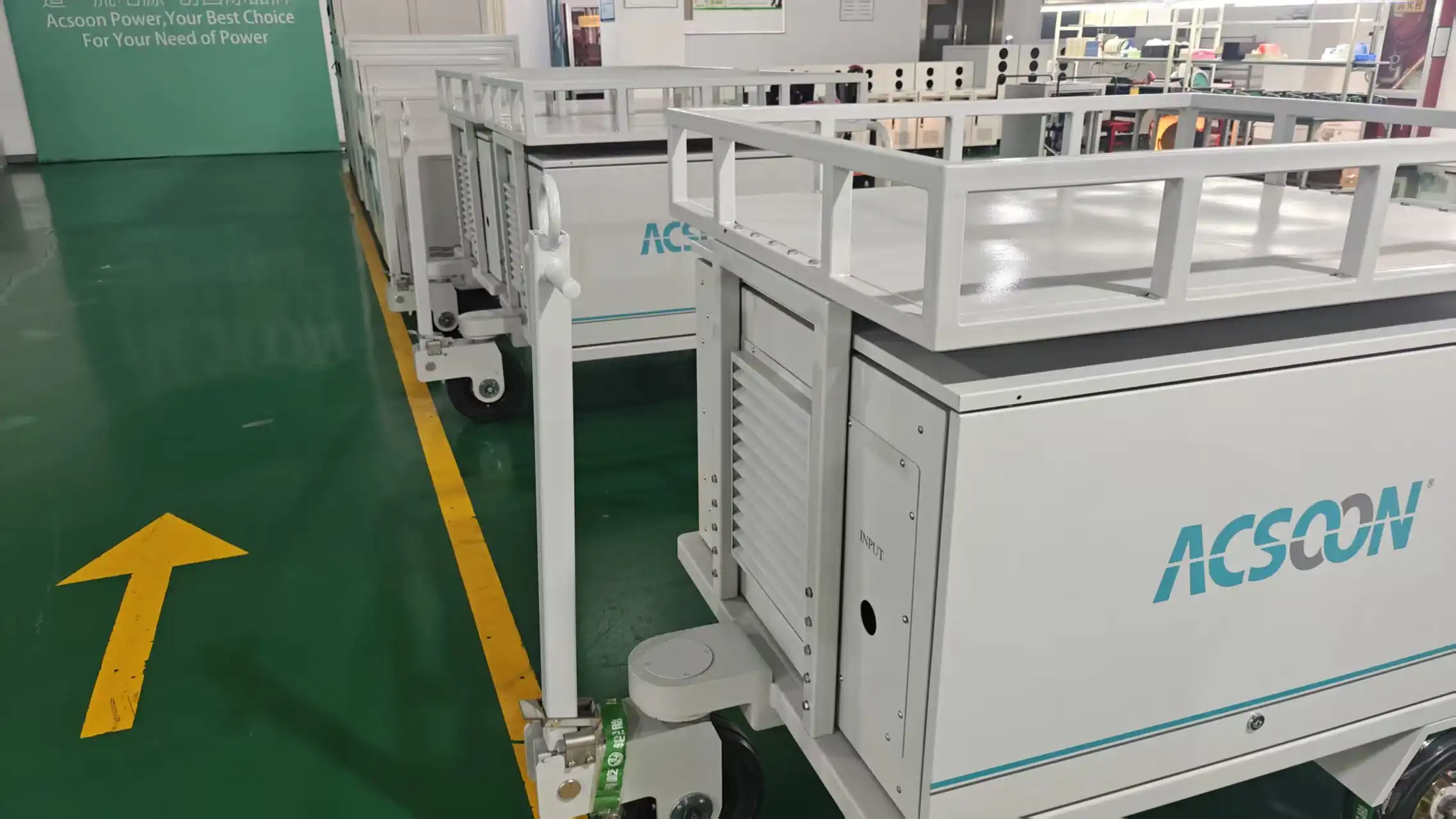
To transform input power into exactly controlled output, solid-state ground power units use advanced semiconductor components called IGBTs (Insulated Gate Bipolar Transistors) and MOSFETs. High-speed semiconductor switching devices precisely control voltage and frequency conversion. Not having any moving parts or heavy copper wires means that there are fewer places where the parts can wear out, and the structure can be small and light. This method is shown by ACSOON's GPU, which takes in 3-phase 380V/50Hz and turns it into clean 115V/200V at 400Hz output through solid-state conversion.Designed for outdoor aviation ground support environments that can be used for flight repair tasks without turning on the APU.
Traditional Motor-Generator GPU
Most ground power equipment uses rotating converters or mixtures of transformers and rectifiers, along with motor-generator sets. To change frequencies and step voltages, these devices use electromagnetic induction through copper coils wrapped around iron cores. Even though this method has been used for decades and worked well, it does come with some problems, including extra weight, noise from cooling fans and mechanical parts, and the chance of failures caused by vibrations. More maintenance needs to be done because brushes wear out, bearings break down, and insulation breaks down from heat cycles.
Operational Environment Considerations
Aviation ramps have special problems, like being exposed to jet fuel vapours, high temperature changes, electromagnetic interference from radar systems, and the constant threat of falling objects. In these circumstances, solid-state designs show greater resilience. Their sealed electronic parts are better at keeping out water than motor housings with vents, and the fact that they don't have mechanical brushes means that there are no risks of sparking near volatile fuels. Because of these safety benefits, military operators increasingly evaluate solid-state systems because of their reliability, mobility, and maintenance advantages.
Key Differences: Solid State Ground Power Unit vs Traditional GPU

There are differences between these systems that go beyond basic operational principles and affect operations budgets and mission readiness directly. Critical performance metrics for the solid-state ground power unit are shown in the following comparison table:
Energy Efficiency and Operating Costs
In places with a lot of use, running costs are directly affected by how efficiently electricity is used. Solid state conversion is 92–95% efficient, while motor–generator sets are only 75–85% efficient. At average use rates of six hours a day for 250 working days, a 50kVA solid state unit uses about 4,200 kWh less each year than a standard unit of the same size. Actual savings depend on operating hours, electricity rates, and load conditions, which adds up to a lot over the 15-year service life of most units. When it comes to big repair facilities that use multiple GPU systems during different shifts, these figures become even more important.
Maintenance Requirements and System Reliability
Scheduled repair times show how different systems are from one another. Traditional units need to be serviced every 500 to 1,000 hours of use. This includes checking and replacing the brushes, lubricating the bearings, cleaning the cooling system, and changing the filters. For these fixes to work, they need trained techs and original new parts, which creates dependencies in the supply chain. With major component changes happening only every 15,000 hours or more, solid-state designs reduce upkeep to yearly checks of electrical connections and cooling paths. Field-replaceable modular systems, also known as Line Replaceable Units (LRUs) in military terms, let regular techs, not just electrical mechanics, swap out parts in just 15 minutes.
Total Cost of Ownership Analysis
The purchase price is only the beginning investment in an item that will last for many years. To make a full TCO model, you need to include the costs of energy use, planned upkeep, unplanned downtime for fixes, and eventually getting rid of the machine. Solid-state units cost 25–35% more to buy, but they usually pay for themselves in three to five years in medium- to high-use situations. Aviation repair shops say that solid-state systems have 40–60% lower lifetime costs when looking at 12-year replacement cycles. Having this economic benefit becomes stronger in remote areas where it costs a lot more to get technicians and extra parts for regular GPU repair.
Procurement Considerations for B2B Clients
To buy GPUs strategically, you need to make sure that the technical specs match up with the way things are done and look at the vendor's skills beyond the product specs. For military and aviation purchases, strict validation methods are needed to make sure that equipment works consistently in mission-critical situations.
Matching Specifications to Operational Requirements
The output characteristics must exactly match the electrical equipment in the aeroplane of the solid-state ground power unit. Most modern military and business aeroplanes need 115V/200V at 400Hz. This frequency makes it possible for transformers and motors to be lighter than those that need 60Hz. This is the normal output from the ACSOON GPU-33050's 50kVA capacity. It works for narrow-body passenger aeroplanes and most military tactical aircraft while they are being serviced. Being able to change the frequency makes the unit more useful because it can be used in marine settings that need different output factors or in test labs that need accurate frequency control between 360Hz and 440Hz. When buying funds that have to serve different equipment fleets with a single inventory method, the ability to customise is very helpful.
Evaluating Supplier Credentials and Support Infrastructure
A vendor's evaluation goes beyond just looking at prices; it also looks at things like manufacturing quality systems, how quickly expert help responds, and the availability of spare parts. More and more, aviation ground support equipment needs compliance paperwork like ISO 9001 quality management certification, outdoor testing records proving IP54 or higher ingress protection, and EMC verification proving electromagnetic compatibility with sensitive electronics. Xi'an Jerrystar Instrument Co., Ltd. uses strict quality controls for all of its ACSOON products. These include checking each component, making sure the products work properly under full load, checking for environmental stress, making sure the products don't cause electromagnetic interference, and using thermal imaging to find possible failure modes before sending the products out. This level of testing accuracy gives purchasing officers written proof that meets safety standards and insurance requirements.
After-Sales Support and Lead Time Reliability
Maintaining operations relies on getting expert help quickly and knowing when things will be delivered. Maintenance shops in the aviation industry can't stand long wait times for new units or important extra parts. JERRYSTAR keeps enough goods on hand to speed up delivery for urgent needs. This is especially useful for military operations, where unpredictable deployment plans require flexible purchasing partnerships. OEM support agreements should make it clear how long it will take to answer technical questions, how long the insurance covers, and how many new units will be available throughout the equipment's service life. When looking at different bids, these agreement terms are often more important than small price differences.
Market Trends and Future Outlook for GPUs
The ground power equipment market is always changing because of new technologies, stricter rules, and shifting ways of doing things in the industry and aircraft markets.
Adoption Patterns Across Industry Segments
The military is the first to adopt solid-state technology because of their need for tactical movement and the harsh conditions they operate in. The logistical benefits—less weight means tactical transports can fly them, and easier upkeep means technicians don't have to be sent forward as far—work perfectly with plans for projecting an expeditionary force. This path is taken more slowly by commercial flight repair centers. Major airlines and MRO companies make the change during normal equipment replacement cycles. The marine industry is one of the newest growth areas. This is because navy ships are looking for small, effective shore power connections that can help them cut down on generator runtime and meet emissions standards while they're in port.
Regulatory Drivers and Environmental Compliance
Toughening noise laws at urban airports speeds up the use of solid state, even if it costs more. During overnight repair, traditional motor-generator sets often break the 75-dB noise limit, which means that activities have to be limited or expensive equipment has to be replaced. Solid state units that work at 65 to 72 dB allow ramp activities to go as planned without any noise barriers. Energy efficiency rules also favour advanced power electronics. For example, California's Title 24 and the European Union's energy laws set minimum efficiency levels that make it impossible to buy traditional designs. These regulatory frameworks give makers who offer compliant products that are ready to be used right away a competitive edge.
Technology Development Roadmap
In the next wave of designs, predictive repair algorithms, IoT connectivity that makes fleet management screens possible, and silicon carbide semiconductors that achieve 97%+ conversion efficiency are all built in. With remote testing, techs can figure out what's wrong before sending out repair teams, which cuts down on the average time it takes to fix something. Battery-buffered hybrid designs smooth out transient loads when an aeroplane engine starts up and provide uninterrupted power when the power from the utility source goes out. With these new ideas, solid-state platforms will be the hubs of linked support ecosystems instead of just power sources, which will make them more useful than just providing electricity.
| Application Scenario | Recommended Technology | Primary Decision Factors |
|---|---|---|
| Military tactical deployment | Solid State | Weight, reliability, field maintainability |
| Commercial airline maintenance | Solid State | TCO, noise compliance, power quality |
| Regional airport FBO | Either (evaluate utilization) | Initial cost vs. operating expenses |
| Marine shore power | Solid State preferred | Efficiency, compact installation, EMI control |
| Industrial test laboratories | Solid State | Frequency precision, clean power, customization |
How to Choose the Right Solid State GPU?
| Application | Recommended GPU |
|---|---|
| Aircraft component testing | GPU400 Series |
| Aircraft maintenance | GPU400M |
| Military ground operation | High capacity 28VDC GPU |
| Laboratory testing | Programmable frequency converter |
Get Your Aircraft GPU Recommendation
Tell us:
- Aircraft model
- Voltage requirement
- Current requirement
- Frequency requirement
Our engineers recommend suitable GPU configuration.
Trusted Brands and Suppliers of Solid State Ground Power Units
Finding qualified makers and forming partnerships with trustworthy suppliers is the best way to make sure you have access to legal tools and good technical support. There are both large global companies and small, specialised companies that only make power conversion technologies in the ground power tools market.
Leading Manufacturers and Product Portfolios
Through its specialised power conversion knowledge, Xi'an Jerrystar Instrument Co., Ltd. makes ACSOON brand equipment that is used in flight, the military, the marine industry, and lab tests. They make voltage and frequency stabilisers, solid-state ground power units, 400Hz static frequency converters, changeable frequency converters, and more. All of these are made to work in difficult conditions. The company's 5,000–10,000-square-meter factory in Shaanxi Province, China, has the ability to both make products and make technical changes that are needed for OEM relationships and unique applications. This manufacturing footprint makes it possible to meet flexible delivery dates and keep quality control high throughout the entire production process, which are both very important when buying deadlines limit project plans.
Certification Standards and Quality Assurance
Before it can be used on busy flight lines, aviation ground support equipment has to meet strict safety and performance standards. Relevant environmental and electromagnetic compatibility testing standards may include MIL-STD-810, DO-160 for electromagnetic compatibility, and different national electricity codes for safe installation. At JERRYSTAR, quality assurance procedures include checking individual semiconductors to make sure they are real, full-load performance testing to make sure output regulation works well in changing conditions, environmental stress screening to find problems with infant mortality before they are shipped, EMC verification to make sure interference isn't present, and thermal imaging to find potential hotspots that could mean design or assembly flaws. This multi-stage validation method gives procurement officers recorded tracking that backs up safety certifications and protects them from liability.
Typical Application Examples
Power quality is always brought up by aerospace experts as the main solid-state benefit. Fly-by-wire flight control systems, glass cockpit screens, and electronic warfare kits are all sensitive electronics that need a clean power source that doesn't have any voltage spikes or harmonic distortion. Total harmonic distortion (THD) in traditional motor-generator sets is between 5 and 8 percent, but less than 3 percent in solid-state designs. This difference keeps annoying circuit breakers from tripping and equipment from breaking down while repair is being done. Military procurement managers stress field reliability in harsh conditions, such as temperature swings from -20°C to +50°C, dust exposure on landing zones that haven't been prepared, and operation by people with little training who are pressed for time. The lack of mechanical wear parts directly affects mission availability, which means that equipment works when it's needed without having to wait for repair, which could mess up working schedules.
Value of OEM Partnerships and Customization
Standard catalogue standards work well for many uses, but for others, they need to be customised to meet particular operating needs. Custom voltage outputs, frequency ranges, communication protocols for connecting to current building management systems, and special enclosures that meet specific environmental protection needs can all be accommodated by ACSOON's OEM support program. For R&D labs that test electromagnetic compatibility, they need very clean power with output settings that can be changed by the user. This is something that normal production units can't do. When wholesalers work with manufacturers to make private-label products and make changes to specifications, they can reach special markets while using already-established production infrastructure. These partnerships help businesses stand out in busy B2B markets, where technical know-how and quick engineering support set top providers apart from commodity vendors.
Conclusion
Moving from old transformer-based ground power systems to solid-state ground power unit architectures shows how the power electronics business is becoming more mature toward digitally controlled power electronics. Both technologies are necessary for keeping aviation running, but solid-state designs are better in many ways, including using less energy, being easier to manage, keeping activities safe, and being able to adapt to changing needs. Instead of just looking at the price of purchase, people making procurement choices should think about the total cost of ownership over a reasonable service life. Solid state dependability and power quality are especially useful in military and aviation uses. Higher investments are worth it because they lower lifecycle costs and make missions more ready. The performance gap between these technologies will only get bigger as regulatory pressures rise and operational speed rises. This means that the decisions you make now about buying will have a bigger impact on your long-term competitive standing.
FAQ
1. What are the primary advantages of solid-state GPUs over traditional units?
Solid state ground power units are more energy efficient (92–95% vs. 75–85%), require much less upkeep, produce less noise, so they can be used in noise-sensitive environments, and provide better power quality to protect sensitive electronics. Their small size and lack of mechanical wear parts make them more reliable in the field while cutting lifecycle costs by 40–60% in normal aircraft maintenance situations.
2. What is the typical service life comparison?
In comparison to conventional motor-generator designs, solid-state units have a mean time between breakdowns of 15,000 to 20,000 hours. In aviation uses, solid-state equipment usually lasts between 15 and 20 years with proper upkeep, while traditional units need major repairs or replacement every 10 to 12 years.
3. Do solid-state GPUs require specialized maintenance training?
In reality, maintenance tasks are easier because they only require basic electricity checking skills instead of advanced mechanical knowledge. Traditional units need specialised motor-generator mechanics to replace individual parts, but modular line replaceable units can be changed by general techs in just 15 minutes.
Partner with JERRYSTAR for Advanced Solid State Ground Power Solutions
Aviation and military operations demand absolute reliability from ground support equipment. JERRYSTAR specializes in ACSOON brand solid-state ground power unit systems engineered specifically for mission-critical applications across aviation, defense, marine, and industrial testing environments. Our GPU-33050 model has a 50kVA capacity and output configurations that can be changed to fit a wide range of operational needs, from maintaining aeroplanes to following strict lab testing procedures. Since we are both a producer and a trade business, we keep enough inventory to meet tight shipping times and offer OEM customisation options to meet specific needs. Talk to our engineering team at acpower@acsoonpower.com about your needs with a reliable, solid-state ground power unit provider that is dedicated to technical quality and quick customer service.
References
1. Aviation Maintenance Magazine. (2023). "Ground Power Equipment: Evaluating Solid State vs. Traditional Technologies for Modern Aircraft Maintenance Operations." Aviation Technical Publishers, Vol. 42, Issue 3, pp. 67-84.
2. Military Logistics Review. (2024). "Power Conversion Systems for Tactical Aviation: Comparative Analysis of Field-Deployable Ground Power Units." Defense Acquisition University Press, January 2024 Edition.
3. International Air Transport Association. (2023). "Ground Support Equipment Standards and Recommended Practices: Technical Manual for Aviation Power Systems." IATA Technical Publications, 8th Edition.
4. Journal of Aerospace Engineering. (2022). "Electromagnetic Compatibility Considerations in Modern Aircraft Ground Power Systems." American Institute of Aeronautics and Astronautics, Vol. 35, No. 6, pp. 1247-1263.
5. Society of Automotive Engineers. (2023). "ARP 1854: General Requirements for Aerospace Ground Support Equipment—Ground Power Units." SAE International Standards, Revision D.
6. Industrial Power Systems Handbook. (2024). "Solid State Power Electronics in Critical Infrastructure Applications: Design, Testing, and Lifecycle Management." McGraw-Hill Professional Engineering Series, Third Edition.