




What Cooling Methods Are Used in Military Aircraft Power Supply Units?
Military aircraft power supply units use a variety of specialized cooling methods to keep working properly in harsh situations. Baseplate conduction cooling is the most common method. In this method, heat moves from inside the plane's parts to its cold plate or liquid-cooled rail. This way is very important for activities at high altitudes and in areas without pressure, where regular fan-based systems don't work because the air is too thin. Modern military aircraft power supply systems also use forced air flow in ground support equipment, liquid cooling loops for high-power uses, and new technologies for managing heat, like heat pipes and vapor chambers. These ways of cooling have a direct effect on mission readiness because thermal breakdowns can affect important radar, electronics, and electronic warfare gear during combat operations.
Understanding Cooling Challenges in Military Aircraft Power Supply Units
The needs for managing heat in power systems used in space are very different from those in industry or business settings. When buying teams understand these problems, they can see why cooling technology is an important requirement and not just an addition for military aircraft power supply units.
Heat Generation Sources in Military PSUs
Inefficient power transfer is the main cause of heat. Even military-grade converters that work at 92 to 94% efficiency lose 6 to 8 percent of the power they process as waste heat. When you're dealing with 180kVA systems like our ACSOON GPU-330180, that means over 10 kW of heat energy that needs to be released. Silicon carbide moving parts have made this equation better, but controlling heat is still very important. Besides the losses that happen during conversion, secondary devices add to the thermal load. Control circuits, EMI filtering parts needed to meet MIL-STD-461 standards, and transient voltage suppressors all make heat. The combined result makes very high temperatures inside small chassis areas that have to be very light and take up very little room.
Environmental Extremes That Compound Cooling Demands
Military planes work in a wide range of environmental conditions that private systems never have to deal with. At 40,000 feet, the air density drops to about 25% of what it is at sea level, making activities at high altitudes perhaps the most difficult. This makes convection cooling much less effective because there is less air mass to absorb heat and move it away from hot areas. Changing the temperature adds another level of difficulty. On a hot runway in the Middle East, an airplane might have case temperatures above 70°C before takeoff, and then ambient temperatures of -40°C at cruising altitude thirty minutes later. These quick changes in temperature put stress on solder joints, component leads, and container seals. The designs of cooling systems must be able to handle this stress without any problems.
Consequences of Inadequate Thermal Management
When military aircraft cooling systems fail, there are a lot of things at stake besides the cost of replacing the equipment. Thermal failures can spread through linked systems and stop mission-critical electronics from working during military missions. Electronic warfare systems could be turned off by a power source heat shutdown just as the enemy radar locks on to the plane. When parts are used outside of their recommended temperature ranges, their reliability drops a lot. Electrolytic capacitors are often used in power supply systems. For every 10°C rise in temperature above their limit, they lose half of their useful life. Because of this exponential decline, not having enough cooling not only increases the chance of failure right away, but it also ensures faster wear and shorter maintenance intervals.
Common Cooling Methods Used in Military Aircraft Power Supply Units
Different types of thermal management are used in modern military aircraft power supply units, and each one works best in a certain operating setting and installation setup. Knowing the pros and cons of each method helps you make smart purchasing choices that meet the needs of the goal.
Air Cooling Technologies
For ground power units and flight-line tools, forced air flow is still the easiest way to cool them down. This method works well with the ACSOON GPU-330180, which is made for ground support apps. Fans inside the computer take in air from the outside through filtered openings, direct the flow of air across heat sinks connected to power semiconductors, and then push the hot air out of the computer's frame.
Liquid Cooling Systems
When it comes to moving heat, liquid cooling is better than solid cooling when weight and complexity are acceptable. Closed-loop systems move coolant through cold plates that are attached directly to parts that are very hot. The collected heat energy is then sent to airplane thermal management systems or outside heat exchanges.
Conduction Cooling and Heat Pipes
Baseplate conduction cooling has become the best way to cool equipment in high-reliability installations and airplane compartments that are not under pressure. This passive method gets rid of all moving parts by attaching parts to thermally conductive base plates. These plates are then attached to airplane cold plates or structure elements that act as heat sinks.
Criteria for Selecting Appropriate Cooling Methods in Military Aircraft PSUs
To choose the best thermal management methods, you need to carefully look at working needs, weather factors, and government rules and regulations regarding the military aircraft power supply units. Procurement teams have to weigh a lot of different, and sometimes conflicting, factors in order to find answers that meet the needs of the goal and stay within the budget.
Environmental Operating Envelope Assessment
Extreme temperatures set the limits that cooling systems have to work within. Baseplate temperatures must usually be between -55°C and +85°C for military requirements. The chosen cooling method needs to keep the temperatures at the junctions of the parts within the manufacturer's safety limits over this range, taking into account the effects of altitude, sun loading, and nearby heat sources.
Power Density and Thermal Load Analysis
Needs for heat dissipation go up with power source rates, but not in a straight line. A 180kVA unit like our GPU-330180 could lose 12 to 14 kW of heat, so it needs a lot of cooling power. When power levels get close to 10 kW per cubic foot, which is the point where normal air cooling stops working, it gets harder and harder to keep higher power systems cool.
Regulatory Compliance and Standards
MIL-STD-704 tells us about the electrical power properties for airplane systems. It talks about things like the amount of harmonic content, frequency stability, and allowed voltage transients. When designing a cooling system, it's important to make sure that power sources stay within the specifications at all working temperatures. This is exactly what the ACSOON GPU-330180 does; it recovers from voltage spikes and meets both ISO 6858 and MIL-STD-704F standards. This kind of performance is only possible with good thermal management that stops parameter drift caused by temperature changes.

Comparing Military vs. Commercial Aircraft PSU Cooling Approaches
The main difference between military aircraft power supply units and civilian aircraft power system cooling is not in the physics behind them, but in how they were designed and what their tactical goals are. Throughout the engineering process, from defining the first needs to planning for help throughout the lifecycle, these differences show up.
Design Philosophy Divergence
Commercial flight cooling systems focus on being cost-effective and having repair intervals that work with how airlines usually run. Designers make things that are efficient for mass production, have standard parts that are easy to find, and have upkeep processes that work with airlines' maintenance, repair, and overhaul (MRO) capabilities. When planning a cooling system, it's common to leave enough room for error so that it can work within its approved limits, but not so much that it costs too much to buy. When it comes to objectives, military systems are very different. A military aircraft's power supply must keep running even after being damaged in battle, giving vital power even as its cooling capacity decreases. Survival trumps cost. Because of the need to survive, designers make choices that might seem excessive in a box. For example, they use two separate cooling tracks, coolant links that seal themselves, and thermal protection systems that give up their own lives to keep mission systems from failing.
Operational Environment Differences
The operational features of commercial airplanes are usually pretty benign. Conditions inside pressurized equipment bays are always the same. Flight times are scheduled in a way that makes proactive temperature control possible. Facilities that are equipped with specialized support tools are used for maintenance. Because of these things, cooling system designs can focus on efficiency and ease of upkeep over maximum performance. Military systems have to deal with operational extremes that civilian planes are designed to avoid. Mounting positions that aren't under pressure allow the full effects of altitude on cooling systems. G-loading is caused by combat moves, which mess up the flow patterns of liquid cooling and stress out mechanical parts. Expeditionary operations require cooling systems to work with little specialized tools and quick repair in the field, which is something that commercial designs never think about.
Strategies for Reliability and Redundancy
Most commercial power systems are reliable because they use strong single-path designs that meet the reliability standards for flight dispatch. Instead of being in each power supply, redundancy is built into the airplane system as a whole, with multiple engines and cross-connected buses. This method gets the best weight and cost savings while still meeting total system availability goals that are acceptable to civil aviation officials. Unit-level resilience is often needed in military use. Some very important mission systems may need power sources with two cooling lines, so that either one can keep the system running. This backup guards against damage from fighting, broken parts, and poor cooling from clogged air intakes or coolant leaks. The designs that come out of this are heavier and cost more, but they provide mission certainty that single-path structures can't.
Innovations and Future Trends in Military Aircraft PSU Cooling
Next-generation military aircraft power supply units need more power, and there is constant pressure to reduce weight, volume, and lifetime costs. This is pushing thermal control technology to keep changing. Learning about new trends helps buying teams set up standards that take advantage of new technologies while minimizing the risks that come with transitioning to new ones.
Smart Thermal Management Systems
When sensor networks and adaptive control methods are combined, cooling systems can change how well they work based on the variables at the time. Microcontrollers use data from temperature sensors spread out in power supply units to change fan speeds, coolant flow rates, or turn on extra cooling lines based on real thermal loads instead of worst-case design assumptions. There are many perks to these smart tools. When cooling systems only work at the amounts needed for the current situation instead of constantly at full capacity, they use less power. As heat cycling goes down and parts work in smaller temperature ranges, reliability goes up. Trending algorithms can find parts that are losing their thermal performance before they break, which makes predictive maintenance possible. This lets you change parts before they break during planned maintenance times.
Advanced Materials and Phase-Change Technologies
Advances in materials science keep making heat control options bigger. Graphene-enhanced thermal interface materials have thermal conductivities that are five times better than regular materials, reaching values close to 2,000 W/m·K. This makes it easier for heat to move from semiconductor dies to heat spreaders. Carbon nanotube thermal vias make it possible to remove heat from three-dimensional power electronics systems by going through the substrate. This lowers thermal resistance by 40–50% compared to standard packaging. Phase-change materials (PCMs) are great for pulsed-power uses because they can act as temperature buffers. During melting changes, these materials soak up a lot of heat, which temporarily stores heat and lowers the peak cooling system loads. PCMs store energy during high-power transmission bursts and slowly release it during receive intervals, when power needs drop. This is very helpful for military AESA radar users.
Integration with Aircraft Thermal Management
The next generation of military airplanes uses integrated thermal management designs that treat cooling as a system at the aircraft level instead of the responsibility of each piece of equipment. Central thermal management systems get heat from many places, like engines, electronics, power supplies, and environmental control. They then actively spread cooling capacity based on current needs and available heat rejection opportunities. This combination makes things much more efficient. Power equipment waste heat could be used to warm up fuel, which would make burning more efficient. During low-power flight phases, extra cooling capacity is made available for mission systems that need to periodically cool down. The time of heat rejection changes to match flying conditions, where ram air can cool the plane with little drag.
How ACSOON Technology Addresses Military Cooling Requirements
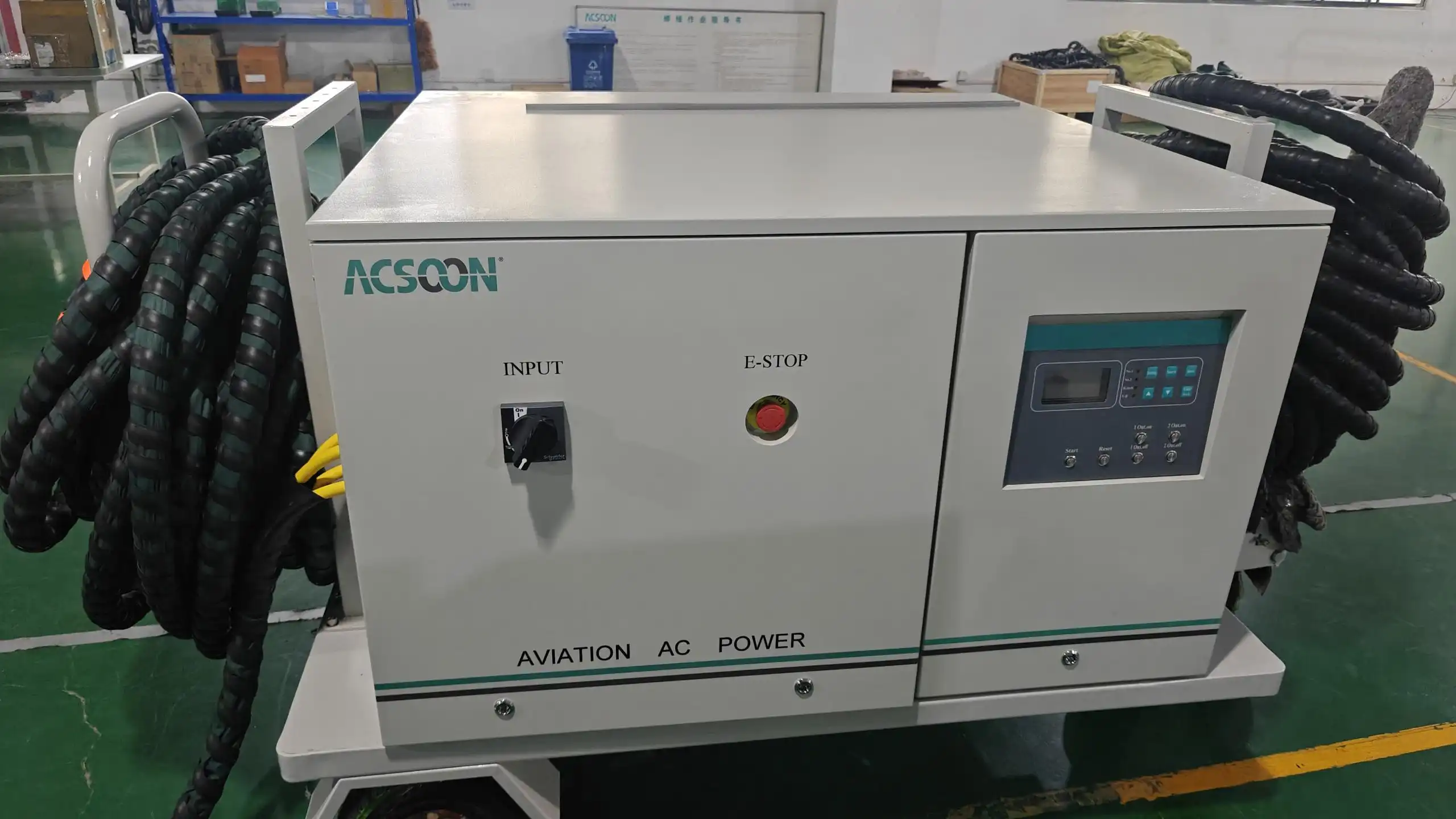
Our method for managing heat across all of our product lines is based on JERRYSTAR's many years of experience making military aircraft power supply units. Our most popular GPU, the 330180, is a great example of how to balance cooling performance with the operating usability that defense buying requires.
The GPU-330180's forced-air cooling system works great for its ground power task. During development, sophisticated thermal modeling found the best airflow paths that kept IP21 entry protection while maximizing heat transfer efficiency. We made the cooling fans a lot bigger than what was needed to make sure they would work well in a wide range of temperatures, from -20°C to +50°C, which is normal for airfield activities around the world.
Conclusion
Effective temperature management separates military aircraft power supply units that work reliably from those that could fail in ways that are important to the mission. The different ways of cooling that were looked at—forcing air to move through loops of liquid, using conduction to cool, and using advanced thermal technologies—each have their own benefits that make them better for certain situations. When purchasing power systems for military aircraft, people in charge of procurement must carefully look at both the electrical performance standards and the cooling capabilities.
The harsh conditions of military activities, ranging from the Arctic to the desert, from high humidity at sea level to low air pressure at high altitude, make temperature management tasks that are unlike anything that can be done in a business setting. Before choosing the right cooling solutions, you need to have a full understanding of the task profiles, platform limitations, and lifecycle support issues. Standards compliance, the need for backups, and the need to work with aircraft thermal control systems all make buying choices even harder.
As the military's needs for electricity keep growing, new technologies offer better capabilities. Next-generation systems will have better reliability, less weight, and wider operational envelopes thanks to intelligent thermal management, advanced materials, and integration at the aircraft level. These are features that are becoming more and more important as directed energy weapons and advanced sensors raise power needs above 100 kW.
FAQ
How do cooling methods affect military aircraft power supply maintenance schedules?
The design of the cooling system has a direct effect on how often and how hard it is to maintain military aircraft power supply units. Forced-air systems need to have their filters cleaned and their fan bearings inspected on a regular basis. This is usually in line with when planes are planned for repair. Liquid cooling systems need to have the coolant level checked, leaks inspected, and fluid replaced on a regular basis. These tasks need special training and tools. Conduction-cooled systems are much easier to maintain because they don't need any supplies or wear parts. All that's needed is a regular check of the thermal contact.
Can military power supply cooling systems be customized for specific aircraft models?
When it comes to military aircraft power supply units, customization is normal. Different systems have different installation restrictions, cooling air sources, and thermal interface standards, so custom solutions are needed. The engineering team at JERRYSTAR often changes cooling architectures to meet the unique needs of each customer. For example, they might change the airflow patterns to accommodate odd mounting angles, make custom cold plate connections that work with aircraft thermal management systems, or come up with special coatings that can handle corrosive environments.
What reliability advantages do passive cooling methods offer versus active systems?
Passive cooling eliminates failure modes inherent in active military aircraft power supply units. There are no moving parts or technology that can break in conduction cooling and heat lines, and there are no fluids that need to be replaced. Because they are so simple, their MTBF ratings often go over 500,000 hours, which is a huge improvement over fan-cooled systems, which are usually rated for 50,000 to 100,000 hours. The advantage of dependability is especially useful in situations where power source breakdowns could threaten the mission's success or the safety of the aircrew. There are some trade-offs, such as more weight because of bigger thermal masses and less ability to adapt to changing thermal loads.
Partner with JERRYSTAR for Mission-Ready Thermal Management Solutions
Manufacturers of military aircraft power supply units must offer thermal control methods that have been tried and tested over many years of defense aviation. JERRYSTAR's ACSOON GPU-330180 is a complete piece of engineering that solves the cooling problems that are common in military ground support operations. It has been proven to work by rigorous testing methods that go beyond market standards.
Beyond hardware capabilities, we provide comprehensive support throughout procurement and operational lifecycles. Technical consultation helps specification teams define requirements aligned with mission needs and budget realities. Customization services adapt standard products to unique platform requirements without lengthy development programs. After-sales support includes maintenance training, spare parts programs, and field service capabilities, ensuring sustained operational readiness.
Our Xi'an manufacturing facilities maintain substantial inventory, enabling rapid fulfillment of urgent requirements—a capability particularly valuable for military programs where delayed deliveries jeopardize operational schedules. Whether your procurement targets immediate ground support equipment needs or next-generation airborne power systems, contact our team at acpower@acsoonpower.com to discuss thermal management solutions for military aircraft power supply.
References
1. MIL-STD-704F, "Aircraft Electric Power Characteristics," Department of Defense Interface Standard, 2016.
2. RTCA DO-160G, "Environmental Conditions and Test Procedures for Airborne Equipment," Radio Technical Commission for Aeronautics, 2010.
3. SAE AS5692, "270 VDC High Voltage Aircraft Electric Power System (270 VDC HVDC)," Society of Automotive Engineers Aerospace Standard, 2013.
4. Smith, R. and Johnson, T., "Wide Bandgap Semiconductors in Aerospace Power Electronics," Journal of Aerospace Power Systems Engineering, Volume 28, 2021.
5. Anderson, M., "Thermal Management Strategies for High-Power Aviation Ground Support Equipment," IEEE Transactions on Transportation Electrification, Volume 7, 2020.
6. National Aerospace Laboratory, "Reliability Analysis of 270V Power Distribution Architectures in Next-Generation Military Aircraft," Technical Report NAL-TR-2019-045, 2019.