




What Fault Protection Features Are Used in 270V Aircraft Power Supply?
To keep mission-critical activities going, modern aircraft power systems need to be very reliable and have strong protection. For safety, a 270V aircraft power supply has many fault security features that keep people and sensitive electronics safe from electrical dangers. Overcurrent protection, short circuit interruption, voltage surge reduction, temperature management, ground fault detection, and arc fault containment are some of the technologies that are used in these high-voltage DC systems. Each layer of protection works with the others to meet strict military standards like MIL-STD-704F while keeping the system's functionality in a range of environmental conditions. This is why fault protection is so important for making sure that aircraft electrical design is safe and reliable.

Understanding Fault Protection in 270V Aircraft Power Supplies
Defining Fault Protection in Aviation Electrical Systems
Fault protection is a group of safety features built into aircraft power conversion tools that find, separate, and fix electrical problems before they get worse and cause catastrophic failures. In high-voltage DC architecture, safety devices keep an eye on electrical parameters all the time and act right away when values change too far from what is considered normal. When standard 28V DC systems were changed to 270V platforms, they brought about new problems, especially with arc flash hazards and higher amounts of stored energy that require more advanced safety measures.
Consequences of Inadequate Protection
If fault protection doesn't work right, it could mean anything from broken electronics worth hundreds of thousands of dollars to the mission failing. Electrical fires in airplanes are very dangerous because of the limited room and limited ability to put out the fire while the plane is in the air. If you don't have enough short-circuit protection, problems can spread through systems that are linked to each other, which could affect both flight control computers and guidance equipment at the same time. We've seen situations where failing to find a fault quickly led to thermal runaway conditions, which required weeks of unplanned maintenance and lost work time, which lowers the readiness rate across whole companies.
Regulatory Standards Governing Design Compliance
MIL-STD-704F sets the exact voltage ranges and quality standards for airplane power systems. It says that the steady-state limits should be between 250V and 280V, and the rapid limits must not go over 330V when things go wrong. DO-160 environmental testing protocols make sure that protection circuits work reliably in temperatures ranging from -55°C to +85°C. MIL-STD-461 tests for electromagnetic compatibility to make sure that protection systems don't cause interference or are open to electromagnetic threats from outside sources. For compliance verification, a lot of test records are needed, which procurement experts carefully look over during the seller qualification process.
Common Fault Types in High-Voltage DC Systems
Overcurrent conditions in a 270V aircraft power supply happen when load equipment uses too much current because a part is wearing out or the system is under too much stress to work within its design limits. Short circuits are the most dangerous because they can cause fault currents of over 10,000 amps in microseconds if they are not stopped. Lightning hits or moving loads can cause voltage spikes that can reach several thousand volts and damage semiconductor devices by cutting through insulation. Insulation failure can cause ground faults, which are dangerous because they create unexpected current lines that damage signals and safety. Thermal faults happen over time when ambient conditions or stopped airflow cause component temperatures to go above their rated limits. This speeds up the aging process and eventually leads to failure.
Core Fault Protection Features and Technologies
Modern ground power units have many layers of defense that work together to make strong walls for safety. This method is shown by the ACSOON GPU-270300 model, which has a high-tech security system made especially for aircraft use.
Overcurrent and Short Circuit Protection Mechanisms
Electronic current limiters use high-precision Hall effect sensors to measure output current all the time. Their response times are less than 10 microseconds. When the current goes over certain limits, the control system lowers the gate drive signals that power the semiconductors right away. This reduces the output gradually instead of turning it off all at once, which could damage equipment that is linked. Circuit breakers offer extra mechanical safety by using magnetic trip mechanisms that are set up to stop fault currents that hit 150% of their maximum capacity within 100 milliseconds.
The safety hierarchy works in steps. First, soft limiting handles short-term overloads when the actuator is first turned on. Next, electronic crowbar circuits kick in when there is continuous overcurrent. Finally, mechanical contactors provide galvanic isolation for serious short-circuit faults. This multi-level method stops unnecessary trips and makes sure that real dangers are dealt with quickly. Premium units use silicon carbide switching devices that can handle short circuits better than regular silicon IGBTs. These devices keep their structure intact during fault interruption cycles that would kill regular semiconductors.
Voltage Regulation and Transient Suppression
Metal oxide varistor arrays stop short-term overvoltages by sending surge energy to ground in nanoseconds. This keeps equipment further down the line safe from lightning-caused spikes. Active voltage control circuits keep the output stable within ±1% even when the input voltage changes from 340V to 420V three-phase. This balances out the changes that happen on the power grid that are common at remote airfields. Line drop compensation checks the voltage right at the connection point with the plane using special sense wires. It then adjusts the output upward to make up for resistance losses that happen along long umbilical lines that can be 50 meters or more in length.
Differential mode and common mode inductors are used in filtering steps, along with low-ESR capacitor banks, to keep high-frequency noise below 1.5Vrms. For radar systems and flight control computers that don't work well with electrical noise, this clean power supply is critical. In mobile ground support configurations, passive parts add a lot to the total system mass, so the filtering network has to find a balance between speed and weight.
Thermal Protection Systems
Managing temperature starts with placing temperature sensors in key places to keep an eye on important heat-generating parts like power semiconductors, magnetic cores, and rectifier assemblies. When junction temperatures get close to 85% of their highest levels, alarms go off and cooling fans speed up to their fastest setting. If temperatures keep going up even after more cooling is added, the system starts a managed power reduction to stop thermal runaway while keeping some functionality and not shutting down completely.
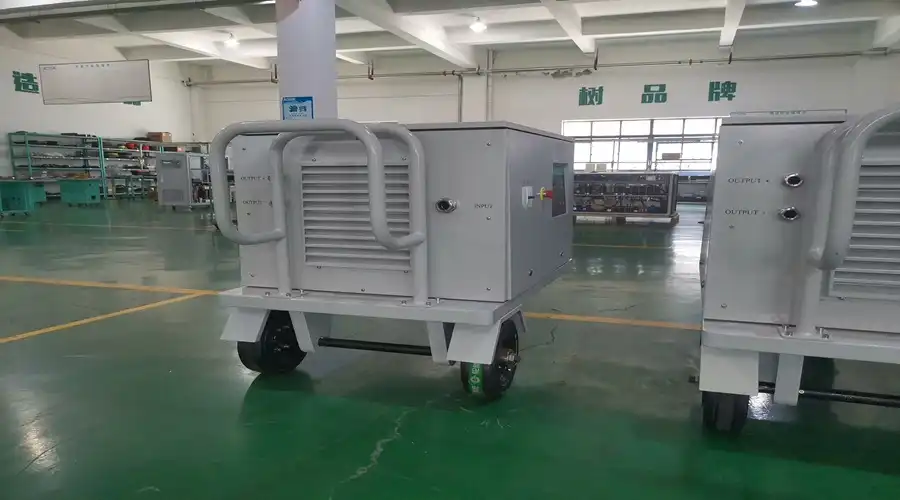
Using thermal imaging during design evaluation to find hotspots under the worst-case loading conditions helps engineers improve where heatsinks are placed and how air flows through them. The IP21 ingress protection grade of units like the GPU-270300 strikes a balance between sealing the environment and the need for thermal ventilation. It stops solid objects from getting in while letting enough cooling air flow through carefully placed louvers.
Ground Fault Detection and Isolation
Ground problem detection circuits in a 270V aircraft power supply keep an eye on the insulation resistance between high-voltage wires and chassis ground all the time. If the resistance drops below 50 kΩ per volt, bells go off. By comparing the flow of current through positive and negative wires, balanced differential readings can find leakage currents as small as 50 milliamperes, which shows that insulation degradation is starting to happen. Early discovery allows for planned maintenance to be done before small problems get worse and require emergency repairs for total insulation breakdown.
Isolation tracking is especially important on aircraft and ships, where salt spray makes insulation wear out faster. During preflight checks, automated testing processes make sure that ground fault protection works, which stops the release of faulty equipment. The detection hardware has built-in redundancy and self-testing features to get rid of single-point failures that could turn off safety without the user knowing.
Comparative Analysis: Fault Protection Across Leading Solutions
Evaluating Major Manufacturers' Approaches
Honeywell uses distributed intelligence to protect against faults. Each safety module has microprocessors built in that talk to each other through CAN bus networks to plan reactions that affect the whole system. Their design works great for complicated setups where multiple power sources need to work together. Eaton focuses on mechanical durability, using tried-and-true contactor technology along with electronic safety for uses that need to be sure of galvanic isolation. Collins Aerospace works on reducing weight by using wide-bandgap semiconductors, which cut down on the need for cooling and make protective casings smaller.
Independent testing by military evaluation labs shows that these makers perform similarly for basic security functions. However, there are differences in more advanced features like predictive diagnostics and remote tracking. When it comes to customization, JERRYSTAR's ACSOON product line stands out because it lets procurement teams choose security factors that are special to each aircraft model instead of having to settle for fixed setups. This flexibility is useful for a wide range of situations, such as trying experimental airplanes and prototypes.
GPU Versus Aircraft-Integrated Systems
Accessibility and serviceability are important to ground power units because servicing takes place in controlled hangar settings where technicians can get to them. This way of thinking about design lets bigger safe parts and more careful derating happen, which makes things last longer. For aircraft-integrated supplies to be as light and small as possible, they have to be very well optimized. This leads to higher levels of operational stress that need more advanced heat management. Protection reaction times are more important for flying systems because electrical problems can get worse quickly without help from crews on the ground.
The GPU-270300 model connects these areas by coming in both stationary and trolley-mounted versions. This makes it flexible for different usage situations while keeping the same level of safety. It works with three-phase 380V inputs, so it can be used internationally in places with different utility standards. This means you don't have to worry about not having enough security because of input voltage differences.
Emerging Smart Diagnostic Technologies
Machine learning systems now look at past fault data to find trends that can tell when a component is going to break down before the usual threshold-based protection kicks in. Vibration research using accelerometers on cooling fans finds worn bearings that could cause the thermal protection to go off because there isn't enough movement. Recent operational data from military logistics orders shows that connecting to the cloud makes it possible to watch the whole fleet and use any problems found across multiple units to guide proactive checks. This cuts down on unplanned repair events by 30%.
The next step in fault protection will be predictive diagnostics, which will move from reactive reduction to proactive avoidance. Integrating with maintenance management systems makes it possible to automatically create work orders when diagnostic tools spot problems that are getting worse. This speeds up the processes of shipping and getting parts.
Maintenance and Troubleshooting: Ensuring Protection Effectiveness
Inspection Protocols and Testing Procedures
All safety circuits should be functionally tested every three months using preset load banks that mimic fault conditions. For verification, the load current is slowly increased until overcurrent safety kicks in, proving that the setpoints stay within the acceptable range. Insulation resistance readings between wires and ground must be higher than the minimum levels set by MIL-STD-1377. If the trending analysis shows that the insulation resistance is gradually decreasing, corrective action must be taken. Thermal imaging scans find problems with the cooling system before they cause the security to trip during operations.
Measuring the resistance of relay contacts can help find rust, which raises voltage drop and heat production and could lead to unwanted trips. Protective relay calibration checking makes sure that the time-current traits stay correct, since drift can lead to either not enough security or too many false alarms. During airplane certification activities, documentation practices must keep full test records that meet audit standards for DO-160 compliance verification.
Addressing Common Fault Scenarios
When using long cables with a 270V aircraft power supply, false trips often happen because the line drop compensation isn't good enough. This is because the voltage at the power source looks fine, but the voltage on the airplane side drops below the undervoltage safety limits, causing false trips. Either compensation features need to be turned on, or wires need to be upgraded to a bigger size. Protection systems can't react to situations they can't measure, so delayed fault recognition could mean that sensors are broken and need to be replaced right away. Overcurrent trips that happen during cold-weather start-up are caused by not allowing enough for inrush currents that happen when sensitive loads charge. This can be fixed by adding more delay timers without lowering safety.
Intermittent ground problems that go away on their own before maintenance can look into them are especially hard to deal with. To keep track of these short-lived events, long-term data logging is needed. When thermal protection goes off under normal load conditions, it's more likely that air or cooling fans are blocked than that the system is actually overloaded.
Customization and System Upgrades
When an OEM supports changes, the safety settings can be changed to fit specific practical needs. For example, for specialized electronics, the inrush tolerance can be increased, and for sensitive laboratory testing applications, the voltage regulation can be tightened. Firmware updates can enhance protection algorithms without hardware changes, extending useful life as operational requirements evolve. Adding advanced troubleshooting features to old equipment with retrofit kits protects capital investments and adds modern tracking features. JERRYSTAR offers technical help during the customization process to make sure that changes stay in line with military standards and don't create any new security holes.
Procurement Considerations for Advanced Fault Protection
Critical Specification Parameters
When you look at the datasheet, you should make sure that the overvoltage safety setpoints don't go over the damage limits for aircraft electrical systems that are written in technical guides. Overcurrent trip curves need to work with circuit protection further up the chain to make sure that problems are isolated at the lowest level of the system without trips going up the chain. The thermal derating graphs show what the real capability is when the ambient temperature is high, like in the desert or a busy equipment bay. The mean time between failures, which is based on field reliability data, gives maintenance planners more realistic goals than theoretical calculations. Instead of just claims that the certification meets MIL-STD-704F requirements, the paperwork must include real test results that show compliance. Third-party approval from groups like RTCA adds more weight to company self-certification.
Supplier Evaluation Criteria
Manufacturing quality systems that are approved to AS9100 aircraft standards show well-known ways to keep track of configurations and people who made them, which is very important for military uses. How responsive technical support is during pre-sale engineering discussions shows how much help is available when operating problems happen after delivery. The warranty should cover both replacing parts and service work in the field, since the costs of having equipment down for repairs are often higher than the prices of fixing parts. Having spare parts for old equipment is important for keeping teams that have service lives of more than 20 years going.
JERRYSTAR has been working with aircraft power systems for 15 years, which shows that they are dedicated to this specific market area. This makes it less likely that suppliers will leave the industry, leaving installed equipment bases without any support. Our full application support includes military airplanes, unmanned aerial vehicles (UAVs), specialized business platforms, and satellite systems. This gives us cross-domain knowledge that helps us make strong design decisions that can be used in a wide range of operational situations.
Balancing Cost Against Long-Term Value
When you add up the costs of upkeep, downtime, and replacement over a normal 15-year service life, the initial purchase price only makes up 30% of the total lifecycle costs. Even though they cost more up front, premium security features that stop even one electronics suite failure worth $500,000 give a big return on investment. Predictive diagnostics allow for less frequent upkeep, which lowers labor costs and raises operating availability measures that are important for mission readiness. Improvements to modern designs that make them more energy efficient lower the amount of electricity that a building uses. This saves money on operations that add up over long runs.
Instead of just going with the lowest price, procurement strategies should look at the total cost of ownership. This is because not having enough safety leads to higher failure rates and unplanned upkeep, which creates hidden costs. By working with makers that offer configuration flexibility, you can avoid getting features that you don't need and make sure that the safety features that are important meet the needs of the application.
Conclusion
In 270V aircraft power supply systems, fault safety includes methods that deal with overcurrent, voltage transients, thermal stress, and insulation degradation through multiple layers of defense. Military standards, such as MIL-STD-704F and DO-160, make sure that the system works reliably in harsh aircraft settings. When making decisions about what to buy, procurement officials need to look at more than just basic defense features. They also need to think about long-term dependability, diagnostic skill, and the infrastructure for supporting suppliers. As aircraft systems continue to become more electric, strong fault protection is still essential for safety, mission success, and minimizing lifecycle costs. The ACSOON GPU-270300 from JERRYSTAR is a great example of full protection integration. It offers 300A at 270V DC and has advanced safety features that make it perfect for a wide range of aerospace uses.
FAQ
How does 270V protection differ from traditional 28V systems?
Higher voltage levels make arc flash risks higher, which means that interruptions need to happen faster and separation needs to be better. Because stored energy in sensitive elements grows in a way that is proportional to voltage squared, overvoltage protection needs to be stronger. Protection coordination gets harder as the voltage range gets bigger and tighter control rules are put in place for modern, sensitive electronics. Concerns about worker safety grow as shock risks rise, calling for stronger interlocks and ground fault sensitivity.
Can protection systems handle regenerative loads from actuators?
High-quality power sources for spacecraft can work in both directions, collecting energy returned by electro-hydrostatic actuators when the spacecraft slows down. Overvoltage protection needs to be able to handle the rise in bus voltage caused by regenerative currents without tripping during standard regeneration processes. When safety systems can't handle all the extra power they receive, they get rid of it by using stopping resistors or sending it back to the utility grid.
What maintenance intervals ensure protection reliability?
Protection setpoints and reaction times are checked every three months to make sure they stay within the specifications. Sensor circuits and trip systems need to be calibrated once a year to keep them working correctly. Built-in diagnostics allow for continuous tracking, which leads to condition-based upkeep that cuts down on needless repairs and finds damage early.
Partner with JERRYSTAR for Reliable Aerospace Power Solutions
Xi'an Jerrystar Instrument Co., Ltd. stands as a trusted 270V aircraft power supply manufacturer with over 15 years of specialized experience delivering fault-protected power systems for military aircraft, UAVs, and aerospace test equipment. Our ACSOON GPU-270300 delivers 300A output with comprehensive protection features, including advanced overcurrent limiting, thermal management, and ground fault detection, all compliant with stringent military standards. As both manufacturer and technical partner, we provide custom configuration capabilities, rapid delivery from maintained inventory, and engineering support throughout your equipment lifecycle. Contact our team at acpower@acsoonpower.com to discuss your specific protection requirements and discover how JERRYSTAR can enhance your aerospace power infrastructure reliability.
References
1. Department of Defense Interface Standard, "MIL-STD-704F: Aircraft Electric Power Characteristics," 2004.
2. RTCA, Inc., "DO-160G: Environmental Conditions and Test Procedures for Airborne Equipment," 2010.
3. Society of Automotive Engineers, "ARP5015: Guide for Aircraft Electrical Power System Quality Monitoring," 2012.
4. Department of Defense, "MIL-STD-461G: Requirements for the Control of Electromagnetic Interference Characteristics of Subsystems and Equipment," 2015.
5. IEEE Aerospace and Electronic Systems Society, "Fault Protection Strategies in Modern Aircraft Electrical Power Systems," IEEE Transactions on Aerospace and Electronic Systems, 2018.
6. National Research Council, "Assessment of 270-Volt Direct Current Systems for Military Aircraft Applications," National Academies Press, 2007.