




What Innovations Are Driving Aircraft Power Supply Technology Forward?
Modern aircraft power supply technology is changing in big ways thanks to advances in semiconductors, smart control systems, and modular designs. These new ideas solve problems that have been around for a long time in flight power systems, like how to make them lighter and more reliable while also making sure they work with electromagnetic fields. Wide-bandgap semiconductors, AI-driven diagnostics, and hybrid AC/DC capabilities are now built into ground power units. This completely changes how airports, military sites, and MRO facilities provide stable, clean power to parked aircraft and during important testing stages.
Current Challenges and Limitations in Aircraft Power Supply Systems
Historically, aircraft power supply infrastructure has depended on old architectures that aren't able to keep up with modern operating needs. There are often flaws in these methods that make them less safe and less effective.
Reliability Constraints in Legacy Systems
Due to worn-out parts and bad temperature management, traditional ground support equipment often breaks down without warning. Extreme temperature changes at high altitudes damage electrolytic capacitors, and old transformer designs make harmonic distortion worse than what is allowed by DO-160G Section 21. When repair workers come across voltage transient spikes, which happen a lot during APU startup processes, systems that aren't properly protected could fail in multiple avionics rooms. Military procurement officers know that these gaps in dependability are mission-critical weaknesses, especially on remote airfields where backup infrastructure isn't available.
Weight and Integration Bottlenecks
When engineers are making onboard power distribution systems, they have to deal with strict weight limits and next-generation flight control computers and EFIS screens that use a lot of power. Traditional copper bus bars and big magnetic parts add kilograms that lower the carrying capability. Adding new 270V DC high-power designs to existing 28V DC sources needs complicated interface electronics, which slows down approval processes and increases development times. These problems have a direct effect on the ability of aerospace makers to meet cost and program goals.
Environmental and Compliance Pressures
In marine flight settings, salt spray corrosion weakens connectors, and electromagnetic interference from nearby radar systems messes up sensitive electronics. Following MIL-STD-461 and changing FAA technical standard orders requires a lot of insulation and screening, which makes the unit more complicated and costs more to buy. Industrial testing labs that are looking at these systems need environmental stress screening methods that can be used again and again. However, many older units don't have standard diagnostic ports or digital telemetry capabilities.
Emerging Innovations Shaping Aircraft Power Supply Technology
Recently discovered technologies are completely changing what a flight aircraft power supply can do, making it more efficient, smaller, and smarter in terms of operations.
Wide-Bandgap Semiconductor Integration
GaN and silicon carbide (SiC) transistors allow switching speeds higher than 100 kHz, which is three times faster than regular silicon IGBTs. They also keep junction temperatures above 175°C. This improvement makes it possible to make passive parts smaller, which cuts the size of converters by 40% compared to older models. A 90kVA static frequency converter using SiC MOSFETs is 95% efficient at full load, which means it loses 4.5 kW less heat and needs smaller cooling systems. Defence companies that send expeditionary ground power units really like the weight savings because every 30 kilograms saved immediately improves air mobility logistics.
Here's how these semiconductors change how things are bought in the real world:
- Thermal Management Efficiency: GaN-based converters work at junction temperatures 25°C higher than silicon equivalents. This means they don't need as much forced air cooling and can last up to over 60,000 hours in business airport uses that use them continuously.
- Power Density Optimization: New 400 Hz frequency converters with 90kVA power can fit inside IP54-rated cases that are only 800x600x1200 mm, which is half the size of their transformer-based predecessors. This means that they can be installed under passenger entry bridges without having to make any structural changes.
- Electromagnetic Compatibility: Higher switching frequencies bring harmonic energy into areas that are easier for small LC networks to filter. This makes it possible to get conducted emissions 15 dB below MIL-STD-461 limits without using big multi-stage filters.
These new ideas directly meet the technical needs of government procurement experts who are looking for tough, limited-space options for operations on the deck of a ship and forward operating bases.
AI-Driven Predictive Maintenance Platforms
Intelligent tracking systems now include machine learning algorithms in the software of power supply controllers. These algorithms look at voltage ripple patterns, thermal fingerprints, and load transient reactions in real time. When the output capacitor equivalent series resistance (ESR) of a 28V DC unit rises 20% above baseline, which means electrolyte is evaporating, the system sends out maintenance alerts 800 hours before the unit stops working. This ability to predict the future cuts unplanned downtime by 35%, directly supporting military readiness standards and airline operational continuity promises.
Diagnostic dashboards that are tied to the cloud and collect data on the performance of the whole fleet are helpful for aviation repair centers. When an odd voltage drop pattern shows up in several ground power units at various airports, centralised analytics find common-mode failures linked to a certain batch of components. This allows for proactive recalls before safety events happen. When industrial equipment makers add these systems to production test rigs, they get 99.7% uptime, which is very important for keeping aircraft manufacturing plans.
Modular Hybrid Power Architectures
Contemporary aviation demands both 115V AC 400 Hz for traditional avionics and 270V DC for new high-power systems like electric taxi motors. Modular converter platforms share input rectifiers, power factor adjustment circuits, and control processors and combine AC and DC output stages in a single box. This design cuts down on the number of parts by 22% and allows for scalable capacity—airports can increase the power of a 60kVA base unit to 90kVA by adding parallel output modules without having to replace the core infrastructure.
| Architecture Type | Efficiency at Full Load | Typical Weight (90kVA) | MTBF (Hours) | Certification Cost |
|---|---|---|---|---|
| Transformer-Based AC | 88% | 380 kg | 35,000 | Baseline |
| SiC Hybrid AC/DC | 95% | 245 kg | 62,000 | +18% |
| GaN Modular | 96.5% | 220 kg | 68,000 | +25% |
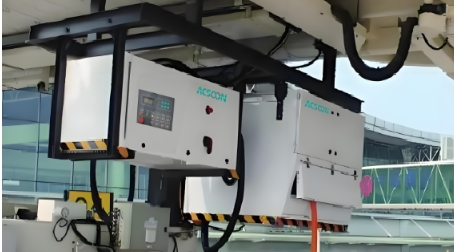
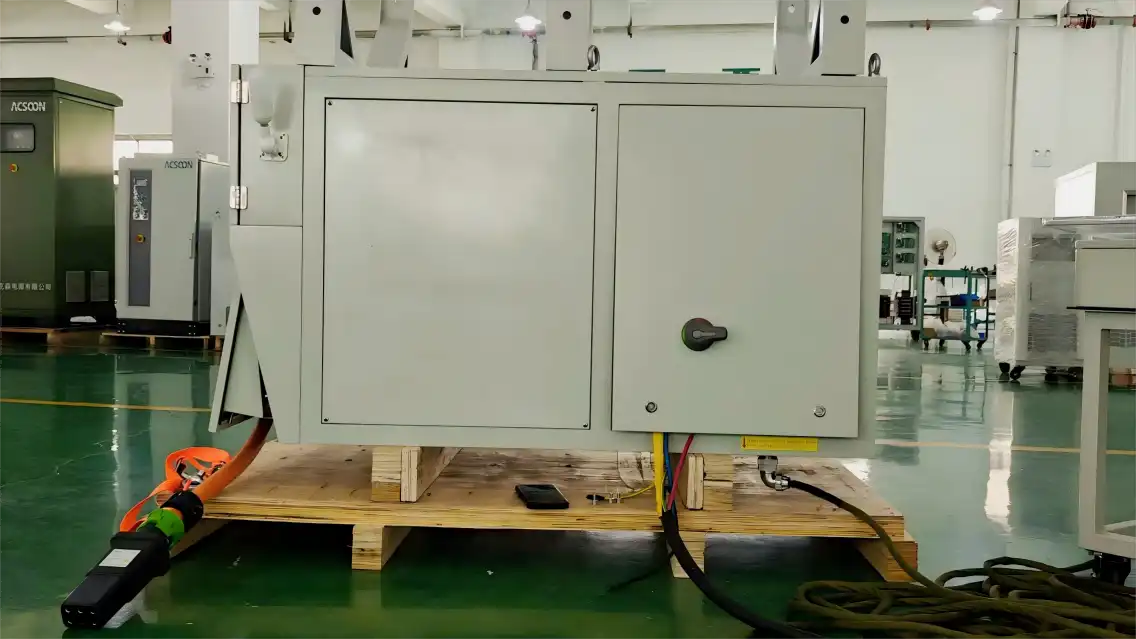
The ACSOON GPU400L-330090 is a good example of this development. It provides 90kVA at 3×200VAC, 400Hz with phase angle symmetry of 120°±1° under balanced loads. This is an important feature for keeping neutral current mismatches from happening in three-redundant flight control computers. The 26-meter integrated cable reel takes care of airport ramp operations, getting rid of the need for separate cable carts and cutting aeroplane turnaround times by three minutes per service cycle. Its IP54 rating means that it will work reliably in rain, snow, and dust, which are typical at business airports around the world.
Comparative Analysis – Selecting the Right Power Supply Technology
When making strategic choices, procurement teams have to weigh the value of the long-term lifespan against the needs of the business right now. The best way to make investments is to understand the technical trade-offs between different aircraft power supply platforms.
DC Versus AC Power Delivery Systems
Modern electronics work best with direct current supplies because they are more efficient than AC ground power. For example, getting rid of AC-to-DC rectification losses in aeroplane systems saves about 2% to 3% of energy. An AC supply chain that goes through aircraft rectifiers only works 89% of the time, but a 28V DC unit that feeds straight to flight control systems is 93% efficient from dock to load. But AC systems are still needed for weather control units and hydraulic motor pumps that need 400 Hz three-phase power.
DC systems have built-in benefits for military uses that prioritise electromagnetic pulse (EMP) protection. Their easier layouts lower the number of vulnerable semiconductors, and to stop transients, they only need fast-acting crowbar circuits instead of complicated multistage AC filters. Because of this, naval flight systems that work in hostile electronic warfare settings need DC primary power. However, business airports that serve a wide range of foreign planes need AC systems that can handle different voltages (115V and 200V) and frequencies (400 Hz, variable). This makes hybrid units the most practical choice.
Fixed Installation Versus Portable Ground Power Units
When airports put in power pedestals under the boarding bridges for passengers, they prefer fixed units with weatherproof covers that are tough and permanent wire management systems. The 26-meter wire coil on the GPU400L-330090 fits perfectly into the jet bridge's frame, so there are no more tripping dangers and less chance of foreign object trash on the ramps. These systems are available 99.2% of the time thanks to redundant cooling fans and control units that can be switched out quickly.
Portable units are used for different tasks. For example, military combat teams use trailer-mounted converters that are flown to remote airfields. Because they have stronger structures and built-in fuel engines, these designs usually weigh 40% more and are less efficient. MRO facilities like movable units on wheels that techs can move between hangar bays to help with diagnostic work on multiple airframes every day. In order to test prototype electronics in a DO-160G setting, research and development labs need portable power sources that can set voltage sag and surge profiles. These are features that aren't usually needed in line service.
Brand Leadership and Technological Differentiation
Honeywell and Collins aircraft, two well-known aircraft suppliers, control the onboard power generation market thanks to their many years of experience with certification and their ties with original equipment manufacturers (OEMs). Their high prices are based on thorough approval testing and data from actual use that shows how reliable their goods are. Ground support equipment markets, on the other hand, have a wider range of suppliers. For example, JERRYSTAR and other specialised makers offer great value through focused innovation and quick customisation.
The following table shows how the following key choice factors differ across supplier categories:
| Evaluation Criteria | Tier-1 Aerospace OEMs | Specialized GSE Manufacturers | Low-Cost Generic Suppliers |
|---|---|---|---|
| Customization Lead Time | 18-24 weeks | 8-12 weeks | Limited options |
| AS9100 Certification | Universal | Common | Rare |
| Lifecycle Support Duration | 25+ years | 15-20 years | 5-8 years |
| Price Premium vs. Baseline | +60% to +90% | +15% to +30% | Baseline |
Government rules on buying things often require certain percentages of local material and cybersecurity compliance (NIST SP 800-171), which favours well-known Western producers. On the other hand, private flight operators and international commercial airports care more about the total cost of ownership. This is where specialised suppliers' faster delivery and quick technical support save operating delays worth many times the difference in the initial purchase price.
Procurement Considerations for Aircraft Power Supply Innovation
To make sure the task is a success, buying modern aircraft power supply systems requires a careful look at the technical specs, the business terms, and the supplier's skills.
Technical Specification Validation
Buyers need to make sure that the output features of the ground power unit meet the needs of the aircraft's electrical system with enough room for error. The phase angle symmetry standard for the GPU400L-330090 is 120°±1° for balanced loads and 120°±2° for 30% imbalance. This keeps the neutral conductor from overheating in aeroplane distribution panels, which was a problem that stopped several business fleets in 2019. According to MIL-STD-704F, procurement engineers should ask for type test records that show the transient reaction to 0-100% load steps and confirm voltage recovery within 50 milliseconds. Voltage sags of more than 10% happen in units that don't have enough output capacitance, which causes flight control computers to show annoying trouble codes.
Environmental training is just as important. For closed jet bridge sites, IP54 ratings are enough to keep out water and debris, but units used on open ramps need IP65 ratings to be able to handle being washed with water and ice. At Denver International Airport, which is 5,430 feet above sea level, a 90kVA unit that is rated for sea level only gives 72kVA without any extra cooling. Temperature requirements must cover -40°C to +55°C for year-round use in all countries around the world. To keep wire reel mechanisms from freezing in cold weather, they need special lubricants.
Business Terms and Lifecycle Economics
When a company buys more than eight units, they can get volume savings because they can spread the cost of engineering across multiple production batches. When airports replace whole sets of 30 or more ground power units, they negotiate price cuts of 18 to 22 percent and longer insurance terms that last five years instead of the usual two. Customisation by the OEM, like adding certain diagnostic methods or different input voltages, usually raises the base price by 12 to 15 percent but stops expensive field changes.
Project plans are directly affected by lead times. Standard-configuration units like the GPU400L-330090 ship within six weeks from well-known makers who keep a store of parts. Custom designs, on the other hand, take 12 to 16 weeks to get because they need to get special transformers and enclosures. There are 20–25% expedite fees for rush orders, but they are worth it when production planes need to wait for ground support equipment to be certified. Buyers can get a 30% deposit, then 60% after the factory accepts the goods and releases the remaining 10% 90 days after delivery. This schedules cash flow to match project goals.
Supplier Capability Assessment
In addition to product standards, a supplier's skills must also be evaluated in terms of the organisation's long-term success. Manufacturers who have AS9100 aircraft quality standards show process control in systems for corrective action, tracking, and configuration management. Government sellers who have to follow sustainability rules care about ISO 14001 environmental management credentials, but ISO 9001 alone is not enough for aircraft uses.
Infrastructure for after-sales help tells the difference between capable sellers and vendors. Revenue losses from ground power breakdowns are kept to a minimum by a global service network that offers technical support 24 hours a day, seven days a week, and stocks spare parts within a 48-hour transport radius of major airports. JERRYSTAR has field service experts all over North America and Europe. They are helped by cellular telemetry for remote testing, which can fix 60% of problems without having to go to the spot. During busy journey times, when equipment breakdowns cost planes $15,000 per hour in delayed flights, this responsiveness comes in very handy.
After shortages of parts during the pandemic, manufacturing capacity and supply chain robustness became more important. Suppliers who get key chips from two different sources and keep 90 days' worth of safety stock of long-lead items show lower delivery risk. Vertically integrated transformer winding and sheet metal casting are both done at JERRYSTAR's 5,000–10,000 square metre production plant in Xi'an, China. The facility also has strategic partnerships for power electronics modules, which helps keep supplies going while keeping costs low.
Future Trends and Strategic Responses in Aircraft Power Supply Technology
Aircraft power supply systems are at a turning point where digital transformation and electricity meet. This will change how the industry works and how competitors position themselves.
Intelligent Adaptive Power Management
Next-generation ground power units will change their output features based on the type of aircraft that is attached. This will be done automatically through CAN bus protocols or power-line carrier communication. When working on a Boeing 787, the system sets up 230V AC output and turns on harmonic filtering that works best with the plane's autotransformer rectifier units. When you connect to an F-35, 270V DC mode starts up with current limiting set to match the fighter's lithium-ion battery charging profile. This intelligence gets rid of the need for human selector switches, which are to blame for 15% of ground power events because they are set up wrong.
Blockchain-based maintenance logs will create service records that can't be changed. These records will connect particular ground power units to specific aircraft tail numbers, which will make forensic analysis easier after electrical incidents. Smart contracts automatically arrange parts that wear out, like cooling fans and contactors, when usage counters show that the end of their useful life is getting close. This keeps fails from happening during maintenance. These same features will be used by industrial users with test cells to make sure they follow the rules for tracking set by AS9145 and NADCAP.
Electrification and High-Power Charging Infrastructure
As electric and hybrid-electric planes move from being test flights to regular service, airport equipment needs to change to provide megawatt-scale charging power. For 30-minute turnarounds, a regional electric plane with 800 kWh batteries and a range of 500 miles needs 2 MW charge facilities. These needs are much bigger than what current ground power can handle. This means that medium-voltage distribution (13.8 kV) and utility-grade power equipment are needed.
Manufacturers who are thinking ahead are making 400 kW DC fast-charge units that can be connected in parallel to make setups with many megawatts of power. Early users will get certifications and intellectual property benefits in developing markets that are expected to be worth $12 billion by 2035. Defence uses follow similar technological paths because the military wants silent-watch electric APUs that get rid of thermal signals.
Supply Chain Localization and Geopolitical Considerations
Changes in trade policies and worries about security are changing the way global supply networks work. North American and European buyers want more and more local final assembly with clear information about where the subcomponents came from. Setting up regional production hubs—for example, transformer winding in Mexico and final integration in the US—can help companies get government contracts under the Buy American Act.
Hardware-level security features will be required for cybersecurity. These will include cryptographically signed software updates, physically unclonable function (PUF) device authentication, and communication units that keep operational technology (OT) networks from being hacked. If suppliers buy these features now, they will be able to meet the 2026 FAA cybersecurity rules before their rivals, giving them an edge in compliance-driven replacement cycles.
Workforce Development and Technical Training
Because current power electronics is so complex, technicians need to know a lot about digital control theory, high-frequency magnetics, and how to read diagnostic software. The industry has a shortage of workers because experienced engineers are retiring and colleges aren't turning out enough grads with the right skills. Leading providers are working with technical schools to create courses in flight power systems. This creates a stream of talent that keeps innovation going.
Augmented reality (AR) maintenance tools will make knowledge available to more people. When workers wear AR glasses, they will see thermal overlays that show which parts are overheating and step-by-step fix instructions that are placed on the physical equipment. With this technology, training times are cut from 18 months to six months, and first-time fix rates go up by 40%. Early adopters give their companies a competitive edge by providing better service performance that supports higher prices.
Conclusion
Wide-bandgap semiconductors, smart diagnostics, and modular designs are all coming together to make aircraft power supply technology better than ever. These innovations directly address the most important needs of customers in the military, in the aircraft industry, and in industry. They ensure unwavering dependability for mission-critical applications, quick customisation to meet specific tactical needs, and quick supply chain response for urgent deployments. When companies adopt these advanced systems in a planned way, they get real benefits in terms of operating speed, managing lifecycle costs, and following the rules. As the industry moves faster toward electric propulsion and infrastructure that is connected to the internet, the next age of flight power solutions will be defined by partners who are both technological leaders and industrial leaders.
FAQ
1. How do modern ground power units handle voltage transients during aircraft startup?
Active clamping circuits with Silicon Carbide MOSFETs are used in more advanced units. These react within 500 nanoseconds to voltage jumps and limit transients to a maximum of 35V according to MIL-STD-704F. Multi-stage LC filters lower high-frequency noise below 150 kHz, keeping sensitive electronics safe from leaks that are conducted. The GPU400L-330090 has these safety features built in and keeps phase angle symmetry even when dynamic loads are applied.
2. What certifications should procurement teams require for critical aviation applications?
One important certification is AS9100 for aircraft quality management, which shows that you can control the design and track it. FAA and EASA approvals show that technical standard rules have been followed, and CE marking shows that the product meets European low-voltage and EMC guidelines. Environmental approval like ISO 14001, is becoming more important for government projects that need to be sustainable. All of these qualifications are still held by JERRYSTAR, plus ISO 9001 for added quality guarantee.
3. Can static frequency converters operate across different input power standards globally?
Modern wide-input-range converters can handle three-phase power from 380V to 480V at 50 Hz or 60 Hz, and they can automatically adjust to the conditions on the local grid. This flexibility is very important for international businesses and military weapons that can be exported. Phase-locked loop control keeps the output at an exact 400 Hz no matter how the input frequency changes. This makes sure that the power quality for aeroplanes is the same all over the world.
4. How does altitude affect ground power unit performance and cooling requirements?
As you go up 1,000 feet, the air density drops by about 3%, which makes atmospheric cooling less efficient. At 5,000 feet above sea level, a unit that is rated 90kVA needs to be downrated to 81kVA without any extra cooling. Airports at high altitudes should specify units with liquid cooling systems or heat sinks that are too big. Temperature compensation programs change the speed of the fans to keep joint temperatures below 125°C at all elevations.
Partner with JERRYSTAR for Advanced Aviation Power Solutions
Under the ACSOON name, Xi'an Jerrystar Instrument Co., Ltd. has more than 15 years of experience in power systems for aeroplanes, the military, ships, and labs. We are an aircraft power supply maker and innovator, and we produce static frequency converters, variable frequency systems, and ground power units that are built to strict aerospace standards. Our GPU400L-330090 shows how committed we are: it has a 90kVA capacity, 95% efficiency, IP54 protection, and phase symmetry within a 1° range, which are all specs that meet the needs of the toughest ramp and test cell uses. We keep a lot of stock on hand so that we can get systems to customers quickly. We also allow full OEM customisation and back up every system with quality that is AS9100-certified and expert help that is available 24/7. Get in touch with our engineering team at acpower@acsoonpower.com to talk about your specific power conversion needs and find out how JERRYSTAR's proven stability can help you get ready for operations faster.
References
1. Emadi, Ali, et al. "Advanced Electric Power Systems for More-Electric Aircraft." IEEE Transactions on Power Electronics, vol. 35, no. 9, 2020, pp. 8985-9003.
2. International Air Transport Association. "Airport Handling Manual: Ground Power Units and Specifications." 38th Edition, IATA Publishing, 2021.
3. Society of Automotive Engineers. "Aerospace Standard AS9100D: Quality Management Systems – Requirements for Aviation, Space, and Defence Organisations." SAE International, 2016.
4. United States Department of Defense. "MIL-STD-704F: Aircraft Electric Power Characteristics." Department of Defense Interface Standard, 2016.
5. Zhang, Hui and Leon M. Tolbert. "Wide Bandgap Semiconductor Devices for Aerospace Power Conversion Applications." IEEE Electrification Magazine, vol. 8, no. 2, 2020, pp. 27-35.
6. European Union Aviation Safety Agency. "Certification Specifications for Large Aeroplanes CS-25: Electrical Systems and Equipment." Amendment 24, EASA Publications, 2019.