




Why Do Aircraft Use a 400Hz Power Supply Instead of 50/60Hz?
Aircraft rely on specialized electrical systems operating at 400 Hz frequencies rather than the standard 50/60 Hz found in commercial and industrial applications. This frequency choice stems from aviation's demanding requirements for lightweight, compact, and highly efficient power systems. The 400hz power supply aircraft systems enable significant weight reduction in transformers and motors while maintaining superior performance characteristics essential for flight operations, making them indispensable for modern aviation electrical infrastructure.
Understanding the Basics of 400Hz Power Supply in Aircraft
Aviation electrical systems operate under fundamentally different constraints compared to ground-based applications. Aircraft power supplies must deliver consistent, reliable electricity while minimizing weight and space consumption—two critical factors that directly impact fuel efficiency and payload capacity.
What Makes 400Hz Different in Aviation Applications?
A 400hz power supply aircrafts alternating current is eight times faster than commercial electricity. Electrical components can be smaller and lighter while producing the same power due to the higher frequency. Avionics, lighting, environmental control systems, and other vital aircraft components receive clean, reliable power from 115V AC or 200V AC, three-phase aviation electrical systems.
Frequency affects transformer and motor design. Higher frequencies allow transformers with smaller magnetic cores, lowering weight and size. Optimization saves pounds, improving fuel efficiency and range in modern airplanes.
Technical Specifications Critical for Aerospace Applications
Aviation power supply has strict technical requirements that exceed commercial standards. Parameters to consider include voltage regulation within ±2%, frequency stability within ±1%, and total harmonic distortion below 5%. These criteria ensure critical avionics equipment compatibility and operational reliability under different flight situations.
Waveform quality is crucial in airplane applications because electromagnetic interference can hinder navigation and communication. Clean sinusoidal output with little distortion eliminates radio interference and assures flight-critical instrument accuracy.
Why Aircraft Use 400Hz Instead of 50/60Hz — Dimensional Analysis Approach?
The transition to 400Hz in aviation occurred during the mid-20th century as aircraft designers recognized the need for more efficient electrical systems. Military aviation pioneered this technology, driven by weight constraints in fighter aircraft and bombers, where every ounce mattered for performance and mission capability.
Historical Development and Technological Evolution
DC electrical systems were used in early airplanes, but power demands required AC alternatives. By increasing frequency from 60Hz to 400Hz, engineers found significant gains without affecting system stability. This frequency was standardized in military and commercial aviation, establishing a compatible ecology.
Standardization required comprehensive aircraft type testing and certification. Technical standards were developed by aviation authorities and manufacturers to balance performance, manufacturing, and maintenance.
Weight and Size Reduction Benefits
The main benefit of 400hz power supply aircrafts is component downsizing. 400Hz transformers need cores about 1/8 the size of 60Hz ones. Most aviation transformers weigh 50-70% less than commercial ones.
Higher frequency operating benefits motors, too. Due to the link between frequency and magnetic flux density, 400Hz motors can provide the same torque with less weight. Aircraft environmental control systems, hydraulic pumps, and fuel system components use these benefits to reduce weight.
Efficiency and System Responsiveness Improvements
Higher frequency operation improves flight control and navigation system responsiveness. Faster switching improves electrical load control and regulation under different operating situations.
The 400Hz operation boosts power conversion efficiency. Inverters and switching power supplies perform more effectively at higher frequencies, decreasing heat and enhancing system reliability. During extended flight operations, electrical system performance directly affects safety, making this efficiency gain essential.
Comparative Analysis: 400Hz vs. 50/60Hz Power Supply in Aviation
Understanding the performance differences between 400Hz and standard frequency systems helps procurement teams make informed decisions about aircraft electrical infrastructure. The comparison reveals distinct advantages that justify the additional complexity and cost associated with specialized aviation power systems.
Efficiency and Reliability Comparison
400Hz aircraft have higher electrical efficiency than 50/60Hz ones. More effective power conversion reduces heat and extends component life at higher frequencies. According to reliability studies, appropriately built 400Hz systems have a mean time between failures above 10,000 hours under typical aircraft operating conditions.
Standard frequency systems need larger components to work similarly, and cascading affects on aircraft design. Additional weight would require bigger fuel loads, lowering payload, and raising running expenses.
Solid-State vs. Rotary Converter Technology
Many modern airplanes use solid-state frequency converters instead of rotary systems. Solid-state units are more reliable, efficient, and low-maintenance. Variable frequency output allows aircraft system improvement.
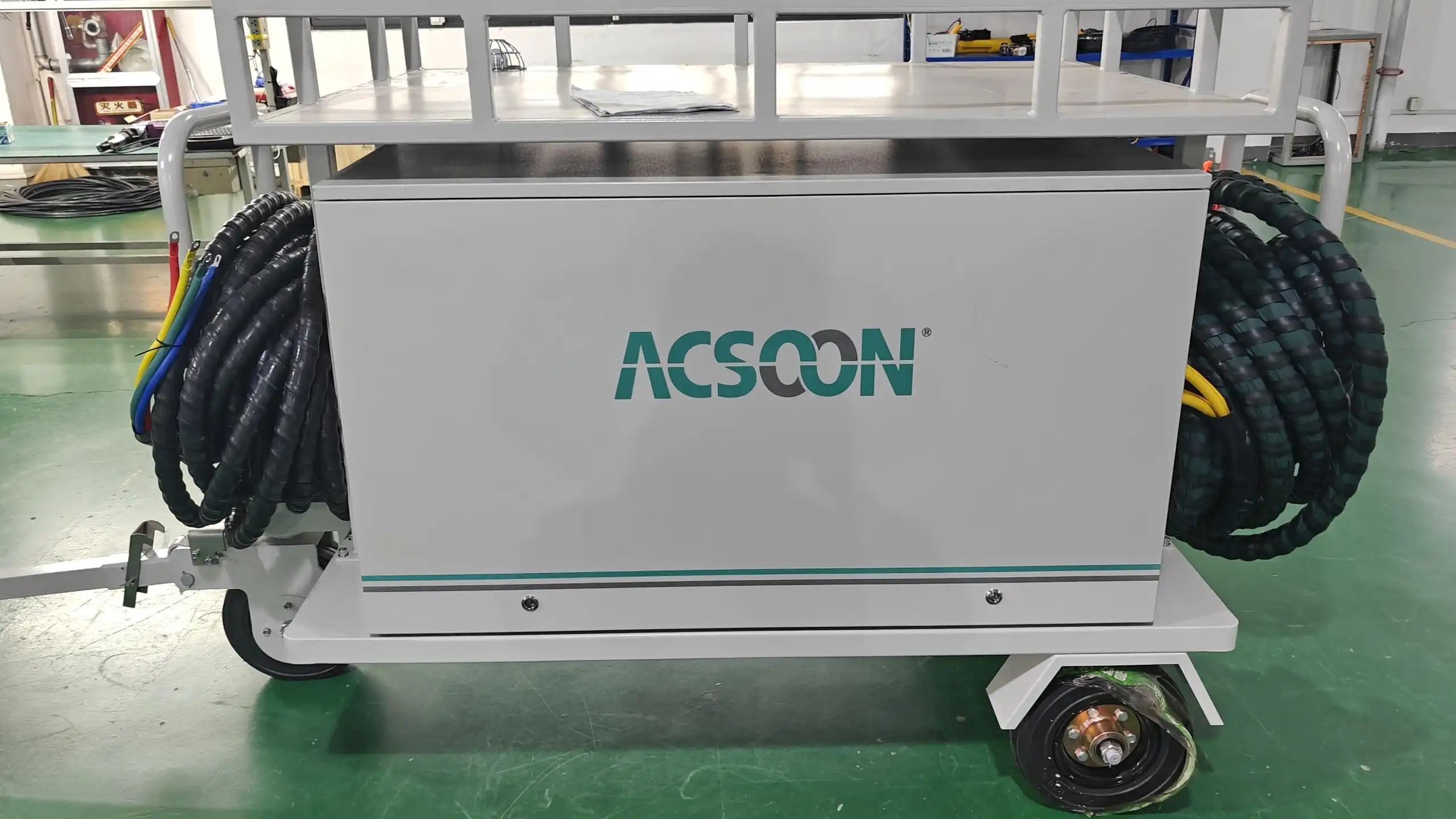
The ACSOON GPU400-330090 uses superior solid-state technology to produce 90KVA of power with precise frequency control. The transportable trolley design allows flexible deployment across aircraft types while protecting against outdoor conditions with IP54.
Real-World Performance in Aviation Environments
Standardized 400Hz systems improve commercial flight operations. Ground support equipment works smoothly across aircraft types, simplifying maintenance and training. Military applications benefit from 400Hz systems' strong performance under high altitude, temperature, and electromagnetic interference.
Aviation's 400Hz commitment has matured the supply chain with optimized component makers. New aircraft and retrofit applications for existing aircraft with electrical system modifications are supported by this ecosystem.

Selecting and Procuring 400Hz Power Supply Units for Aircraft
Procurement decisions for aircraft electrical systems require careful consideration of multiple factors beyond initial purchase price. The specialized nature of aviation applications demands suppliers with proven track records and comprehensive support capabilities.
Performance Metrics and Reliability Criteria
Key procurement criteria include voltage regulation accuracy, frequency stability, harmonic distortion levels, and environmental operating ranges. Buyers should evaluate suppliers based on their ability to meet aviation-specific certifications, including DO-160 environmental testing and applicable airworthiness standards.
Reliability metrics become particularly important given the critical nature of aircraft electrical systems. Mean time between failures, repair time requirements, and parts availability all influence the total cost of ownership over the equipment lifecycle.
Leading Manufacturers and Industry Standards
Aviation power supply manufacturers have decades of aerospace experience. Honeywell, Collins Aerospace, and other major suppliers offer product lines for general aviation and big commercial carriers.
New suppliers offer competitive pricing and innovative technologies. New manufacturers should be assessed for technical expertise, quality, and supplier viability. The specialized nature of aircraft applications needs vendors with aviation and regulatory compliance expertise.
Procurement Process Considerations
Depending on customization, airplane power supply equipment lead times can range from weeks to months. Planning and strategic inventory for crucial applications are important for procurement teams. Custom solutions may take longer to create and test for certification.
Cost of ownership should include installation, training, maintenance, and parts availability while negotiating prices. Long-term supplier partnerships are typically better than lowest-cost purchasing, especially for aircraft electrical systems that require specialist support.
JERRYSTAR's Advanced 400Hz Power Supply Solutions
Xi'an Jerrystar Instrument Co., Ltd. brings over 15 years of specialized expertise in aviation power conversion technology, establishing ourselves as a trusted supplier in the aerospace market. Our comprehensive understanding of aircraft electrical requirements enables us to deliver solutions that meet the demanding specifications of modern aviation applications.
Our ACSOON Product Portfolio
Our flagship GPU400-330090 model represents the latest advancement in solid-state frequency converter technology. This 90KVA unit converts standard 3-phase 380V, 50Hz input power to precise 3-phase 115V/200V, 400Hz output suitable for aircraft ground support and testing applications. The mobile trolley configuration provides operational flexibility across different aircraft types and maintenance scenarios.
The unit's advanced control systems maintain voltage regulation within strict tolerances while providing variable output capabilities. Short circuit protection, controlled voltage error management, and precise crest factor control ensure reliable operation with sensitive avionics equipment. The IP54 protection rating enables operation in challenging environments typical of aircraft maintenance facilities.
Quality Assurance and Compliance Standards
We use international aviation-standard quality control in our manufacturing operations. Thermal cycling, vibration testing, and electromagnetic compatibility testing are performed on each device. All production units perform consistently under our quality control system.
ACSOON stands for reliability and technical excellence. We invest in aviation technology and maintain certifications to fulfill industry needs. We serve avionics production, radar equipment testing, and ground support operations.
Customer Support and Technical Expertise
We offer complete procurement and implementation help from our technical staff. Working with customers to maximize performance, we design tailored solutions for unique applications. Our global service network provides fast technical help and parts.
Long-term collaborations with clients let us identify changing needs and create future solutions. We have enough inventory to offer conventional products quickly and customize them for unique purposes.
Conclusion
The aviation industry's adoption of 400hz power supply aircrafts the critical importance of optimized electrical infrastructure in aircraft design. The substantial benefits in weight reduction, component efficiency, and system performance justify the specialized requirements and costs associated with these systems. Modern solid-state technologies continue to advance the capabilities of 400Hz power supplies, providing enhanced reliability and operational flexibility. As aircraft systems become increasingly sophisticated, the role of high-quality power conversion equipment becomes even more critical for ensuring safe, efficient flight operations.
FAQ
Why is 400Hz specifically chosen over other high frequencies?
The 400Hz frequency represents an optimal balance between component miniaturization benefits and practical engineering constraints. Higher frequencies would provide additional size reductions but create challenges with electromagnetic interference, component heating, and manufacturing complexity. The aviation industry standardized on 400Hz after extensive testing determined it provided the best combination of performance benefits and reliability.
Can older aircraft be retrofitted with modern 400Hz systems?
Retrofitting older aircraft with updated 400Hz systems is technically feasible but requires careful engineering analysis. The retrofit process must consider existing electrical infrastructure, available space, weight distribution, and regulatory compliance requirements. Many successful retrofits have been completed, often as part of broader avionics upgrade programs that modernize multiple aircraft systems simultaneously.
What maintenance requirements are specific to 400Hz aircraft power systems?
Maintenance requirements for 400Hz systems focus primarily on preventive care, including regular inspections, connection integrity verification, and performance testing. Solid-state systems generally require less maintenance than rotary converters, with typical service intervals extending several thousand operating hours. Proper training for maintenance personnel ensures optimal system performance and longevity.
How do environmental conditions affect 400Hz power supply performance?
Aviation-grade 400Hz power supplies are designed to operate across wide temperature ranges and altitude conditions typical of aircraft operations. Environmental testing validates performance under extreme conditions including temperature cycling, humidity exposure, and vibration. Proper installation and environmental protection ensure reliable operation throughout the aircraft's operational envelope.
Partner with JERRYSTAR for Your Aviation Power Supply Needs
Xi'an Jerrystar Instrument Co., Ltd. stands ready to support your aircraft electrical system requirements with our proven ACSOON technology and comprehensive technical expertise. As a leading 400hz power supply aircraft manufacturer, we deliver customized solutions backed by responsive customer service and competitive pricing. Our experienced engineering team collaborates with customers to optimize power system performance while ensuring compliance with aviation standards. Contact us at acpower@acsoonpower.com to discuss your specific requirements and discover how our advanced frequency converter technology can enhance your aircraft operations with reliable, efficient power conversion solutions.
References
1. Aircraft Electrical Systems Engineering Handbook, Society of Automotive Engineers International, 2019.
2. Federal Aviation Administration Advisory Circular AC 25.1351-1, "Electrical Systems and Equipment Installation Guidelines for Transport Category Aircraft," 2018.
3. Institute of Electrical and Electronics Engineers Standard 519, "Recommended Practice and Requirements for Harmonic Control in Electric Power Systems," 2022.
4. Aviation Week & Space Technology, "Power Systems Evolution in Commercial Aircraft Design," Technical Analysis Report, 2021.
5. International Air Transport Association Technical Manual, "Aircraft Ground Support Equipment Standards and Specifications," 2020.
6. Aerospace Industries Association Publication AIR-1845, "Guidelines for Aircraft Electrical Power Quality and Distribution Systems," 2019.