




400hz Ground Power Supply: Is Mobile or Fixed Installation Better?
For aviation operators, MRO facilities, and airport infrastructure planners across Southeast Asia—especially in Singapore, Malaysia, and Vietnam—the selection of a reliable 400hz ground power supply is not only a technical decision but also a long-term infrastructure investment. Fixed systems are widely used in high-throughput international airports such as Changi Airport and KLIA, where consistent gate assignments demand stable and centralized power delivery. Mobile systems, on the other hand, are increasingly preferred in regional airports, military bases, and maintenance hangars where operational flexibility is a priority. Both systems deliver standardized 115V/200V 400Hz aviation power compliant with MIL-STD-704F, but their installation logic, lifecycle cost, and operational efficiency differ significantly.

Understanding 400Hz Ground Power Supply Technology
Why Aviation Uses 400Hz Power Standard
The 400Hz ground power supply standard exists primarily for one reason: weight reduction and power density optimization.
At higher frequency:
- Transformer size decreases
- Copper usage reduces
- Magnetic core volume shrinks
- Total system weight drops by up to 70%
This is critical in aviation environments where every kilogram affects fuel consumption.
Core Engineering Principle
| Parameter | 50/60Hz Systems | 400Hz Systems |
|---|---|---|
| Transformer size | Large | Compact |
| Weight impact | High | Low (-70%) |
| Power density | Low | High |
| Aircraft compatibility | Not suitable | Fully compatible |
| Fuel efficiency impact | Negative | Optimized |
The ACSOON GPU400-330075 solid-state converter demonstrates how modern designs maintain THD < 3% while ensuring stable 400Hz output for avionics, radar, and flight control systems.
Solid-State Conversion Advantages
Modern systems replace rotary converters with IGBT-based digital power conversion.
Key benefits include:
- Faster transient response
- Lower maintenance requirements
- Higher efficiency (typically 90–93%)
- Stable sine wave output
Mobile vs Fixed 400Hz Ground Power Supply Systems
System Architecture Comparison
The core decision revolves around infrastructure integration versus operational flexibility.
| Aspect | Mobile System | Fixed Installation |
|---|---|---|
| Deployment flexibility | High | Low |
| Installation cost | Low | High |
| Power stability | Medium–High | Very High |
| Maintenance access | Easy replacement | Scheduled maintenance |
| Scalability | High | Limited by design |
| Best use case | MRO, military, remote stands | Major airports, fixed gates |
Both configurations rely on the same 400hz ground power supply technology, but operational logic differs significantly.
Operational Trade-Off Analysis
1. Fixed Installation Advantages
Fixed systems are preferred in:
- International airports (e.g., Singapore Changi)
- High-turnover gates
- Long-duration aircraft parking
They offer:
- Direct grid integration
- Higher continuous load capacity
- Reduced operator handling errors
2. Mobile System Advantages
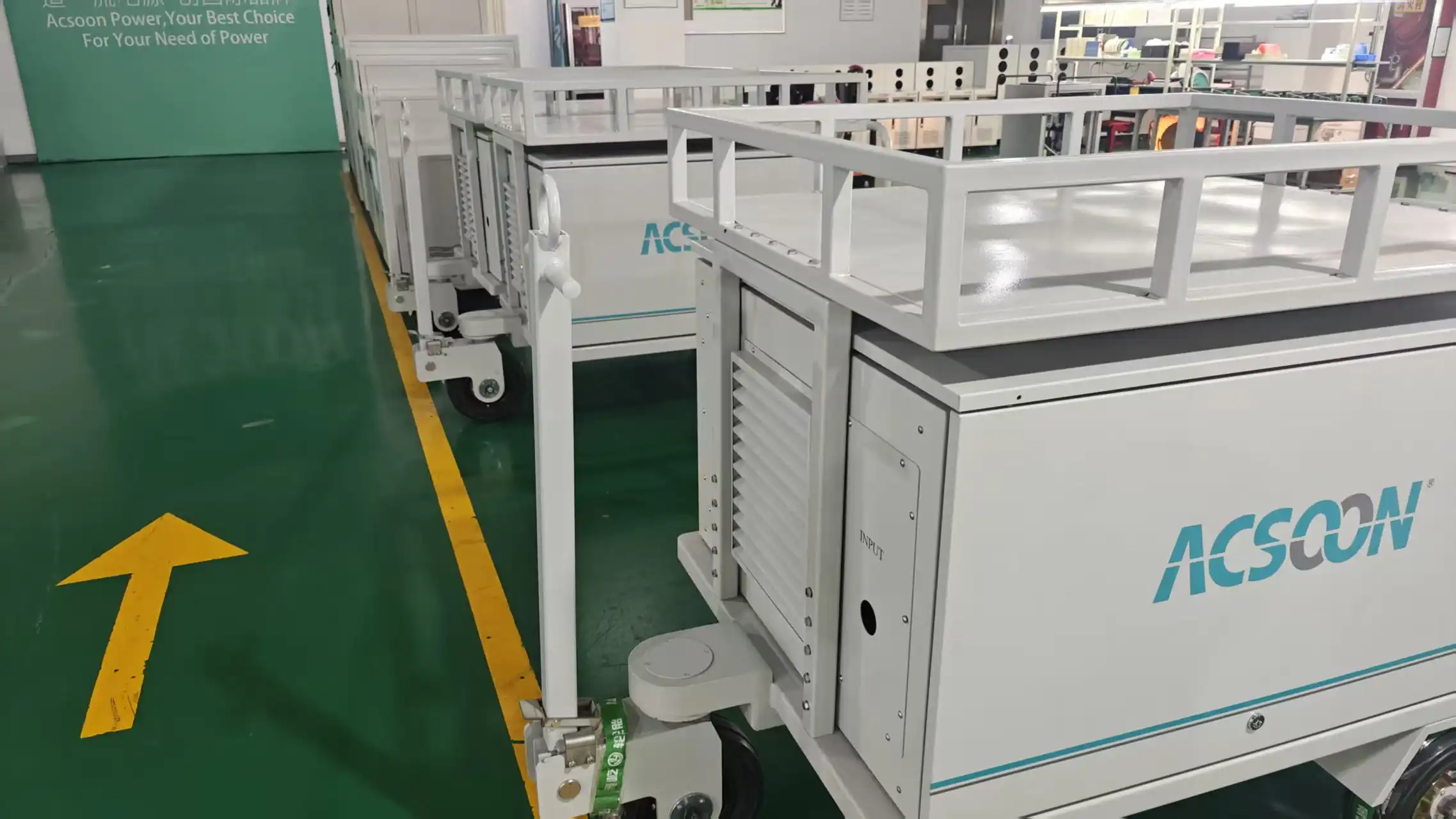
Mobile GPU units like trolley-mounted ACSOON models are widely used in:
- Military airbases
- Aircraft maintenance hangars
- Remote apron operations
Advantages include:
- No civil infrastructure required
- Rapid redeployment between aircraft
- Emergency backup capability
Cost Structure Comparison (Lifecycle Perspective)
| Cost Factor | Mobile System | Fixed System |
|---|---|---|
| Initial CAPEX | Low | High |
| Civil engineering cost | None | Significant |
| Maintenance cost | Medium | Low |
| Labor cost per operation | Higher | Lower |
| ROI timeline | Short-term | Long-term |
For Southeast Asian airports with expanding infrastructure (Vietnam, secondary airports in Malaysia), mobile systems often provide faster ROI during early expansion phases.
How to Choose the Right 400Hz Ground Power Supply System
Capacity and Aircraft Compatibility
Different aircraft types require different load capacities.
| Aircraft Type | Typical Power Demand | Recommended System Size |
|---|---|---|
| Business jet | 20–40 kVA | Small mobile GPU |
| Narrow-body aircraft | 40–90 kVA | Medium fixed/mobile |
| Wide-body aircraft | 90–180 kVA | Fixed high-capacity unit |
A properly sized 400hz ground power supply ensures stable avionics operation and avoids undervoltage issues during peak load conditions.
Environmental Considerations (Southeast Asia Focus)
Southeast Asia introduces unique operational challenges:
- High humidity (70–95%)
- Coastal corrosion (salt exposure)
- High ambient temperature (35–45°C)
Recommended Protection Levels
| Environment | Recommended IP Rating | Notes |
|---|---|---|
| Indoor hangar | IP54 | Standard protection |
| Coastal airport | IP55–IP65 | Anti-corrosion required |
| Outdoor apron | IP65+ | Heavy rain + dust protection |
Procurement Decision Matrix
| Factor | Weight in ASEAN Market | Impact on Decision |
|---|---|---|
| Initial investment | High | Influences mobile preference |
| Reliability | Very High | Favors fixed systems |
| Flexibility | High | Supports mobile adoption |
| Maintenance capability | Medium | Depends on local workforce |
| Supplier support | Very High | Critical for uptime |
Installation and Safety Standards
Electrical Infrastructure Requirements
Proper installation of a 400hz ground power supply must consider:
- Ground resistance < 5 ohms
- Shielded low-impedance cabling
- Load balancing across phases
- Voltage drop compensation systems
Cable Performance Consideration
| Parameter | Standard Power | 400Hz Aviation Power |
|---|---|---|
| Reactance impact | Low | High |
| Voltage drop sensitivity | Medium | High |
| Cable design requirement | Standard | Low-impedance aviation grade |
Safety Compliance Standards
All systems must comply with:
- MIL-STD-704F (Aircraft power quality)
- DO-160G (Environmental testing)
- IEC aviation grounding standards
These ensure compatibility with international aircraft fleets operating across ASEAN hubs.
Maintenance Strategy for Mobile vs Fixed Systems
Preventive Maintenance Comparison
| Maintenance Task | Mobile System | Fixed System |
|---|---|---|
| Cable inspection | Monthly | Quarterly |
| Cooling system check | Monthly | Quarterly |
| Power calibration | Quarterly | Semi-annual |
| Full system overhaul | Annual | Annual–biannual |
Mobile systems require more frequent mechanical inspection due to movement and connector wear.
Common Fault Diagnosis
Typical issues in 400hz ground power supply systems include:
- Output voltage fluctuation
- Overtemperature shutdown
- Frequency instability (rare in solid-state systems)
- Connector wear in mobile units
Digital monitoring systems (like ACSOON GPU series) simplify diagnostics via real-time LCD display and fault logging.
Future Trends in 400Hz Ground Power Supply Systems
Smart Airport Integration
Next-generation systems include:
- IoT-based monitoring
- Predictive maintenance analytics
- Remote load control
- Automated billing integration
Energy Efficiency Evolution
| Technology Trend | Impact |
|---|---|
| SiC semiconductors | Higher efficiency (>95%) |
| Digital control loops | Faster response time |
| Hybrid energy systems | Lower grid dependency |
Southeast Asian airports are increasingly adopting hybrid solar + grid + GPU systems to reduce operational costs.
Conclusion
Choosing between mobile and fixed 400hz ground power supply systems depends on operational structure, airport maturity, and long-term infrastructure planning.
- Fixed systems deliver maximum efficiency for high-traffic international airports
- Mobile systems provide unmatched flexibility for expanding or distributed operations
- Many ASEAN facilities adopt hybrid models for optimal ROI and scalability
For procurement teams in Vietnam, Malaysia, and Singapore, the most effective strategy is not choosing one over the other—but balancing both according to operational density and growth trajectory.
FAQ
Why does aviation use 400Hz instead of standard 60Hz power?
The 400Hz frequency enables dramatic reductions in transformer and motor size because magnetic core volumes decrease inversely with frequency. This allows aircraft electrical systems to achieve weight savings of up to 70%, directly improving fuel efficiency and payload capacity. Ground support equipment maintains this frequency to ensure compatibility with aircraft systems designed for 400Hz operation.
Can mobile GPU units deliver the same power quality as fixed installations?
Modern mobile units equipped with advanced voltage regulation and automatic compensation systems achieve power quality matching fixed installations. The ACSOON GPU400-330075 features automatic output voltage compensation that actively adjusts for cable losses, maintaining tight regulation at aircraft connection points. The key difference lies in continuous capacity rather than quality—fixed installations typically support higher sustained power levels over extended periods.
What maintenance differences exist between mobile and fixed configurations?
Mobile units require more frequent inspection of mechanical components, cables experiencing flexing stress, and connectors subjected to repeated mating cycles. Fixed installations concentrate maintenance on electrical components, cooling systems, and scheduled component replacement. However, mobile systems offer redundancy advantages since backup units can immediately substitute for equipment undergoing service.
Partner with JERRYSTAR for Reliable 400Hz Ground Power Supply Solutions
Selecting the right 400 Hz ground power supply manufacturer determines your operational success for the next decade and beyond. JERRYSTAR brings over 15 years of specialized expertise in aviation and military power systems, delivering ACSOON brand solutions that meet the highest performance and safety standards. Our GPU400-330075 model reflects our engineering philosophy by combining 75kVA capacity, solid-state reliability, IP54 environmental protection, and intelligent monitoring with digital LCDs. Whether your facility requires fixed installation stability or mobile deployment flexibility, our technical team provides customized solutions backed by ISO 9001 quality certification and comprehensive after-sales support. We maintain adequate inventory for rapid delivery when urgent operational demands arise, and our OEM capabilities adapt equipment specifications to your unique requirements. Contact our team at acpower@acsoonpower.com to discuss your ground power needs with specialists who understand the critical nature of aviation power systems and stand ready to deliver reliable solutions.
References
1. "Aircraft Electrical Power Systems: Design and Performance Standards," Society of Automotive Engineers International, Aerospace Council Technical Committee, 2021.
2. "MIL-STD-704F: Aircraft Electric Power Characteristics," United States Department of Defense, Military Standard Documentation, 2018.
3. "Ground Support Equipment for Commercial Aviation: Technical Requirements and Safety Protocols," International Air Transport Association, Airport Operations Manual, 2022.
4. "Frequency Conversion Technologies in Aerospace Applications," IEEE Power Electronics Society, Conference Proceedings on Aviation Power Systems, 2020.
5. "Lifecycle Cost Analysis of Airport Ground Power Infrastructure," Airports Council International, Technical Standards and Best Practices Report, 2023.
6. "DO-160G: Environmental Conditions and Test Procedures for Airborne Equipment," RTCA Special Committee 135, Aviation Electronics Standards Documentation, 2019.