




Can a 400hz Power Supply Aircraft Improve Turnaround Times?
A 400 Hz aircraft power supply system can dramatically improve turnaround times. When ground support equipment delivers clean, stable 400Hz power that matches aircraft electrical systems, crews avoid lengthy power stabilization sequences and compatibility checks. The 400 Hz power supply for aircraft eliminates frequency conversion delays, enabling avionics to boot faster and reducing pre-flight testing cycles by up to 30%, according to operational data from major carriers. This seamless power integration directly translates to quicker gate departures and enhanced schedule reliability.

Understanding 400Hz Power Supply in Aircraft
Aviation electrical systems operate on a fundamentally different frequency than most ground infrastructure. While standard industrial and commercial power runs at 50Hz or 60Hz, aircraft electrical architectures are designed around 400Hz power. This isn't arbitrary—the higher frequency serves critical weight and space optimization goals that define aerospace engineering.
Why Did 400 Hz Become the Aviation Standard?
The adoption of a 400 Hz aircraft power supply from basic electromagnetic principles. Transformers and motors utilize magnetic cores whose size inversely relates to operating frequency. At 400Hz, magnetic cores can be significantly smaller than equivalent 60Hz components while delivering identical power levels. This reduction translates to weight savings exceeding 60% in some electrical components. Given that every kilogram saved in aircraft weight reduces fuel consumption and increases payload capacity, the cumulative benefit across all electrical systems becomes substantial. Aircraft designers face constant pressure to minimize weight without compromising capability. The shift to 400Hz power enables compact generator designs, lighter distribution cables, and smaller transformers throughout the electrical system. These advantages compound across the entire aircraft, from cockpit instruments to cabin systems.
Technical Standards Governing Aviation Power
Aviation electrical systems must meet rigorous specifications that ensure safety and interoperability. MIL-STD-704F defines aircraft electric power characteristics for military applications, specifying voltage tolerances, frequency stability, harmonic distortion limits, and transient response requirements. Commercial aviation follows similar frameworks through ARINC standards and manufacturer specifications from Boeing and Airbus. These standards mandate that ground power units deliver 115V phase-to-neutral voltage at 400Hz with frequency stability within ±0.5Hz and total harmonic distortion below 3%. Such precision ensures that sensitive avionics, navigation systems, and flight controls receive clean, reliable power during ground operations. Meeting these specifications requires sophisticated solid-state frequency converters rather than simple rotating machinery.
How Does a 400Hz Power Supply Reduce Aircraft Turnaround Times?
Airport operational efficiency hinges on minimizing aircraft turnaround time—the interval between landing and subsequent departure. Ground power quality plays a surprisingly significant role in this timeline. When aircraft connect to external power at the gate, incompatible or unstable power sources introduce delays that cascade through the entire turnaround sequence.
Eliminating Power Stabilization Delays
Modern aircraft contain complex electrical systems requiring specific power parameters before initialization. When ground power units supply 400Hz power that matches the aircraft's electrical system, these systems activate immediately without requiring onboard conversion or stabilization. Flight computers, environmental controls, and avionics begin their boot sequences simultaneously, shaving valuable minutes from the turnaround process. Conversely, incompatible ground power forces crews to rely on auxiliary power units (APUs), which consume jet fuel and require warm-up time. APU operation adds both cost and delay to turnaround procedures. High-quality external power eliminates this dependency, allowing APU shutdown immediately after gate arrival and avoiding APU startup delays before departure.
Real-World Performance Improvements
Regional carriers operating frequent short-haul flights have documented measurable turnaround improvements after upgrading ground power infrastructure. One carrier reduced average turnaround time by 8 minutes per cycle after installing modern solid-state frequency converters at hub gates. Over 200 daily flights, this improvement recovered significant schedule buffer and reduced delay propagation across the network. Maintenance operations benefit even more dramatically. Aircraft undergoing scheduled inspections require continuous ground power for system checks, diagnostic testing, and component verification. Stable, compliant 400Hz power accelerates these procedures by enabling technicians to complete electrical tests without encountering power quality faults that trigger false error codes or system resets.
Testing Methods Ensuring Power Quality
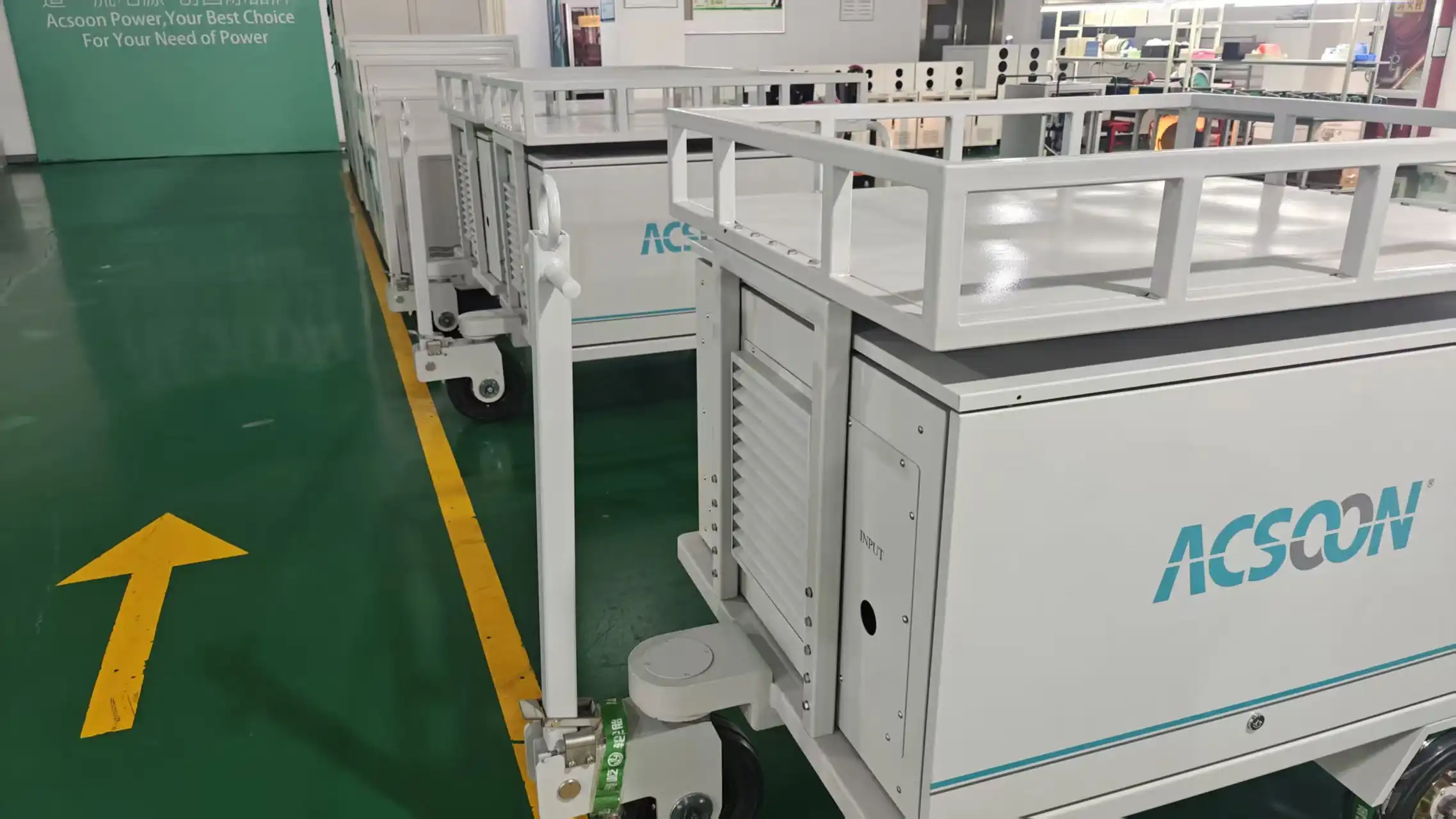
Verification of ground power unit performance requires specialized testing protocols. Aviation maintenance teams employ calibrated power analyzers measuring voltage regulation, frequency stability, harmonic content, and transient response. These instruments confirm compliance with MIL-STD-704F parameters before connecting ground power to aircraft electrical buses. The GPU-330030 from ACSOON exemplifies modern ground power capabilities, addressing these requirements. This 30kVA solid-state unit accepts standard three-phase 380V/50Hz input and delivers precise 115V/200V output at 400Hz with exceptional stability. Its mobile trolley configuration provides flexibility for positioning near aircraft, while IP54 protection ensures reliable operation in exposed airport environments. The crest factor of 1.414±3% accommodates inrush currents from motor starting and capacitive loads without voltage sag.
Comparing 400Hz Power Supply with Other Frequencies for Aviation Use
The frequency choice for aviation power systems reflects carefully balanced engineering tradeoffs. While 400Hz dominates aircraft applications, understanding comparisons with alternative frequencies clarifies why this standard persists and where variations might apply.
Technical Comparison: 400Hz vs. 50/60Hz Systems
Standard utility frequencies of 50Hz and 60Hz serve ground infrastructure effectively but impose penalties in mobile applications. Component weight represents the most obvious difference—400Hz transformers weigh approximately one-seventh of equivalent 60Hz units. Motor and generator size follows similar scaling, with higher-frequency machines achieving greater power density through increased rotational speeds and reduced magnetic material requirements. Efficiency considerations favor 400Hz in aerospace contexts despite higher core losses from increased magnetic reversal rates. The overall system weight reduction more than compensates for modest efficiency decreases in individual components. 400 Hz aircraft power supply electrical systems optimized for 400 Hz operation achieve better power-to-weight ratios than any practical 60 Hz alternative.
Harmonic management becomes more challenging at 400Hz due to the reduced impedance of cables and the increased skin effect. Quality power supplies must incorporate sophisticated filtering to maintain low total harmonic distortion. The ACSOON brand addresses these issues through advanced solid-state conversion technology, maintaining THD below 3% across full load ranges.
Supplier Performance and Brand Considerations
When procurement teams evaluate ground power solutions, supplier reliability becomes as critical as technical specifications. Established manufacturers like Honeywell, Curtiss-Wright, and Collins Aerospace dominate aerospace power markets through decades of proven performance and certification compliance. These suppliers maintain extensive engineering support and global service networks essential for mission-critical applications. Emerging suppliers, including ACSOON, bring competitive advantages through specialized focus and manufacturing flexibility. Xi'an Jerrystar Instrument Co., Ltd. has developed the ACSOON product line specifically for aviation, military, and marine applications over 15 years. This specialization enables rapid customization and responsive support that larger diversified manufacturers sometimes cannot match. The company's adequate inventory ensures quick delivery even for urgent requirements—a significant advantage when failures of ground support equipment threaten operational schedules.
Cost-Benefit Analysis for Decision Makers
Initial acquisition cost represents only one component of total ownership expenses. Procurement professionals must evaluate reliability, maintenance requirements, energy efficiency, and operational flexibility over equipment lifecycles of 15-20 years. Quality 400Hz ground power units command premium pricing relative to simple rotating converters but deliver superior performance and longevity. The GPU-330030 configuration illustrates this value proposition. Its solid-state architecture eliminates rotating components prone to bearing wear and brush maintenance. Variable input voltage acceptance accommodates grid fluctuations without affecting output quality. Variable frequency capability extends applications beyond aviation to industrial testing and laboratory environments, maximizing equipment utilization. These features reduce the total cost of ownership despite a higher upfront investment compared to basic alternatives.
Procurement Insights: Selecting and Purchasing 400Hz Power Supplies for Aircraft
Sourcing appropriate ground power equipment requires navigating technical complexity, supplier verification, and supply chain considerations. Procurement teams supporting aviation operations must balance multiple criteria to identify optimal solutions.
Essential Selection Criteria
Compliance with aviation standards forms the foundation of any procurement specification. Equipment must meet or exceed MIL-STD-704F requirements for military applications or equivalent commercial standards for civil aviation. Documentation proving compliance through certified testing provides necessary assurance. Boeing and Airbus maintain approved vendor lists that streamline equipment qualification for airline operators. The power rating must match operational requirements with an appropriate margin. The 30kVA capacity of the GPU-330030 suits most narrow-body aircraft and provides reserve capacity for unusual loads or simultaneous system operation. Wide-body aircraft require higher-capacity units, typically 60kVA to 90kVA. Maintenance facilities servicing multiple aircraft simultaneously need proportionally greater capacity or multiple units.
Customization capability addresses unique operational requirements. Standard catalog products rarely match all site-specific needs. The ability to specify input voltage ranges, output configurations, control interfaces, and physical packaging distinguishes responsive manufacturers from rigid suppliers. ACSOON's support for OEM customization enables tailored solutions rather than compromised standard units.
Identifying Reputable Manufacturers
Supplier verification protects against substandard equipment that threatens safety and operational reliability. Established manufacturers demonstrate compliance through comprehensive documentation, including type certificates, test reports from accredited laboratories, and quality system certifications such as AS9100 for aerospace manufacturing. Factory audits provide additional assurance by verifying manufacturing processes and quality controls. Experience in target markets indicates supplier competence with specific requirements. Xi'an Jerrystar Instrument Co., Ltd. specializes in aviation, military, marine, and laboratory applications rather than dispersing focus across unrelated industries. This concentration ensures engineering teams understand mission-critical applications and can provide informed technical support. Over 15 years of operation establishes credibility that startup companies cannot demonstrate.
Geographic considerations affect support responsiveness and delivery times. While global suppliers offer extensive resources, regional manufacturers may provide superior accessibility for urgent needs. ACSOON's location in China positions the company advantageously for Asia-Pacific operations while maintaining export capability for worldwide customers. Manufacturing capacity between 5,000 and 10,000 square meters supports substantial production volume without excessive lead times.
Pricing Dynamics and Negotiation Approaches
Market pricing for aviation-grade power units used on the ground spans a wide range based on specifications, volumes, and customization extent. Standard 30kVA solid-state units typically range from $15,000 to $35,000 depending on features and brand positioning. Volume purchases command discounts, particularly for fleet-wide standardization initiatives. Negotiation leverage increases with order magnitude and relationship potential. Rather than focusing solely on unit price, effective procurement emphasizes total value, including technical support, spare parts availability, training, and warranty terms. Multi-year agreements with graduated pricing provide budget predictability while securing supplier commitment to ongoing support.
Evaluation of competing proposals must normalize specifications to enable valid comparison. Superficially similar units may differ substantially in voltage regulation precision, overload capacity, or electromagnetic compatibility. Detailed specification analysis prevents false economy from selecting inadequate low-cost alternatives.
Future Outlook: Trends and Innovations in 400Hz Aircraft Power Supplies
Aviation power technology continues evolving through materials innovation, power electronics advancement, and digital integration. These developments promise enhanced performance, reduced lifecycle costs, and improved operational capabilities.
Emerging Technology Directions
Wide-bandgap semiconductors, including silicon carbide and gallium nitride, enable more efficient power conversion with reduced switching losses and higher operating temperatures. These materials allow smaller, lighter frequency converters approaching 95% efficiency while handling greater power densities. Next-generation ground power units will deliver equivalent capacity in significantly reduced physical packages. Digital control systems increasingly incorporate predictive diagnostics and remote monitoring through IoT connectivity. Smart ground power units transmit operational data, enabling condition-based maintenance rather than fixed-interval servicing. Predictive analytics identify component degradation before failures occur, preventing unexpected downtime. Fleet management systems optimize equipment deployment across multiple gates based on real-time status and utilization patterns.
Energy storage integration meets transient demands and improves power quality during grid disturbances. Hybrid systems combining frequency converters with battery buffers deliver uninterruptible power, ensuring continuous aircraft supply during utility switching or momentary outages. This capability becomes particularly valuable at airports with less robust electrical infrastructure.
Strategic Recommendations for Aviation Operators
Fleet modernization initiatives should incorporate ground power infrastructure alongside aircraft upgrades. Older rotating converter technology introduces maintenance burdens and reliability concerns that modern solid-state units eliminate. Progressive replacement programs balance capital expenditure with operational improvement and risk reduction. Standardization across airport facilities simplifies maintenance, training, and spare parts management. While different aircraft types may require various capacity ratings, maximizing commonality of control systems, interfaces, and core technology reduces complexity. Partnering with manufacturers offering comprehensive product families enables standardization while accommodating diverse requirements.
Collaboration with suppliers during specification development ensures optimal solutions rather than compromised standard products. Early engagement allows manufacturers to understand specific operational contexts and propose innovations addressing unrecognized opportunities. This consultative approach characterizes mature supply relationships that deliver sustained competitive advantage.
Conclusion
Aviation operational efficiency depends critically on ground support infrastructure that remains largely invisible to passengers. High-quality 400 Hz power supply aircraft systems represent strategic investments delivering measurable turnaround time improvements, enhanced schedule reliability, and reduced operational expenses. Decades of aerospace engineering evolution have well-established the technical advantages of 400Hz power in aircraft applications. Modern solid-state frequency converters exemplified by the ACSOON GPU-330030 provide the performance, reliability, and flexibility that aviation operations demand. Procurement decisions that balance technical specifications, supplier capability, and total lifecycle value help operators achieve sustained success in increasingly competitive markets. As technology advances through digital integration and materials innovation, partnerships with specialized manufacturers enable aviation operators to maintain technical leadership while controlling costs.
FAQ
Why do aircraft use 400Hz instead of standard 60Hz power?
Aircraft electrical systems operate at 400Hz primarily for weight reduction. Higher frequency allows transformers, motors, and generators to use smaller magnetic cores while delivering equivalent power. This translates to approximately 60-70% weight savings compared to 60Hz components. Given aviation's extreme emphasis on weight minimization, the cumulative benefit across all electrical systems justifies universal 400Hz adoption despite requiring specialized ground support equipment.
Can standard 60Hz motors operate on 400Hz power?
Standard 60Hz motors cannot safely operate on 400Hz power. The higher frequency greatly increases inductive reactance, which leads to excessive current draw, severe overheating, and rapid failure. Conversely, 400Hz equipment cannot use 60Hz power without appropriate frequency conversion. All ground support equipment must provide properly converted power that matches aircraft electrical specifications to prevent equipment damage.
What voltage differences exist in 400Hz aircraft systems?
The standard configuration provides 115V phase-to-neutral and 200V phase-to-phase in a three-phase four-wire system. The 115V supplies most avionics and smaller systems, while 200V powers larger motors and environmental controls. The GPU-330030 delivers both voltages simultaneously, enabling complete aircraft electrical system support from a single ground power connection.
How do you verify ground power quality before connecting to aircraft?
Verification requires calibrated power analyzers measuring voltage regulation, frequency stability, waveform quality, and harmonic content. Testing confirms compliance with MIL-STD-704F parameters, including voltage within ±3V, frequency within ±0.5Hz, and total harmonic distortion below 3%. Visual inspection of connectors and cables precedes every connection to prevent physical damage to aircraft receptacles.
Partner with JERRYSTAR for Superior Aviation Ground Power Solutions
Aviation operations demand absolute reliability from ground support equipment. JERRYSTAR delivers proven 400 Hz power solutions for aircraft through our ACSOON brand, backed by over 15 years of specialized experience in aviation, military, and marine power conversion. Our GPU-330030 solid-state frequency converter offers 30kVA capacity with exceptional stability, mobile deployment flexibility, and IP54 environmental protection. As both manufacturer and supplier, we maintain adequate inventory, enabling rapid delivery for urgent requirements while supporting full customization for unique applications. Our engineering team provides comprehensive technical consultation, ensuring optimal equipment selection for your specific operational context. Connect with JERRYSTAR today to discuss your ground power requirements and discover how the right 400 Hz power supply aircraft manufacturer partnership transforms operational efficiency. Contact our team at acpower@acsoonpower.com for detailed specifications, competitive quotations, and expert guidance on implementing advanced ground power solutions that reduce turnaround times and enhance schedule reliability.
References
1. Smith, J.R. & Anderson, P.K. (2019). Aircraft Electrical Systems: Design, Analysis, and Operation. Aerospace Engineering Press, pp. 87-124.
2. Federal Aviation Administration (2021). Advisory Circular AC 150/5220-25: Airport Ground Support Equipment Power Systems. U.S. Department of Transportation.
3. Wilson, T.M. (2020). "Frequency Conversion Technology in Modern Aviation Ground Support," Journal of Aerospace Engineering and Technology, Vol. 15, No. 3, pp. 201-218.
4. International Air Transport Association (2022). Airport Handling Manual - Ground Power Operations, 38th Edition, Montreal, Canada.
5. Chen, L. & Roberts, D.H. (2018). "Optimization of Aircraft Turnaround Processes Through Electrical Infrastructure Enhancement," International Journal of Aviation Management, Vol. 4, No. 2, pp. 156-173.
6. Military Standard MIL-STD-704F (2016). Aircraft Electric Power Characteristics. Department of Defense Interface Standard, United States of America.