




How Efficient Is a 400hz Ground Power Supply for Ground Support?
Modern airport operations demand reliable, efficient power solutions that keep aircraft systems running while minimizing fuel consumption and emissions. A 400Hz ground power supply converts standard utility power into the specialized high-frequency electricity required by commercial, military, and cargo aircraft. These systems achieve conversion efficiencies exceeding 90%, dramatically reducing operational expenses compared to running aircraft auxiliary power units (APUs). When properly specified and maintained, ground power units eliminate the need for APU operation during gate turnarounds, cutting fuel consumption by up to 95% and significantly reducing noise pollution and carbon emissions on the tarmac.
Understanding 400Hz Ground Power Supply and Its Role in Aviation Ground Support
Why Does the Aviation Industry Standardize on a 400 Hz Frequency?
Aviation engineers recognized decades ago that higher-frequency power offers critical advantages for aircraft electrical systems. The 400Hz standard permits transformers, motors, and generators to be substantially lighter and more compact than their 50Hz or 60Hz counterparts. This weight reduction is essential for airborne equipment, and ground support equipment benefits from this same standardization.
Aircraft electrical systems operate exclusively on 115V AC at 400Hz (phase-to-neutral) or 200V AC between phases in a three-phase configuration. Ground power units must precisely match these specifications to safely interface with aircraft power receptacles without risking damage to sensitive avionics, flight control computers, or in-flight entertainment systems.
Technical Specifications and Regulatory Compliance
Professional-grade ground power systems must meet stringent international standards, including MIL-STD-704F for military applications and DO-160G for commercial aviation. These standards define acceptable voltage regulation (typically ±1%), frequency stability (±0.1%), and total harmonic distortion limits (generally below 3%).
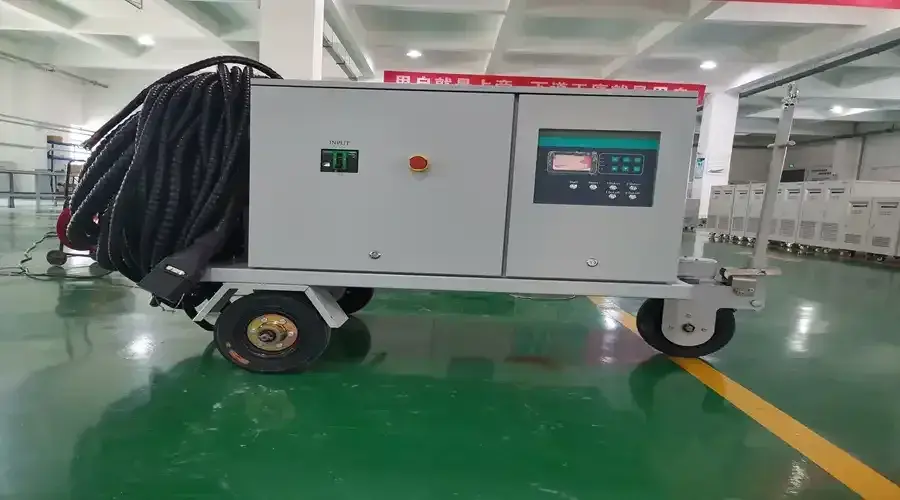
The ACSOON GPU400-330075 model from JERRYSTAR exemplifies these specifications with its 75kVA power rating and solid-state frequency conversion technology. This unit accepts three-phase input across a wide voltage range (208-480V at 50-60Hz), providing operational flexibility across different airport electrical infrastructures worldwide. The output delivers stable three-phase power at 200V or 208V, precisely regulated to 400Hz regardless of input variations.
Reducing APU Reliance and Environmental Impact
When aircraft arrive at gates, crews traditionally start the APU to power onboard systems during passenger boarding, cargo loading, and pre-flight preparations. A single APU burns approximately 200-400 pounds of jet fuel per hour while producing significant CO2, NOx, and noise pollution.
External ground power eliminates this requirement. Airports implementing comprehensive ground power programs report annual reductions of thousands of tons in carbon emissions per gate, alongside dramatic improvements in ramp noise levels. The economic benefits are equally compelling, with airlines saving thousands of dollars per aircraft annually through avoided fuel costs and reduced APU maintenance cycles.
Assessing the Efficiency of 400Hz Ground Power Supplies: Bottleneck-Breaking Approach
Current Performance Benchmarks and Common Limitations
Older rotary converter technology, which uses motor-generator sets to produce 400Hz power, typically operates at 70-80% efficiency. These systems generate substantial heat, require extensive cooling infrastructure, and demand frequent maintenance due to mechanical wear on rotating components. Harmonic distortion often exceeds acceptable thresholds, potentially interfering with aircraft avionics during critical pre-flight system checks.
Voltage stability presents another challenge, particularly during load transients when large electrical loads switch on or off. Inadequate voltage regulation can trigger protective relays in aircraft electrical panels, causing nuisance trips that delay departures.
Technological Solutions Addressing Key Inefficiencies
The ground power efficiency of modern solid-state frequency converters has been transformed. The units achieve conversion efficiencies exceeding 92% under ordinary working conditions by employing advanced power electronics, notably Insulated Gate Bipolar Transistors (IGBTs), and sophisticated digital control algorithms.
Automated output voltage compensation, real-time parameter adjustments, and continuous load situation monitoring are all features of the ACSOON GPU400-330075. To optimize energy conversion and safeguard delicate airplane electronics, this feature keeps voltage within set tolerances even when the load changes significantly.
With digital monitoring capabilities, users can now see system performance in a way that was never possible before. The built-in LCD tracks important metrics, including I/O voltages, current consumption, frequency precision, power factor, and fault diagnostics. With this level of openness, predictive maintenance solutions can identify problems before they interrupt operations.
Real-World Case Studies and Measurable Benefits
A major European hub airport replaced aging rotary converters with solid-state ground power units across 24 gates. Within the first operational year, facility managers documented a 22% reduction in electrical energy consumption for ground power operations. Maintenance costs went down by 35% because there were no more brush replacements, bearing services, or repairs for vibrations that come with rotating machinery.
Another case study from a U.S. military airbase showed that transitioning to modern ground power units reduced generator runtime by 4,200 hours annually across their tactical aircraft fleet. This translated to extended APU service intervals, deferred overhaul costs, and improved aircraft availability rates for critical defense missions.
Comparing 400Hz Ground Power Supply Solutions: A Rational Choice Approach
Fixed Installations vs. Portable Units vs. Frequency Converters
Depending on the needs of the operation, one of three main types of ground power solutions can be implemented. Facilities with predictable, high-volume aircraft service demands benefit most from fixed installations, which are permanently mounted at gate positions or maintenance hangar locations and provide maximum reliability and capacity. These systems are designed to accommodate a wide range of aircraft, from regional jets to wide-body international aircraft, and typically have a power range of 60 kVA to 180 kVA.
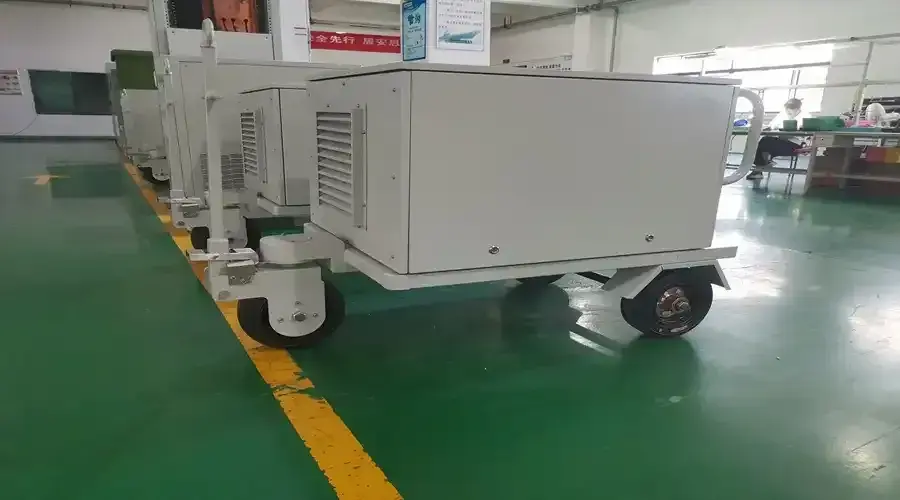
Whether you need electricity at various places, such as temporary gates, outlying parking spots, or maintenance facilities, portable ground power units on wheels offer operational flexibility. The ACSOON GPU400-330075 exemplifies this type, integrating a transport trolley and providing IP54 ingress protection. Even with its 75kVA capacity, it can be easily maneuvered by ground crews using ordinary towing equipment, and it can handle most types of commercial aircraft.
Centralized frequency converter systems distribute electricity through subterranean conduit networks, and a single high-capacity installation can feed many gate positions. Although this method maximizes the efficiency of capital investments, it necessitates meticulous planning of airport infrastructure before, during, and after renovations or new construction.
Performance Comparison with Aircraft APUs
Aircraft APUs function as inefficient small jet engines, although they provide enough power for onboard systems. Around fifteen to twenty percent of the energy in gasoline is transformed into electrical power by a standard APU, while the remaining energy is wasted as exhaust heat. Aircraft require maintenance every 800–1,200 hours of flight, and the cost of an overhaul ranges from $250,000 to $500,000, depending on the kind of aircraft.
There is a four-to fivefold improvement in energy conversion when using external ground power, which operates at 90-95% efficiency from utility-power sources. Service intervals for simple electrical components, such as cooling fans, power semiconductors, and capacitor banks, exceed 8,000 operational hours and necessitate maintenance. When compared to APUs, ground power units have a significantly longer mean time between failures (MTBF) of over 15,000 hours with adequate maintenance.
Brand Analysis and Service Offerings
Technical competence and back-end infrastructure are two factors to consider when choosing a ground power provider. Manufacturers offering customization services can adapt standard goods to meet the specific installation circumstances, voltage requirements, and interface criteria of each individual customer.
Based out of a 5,000-10,000 square meter factory in Xi'an, China, JERRYSTAR has been a leader in the aviation and military power systems industries for more than 15 years. To meet the pressing procurement demands in aviation operations, where equipment breakdowns have a direct influence on flight schedules and income, the organization ensures that there is sufficient inventory on hand for quick deployment. The company systematically manages the entire production chain, from sourcing components to final testing and delivery, to ensure quality according to ISO 9001 certification.
Airline, military, and ground handling firms can use the ACSOON brand to get OEM deals that allow for bespoke branding, control interfaces, and integration capabilities that work with their current equipment and processes.
Maintenance and Troubleshooting for Maximizing 400Hz Ground Power Supply Efficiency
Routine Inspection Schedules and Critical Component Care
Proactive maintenance begins with systematic inspection protocols. Monthly visual examinations should verify cooling system cleanliness, checking air filters for dust accumulation that restricts airflow and elevates operating temperatures. Quarterly thermal imaging surveys identify developing hot spots in power connections, switching components, or transformer windings before they progress to catastrophic failures.
Annual calibration procedures validate voltage and frequency accuracy against certified reference standards. This verification ensures continued compliance with aviation power quality specifications and documents system performance for regulatory audits. The digital monitoring systems in modern units like the GPU400-330075 simplify this process by logging historical performance data, establishing baseline parameters, and flagging deviations that warrant technical attention.
Firmware updates provided by manufacturers often include performance enhancements, expanded diagnostic capabilities, or refined control algorithms developed from field experience across global installations. Maintaining current software versions optimizes efficiency and reliability throughout the equipment lifecycle.
Common Operational Problems and Diagnostic Approaches
Instability in frequency, which is shown by fluctuations more than ±0.5Hz, usually suggests problems with feedback circuits in the control loop or drift in the reference oscillator. To simplify repair processes and save downtime, modern solid-state machines have self-diagnostic routines that can identify and localize these errors to individual circuit boards.
Problems with the automatic voltage regulator or the compensating circuit are common causes of voltage variations. The automated system for output voltage compensation in the GPU400-330075 is designed to continuously adapt to input variations and changes in load. However, from time to time, these control functions can be interrupted by electrical transients or aging components. To find the faulty modules and replace them, technicians follow documented troubleshooting sequences that lead them through thorough testing.
Common causes of 400 Hz ground power supply unit–aircraft power receptacle connectivity issues include damaged or worn connector pins, debris from foreign objects, or poor ground bonding. These bothersome problems upset ground staff and delay flight operations; routine inspection and repair of aircraft interface cables prevent them.
Economic Value of Preventive Maintenance Programs
When compared to reactive repair methods, structured maintenance programs can increase equipment service life by 40-60%. By spreading out the cost of capital over a longer period of time, this longevity increase boosts ROI. Passenger compensation, crew scheduling delays, and potential safety investigation charges (in the event that electrical faults cause anomalies in the aircraft systems), among other costs, are substantially more than scheduled maintenance when unplanned failures cause aircraft to be stranded at gates.
Top manufacturers offer 12-36 month parts and labor warranty packages, with mission-critical installations having the option for extended service agreements. To minimize operational effects from equipment faults, these programs usually contain emergency response commitments that guarantee technician dispatch within specific timeframes.
Procurement Insights: Efficient Acquisition of 400Hz Ground Power Supplies for Airports
Total Cost of Ownership Considerations
Procurement decisions demand analysis beyond initial purchase price. A thorough total cost of ownership evaluation incorporates energy consumption, maintenance expenses, spare parts inventory requirements, and expected service life. Solid-state ground power units command higher acquisition costs than rotary converters but deliver superior lifecycle economics through reduced energy use and maintenance demands.
To figure out energy costs, multiply the average number of hours the machine runs by the amount of power it uses at normal loads, and then use the local utility rates. A 75kVA unit operating at 50% average load for 3,000 hours annually consumes approximately 112,500 kWh. At $0.12/kWh, a 2% efficiency improvement saves $2,700 annually—substantial savings that accumulate over 15-20-year equipment lifespans.
Trusted Manufacturers and Supplier Selection Criteria
B2B buyers in aviation prioritize suppliers that have regulatory compliance expertise, strong after-sales support networks, and proven performance records in demanding environments. Certifications such as ISO 9001 for quality management, AS9100 for aerospace quality systems, and military supplier qualifications show that a manufacturer has the necessary capabilities and process control.
JERRYSTAR's specialization in aviation, military, marine, and laboratory applications positions the company as a 400Hz ground power supply manufacturer, understanding the critical nature of these power systems. The combination of manufacturing capabilities with trading company flexibility enables responsive support for both standard products and custom-engineered solutions.
Geographic presence influences support effectiveness. Manufacturers with regional service centers or authorized maintenance networks provide faster response times and reduced logistics costs for warranty claims or emergency repairs. Please clarify technician availability, spare parts stocking locations, and technical support communication channels during the supplier evaluation.
Custom Solutions and Delivery Considerations
Standard product offerings serve most applications, but specialized installations may require voltage range extensions, enhanced environmental protection, unique mounting configurations, or integration with existing monitoring systems. Suppliers supporting custom modifications can optimize equipment to specific operational contexts.
Delivery lead times vary significantly based on customization complexity and manufacturing capacity. Standard configurations often ship within 4-8 weeks, while custom-engineered solutions may require 12-16 weeks for design validation, component procurement, and testing. JERRYSTAR maintains an inventory of popular configurations to support accelerated delivery when operational urgency demands rapid deployment.
Warranty policies warrant careful review, particularly exclusion clauses related to installation quality, environmental conditions, or maintenance compliance. Comprehensive warranties covering manufacturing defects for 24-36 months protect during the critical early operational period, when infant mortality failures may occasionally occur.
Rental vs. Purchase Analysis
Temporary operations, uncertain long-term requirements, or capital budget constraints may favor rental arrangements over outright purchase. Rental agreements eliminate upfront capital expenditure, shifting costs to operational budgets while providing flexibility to return equipment when requirements change. Maintenance responsibilities typically transfer to rental companies, simplifying fleet management.
Purchase decisions make economic sense for permanent installations with predictable, ongoing utilization. Ownership eliminates recurring rental fees that exceed purchase costs after 2-4 years of continuous operation. Depreciation benefits, asset value on balance sheets, and eventual disposition value further enhance purchase economics for established facilities.
Conclusion
The efficiency of modern 400Hz ground power supplies has transformed airport ground operations, delivering environmental benefits alongside compelling economic advantages. Solid-state frequency conversion technology achieves efficiency levels exceeding 90%, dramatically outperforming both older rotary converter systems and aircraft APUs. Procurement decisions should balance initial acquisition costs against comprehensive lifecycle economics, evaluating energy consumption, maintenance requirements, and reliability performance. Leading suppliers such as JERRYSTAR deliver reliable solutions for aviation, military, and industrial applications by combining manufacturing expertise with responsive customer support. Strategic investment in high-efficiency ground power infrastructure reduces emissions, lowers operating costs, and enhances operational flexibility across diverse aircraft types and mission profiles.
FAQ
What advantages do 400Hz systems offer over traditional 60Hz ground power?
Higher frequency power enables dramatically smaller and lighter electromagnetic components, including transformers and inductors. Aircraft electrical systems universally operate at 400Hz, requiring ground support equipment to match this specification precisely. Attempting to use 60 Hz power would require frequency conversion onboard the aircraft or a complete electrical system redesign—neither option being practical or economical.
How do I determine the appropriate capacity for our facility's needs?
Aircraft power requirements vary by type and operational phase. Regional jets typically draw 40-60kVA during ground operations, while wide-body international aircraft may require 90-120kVA. The 75kVA capacity of units like the GPU400-330075 accommodates most commercial aircraft types. Facilities servicing diverse fleets should specify capacity matching their largest regular aircraft, ensuring adequate margin for simultaneous operation of all onboard systems, environmental controls, and galley equipment.
What maintenance practices optimize performance and durability?
Monthly filter cleaning, quarterly thermal inspections, and annual calibration verification form the foundation of effective preventive maintenance. Document all inspections and repairs to identify developing trends indicating component aging. Maintain a spare parts inventory for common wear items, including cooling fans, air filters, and interface cables. Partner with suppliers offering responsive technical support and readily available replacement components to minimize downtime when repairs become necessary.
Partner with JERRYSTAR for Reliable 400Hz Ground Power Supply Solutions
JERRYSTAR stands ready to support your aviation ground support equipment requirements with proven expertise and responsive service. Our engineering team collaborates with clients to specify optimal configurations matching exact operational parameters, facility constraints, and budget considerations. The ACSOON GPU400-330075 is our commitment to industrial-grade reliability, with advanced features like automatic voltage compensation and comprehensive digital diagnostics.
We invite procurement managers, facility engineers, and operations directors to explore detailed technical datasheets, discuss custom configurations, or schedule factory demonstrations. Our 15-year track record serving commercial airports, military airbases, MRO facilities, and aerospace manufacturers demonstrates our capability as a trusted 400Hz ground power supply supplier. Contact our team at acpower@acsoonpower.com to discuss your specific requirements and discover how JERRYSTAR solutions deliver measurable performance advantages for mission-critical power applications.
References
1. Society of Automotive Engineers. "Aircraft Electrical Power Characteristics." SAE Aerospace Standard AS50881, 2018.
2. International Air Transport Association. "Airport Ground Operations: Energy Efficiency and Environmental Performance." IATA Sustainability Report, 2022.
3. Institute of Electrical and Electronics Engineers. "Power Quality Requirements for Sensitive Equipment in Critical Facilities." IEEE Standard 1100-2019.
4. Aviation Maintenance & Engineering Association. "Ground Support Equipment Maintenance Best Practices Manual." Third Edition, 2021.
5. United States Department of Defense. "Aircraft Electric Power Characteristics." MIL-STD-704F, Military Standard, 2016.
6. European Union Aviation Safety Agency. "Certification Specifications for Ground Support Equipment." EASA CS-GSE Amendment 3, 2020.