




Variable-Frequency AC Power Supply vs VFD: How to Specify the Right Equipment?
“Frequency converter” is a useful starting phrase, but it is not a complete purchase specification. It can refer to an AC source that supplies equipment at a required frequency, or to a variable-frequency drive (VFD) that controls an AC motor. Both involve frequency conversion. They are selected against different loads and acceptance criteria.
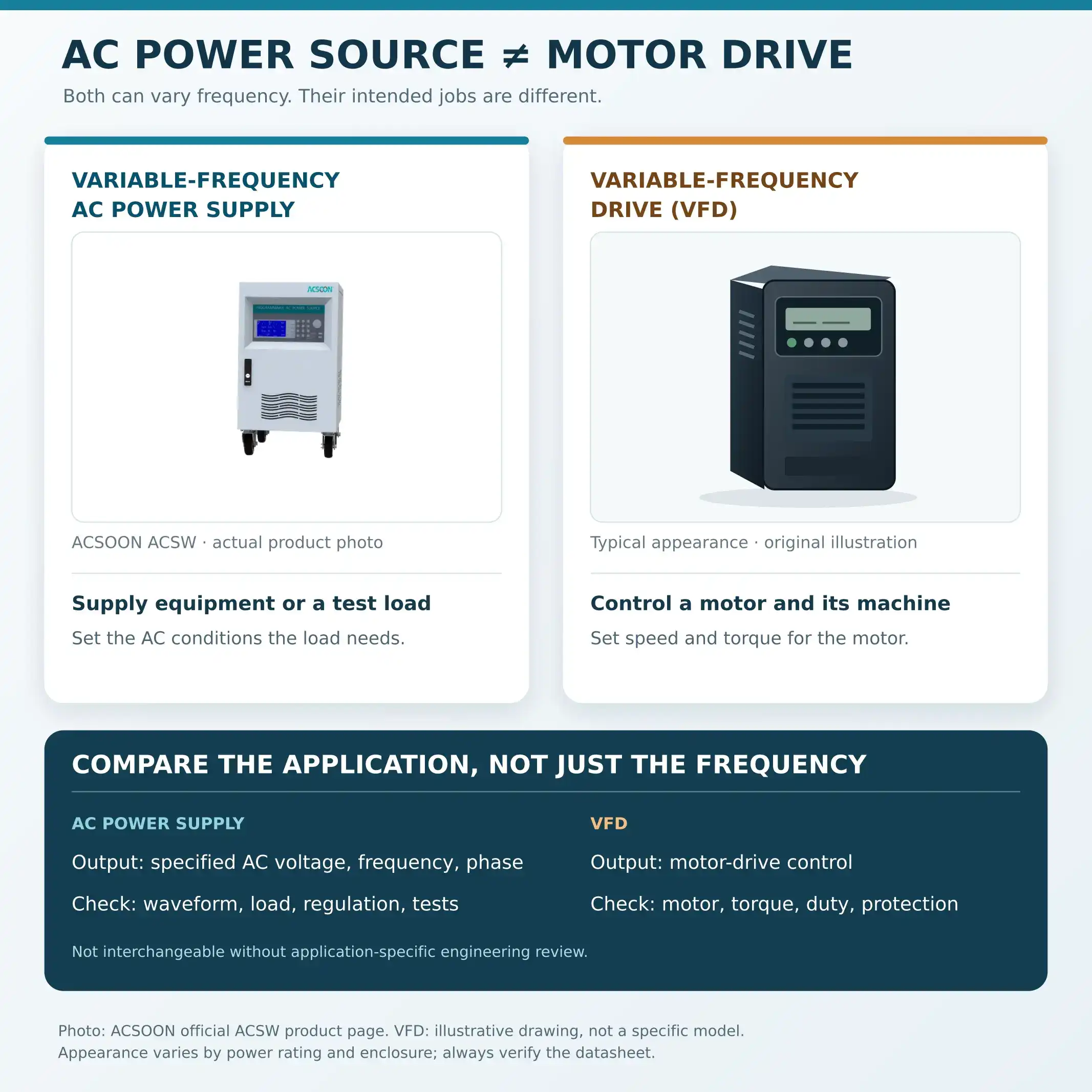
For an engineer or buyer, the fastest way to clear up the ambiguity is to ask one question: What is connected to the output?
Start with the load, not the enclosure
A variable-frequency AC power supply is selected to deliver defined electrical conditions to equipment or a test load. Depending on the product, voltage and frequency may be adjustable or programmable, with output phase configuration and waveform performance specified for the intended application. Laboratories use AC sources to reproduce input conditions during evaluation; industrial users may need to supply equipment designed for a different mains frequency.
A VFD is selected primarily for motor-speed and torque control. The engineer considers the motor, driven machine, speed range, starting and stopping behaviour, duty cycle and protection settings. A conventional VFD output is part of a motor-drive system, not automatically a substitute for a general-purpose AC input to unrelated equipment.
The physical appearance is not a reliable shortcut. Both categories can have displays, keypads, cooling vents and cabinet-style enclosures. The nameplate, output specification and intended load matter more than the shape of the box.
Two purchase paths that should not be confused
Consider a maintenance bench that needs to energise an item of equipment at a specified AC voltage and frequency. The buyer should describe the equipment's input requirements, expected current, starting demand, allowable waveform distortion and how the output will be checked. An AC power source is the category to investigate.
Now consider a pump whose motor needs adjustable speed. The buyer should describe the motor nameplate, mechanical load, speed and torque range, operating cycle and installation environment. A VFD is the category to investigate.
There is an important exception to overly simple rules: an AC source may be used in a properly engineered motor test. Equally, a drive system may have added filtering or other application-specific features. Neither observation makes every source and drive interchangeable. Suitability still depends on the actual load and the manufacturer's verified specification.
The RFQ checklist
When the requirement is equipment supply or testing, send the supplier:
Load identity and purpose: What equipment will be powered, and is the task continuous operation, evaluation or a repeatable test?
Available input: Supply voltage, frequency, number of phases and site limitations.
Required output: Voltage stated as line-to-line or line-to-neutral where applicable, frequency or frequency range, phase configuration and neutral requirement.
Electrical demand: Continuous kVA or kW, power factor if known, inrush or peak current, and the duration of each operating state. Do not treat kVA and kW as interchangeable without the relevant power factor.
Output behaviour: Waveform, voltage regulation, response to load changes and any test profile that must be repeatable. State how each requirement will be measured and under what load.
Installation and verification: Connection method, ambient conditions, protection requirements, documentation and acceptance checks.
If the requirement is motor control instead, start with the motor and driven machine. Ask about speed range, torque profile, acceleration and deceleration, duty, braking, cable length and protective coordination. A list of output frequencies alone cannot settle either specification.
If waveform quality is part of the acceptance test, define the load and measurement conditions rather than asking only for a “pure sine wave.” Our guide to sine-wave output, THD and loads explains why that distinction matters.
Write the category into the enquiry
If the load needs a controlled AC input, this line can prevent a quotation for the wrong equipment:
We require a variable-frequency AC power supply for the specified equipment load, not a VFD for motor-speed control.
JERRYSTAR's programmable AC power source product page provides a model-oriented starting point. The ACSOON ACSW product page describes the programmable AC supply family. Neither page replaces a project-specific check of the load, configuration and acceptance conditions.
If you are preparing an enquiry, send the input conditions, the load's nameplate or technical sheet, and the required output and test conditions. That allows the proposed AC source configuration to be reviewed against the actual application.
Related Links:
ACSOON ACSW :https://acsoonpower.com/product/176.html
JERRYSTAR ACSW:https://www.jrd-instrument.com/ac-power-supply/programmable-ac-power-source-45-800hz
Operating Principle of Yaskawa VFDs:https://www.yaskawa.com/delegate/getAttachment?cmd=documents&documentId=AR.AFD.03&documentName=AR.AFD.03.pdf
Applications of Chroma Programmable AC Power Sources:https://www.chromausa.com/product/programable-ac-power/