




What Are the Key Specs of a 400Hz Static Frequency Converter?
It is important to know the specs of a 400Hz static frequency converter when looking at power conversion tools for military, aerospace, or specialized industry uses. Standard 50Hz or 60Hz grid power is changed by these devices into a stable 400Hz output that aircraft systems, radar sites, and military tools need. Some of the most important specs are the power rate (in kVA), the ranges of input and output voltage, the accuracy of the frequency, the level of efficiency, power quality measures like total harmonic distortion, outdoor durability scores like ingress protection grades, and the ability to handle overloading. Besides these basic factors, things like MTBF (mean time between failures), the ability to customize, and the ability to work in tough operational settings also play a role in procurement choices. Engineers and procurement workers can choose equipment that works reliably in mission-critical situations if they know these specs.

Understanding 400Hz Static Frequency Converters: Core Concepts
Specialized power systems that are very different from business electrical infrastructure are used a lot in aviation and military activities. Most aircraft, military ships, and ground support systems work at 400Hz instead of the normal 50Hz or 60Hz that is used in industrial power grids. This higher frequency makes it possible for motors and generators to be smaller and lighter, which is very important when space and weight are limited.
What Makes Static Converters Different from Traditional Solutions
To change frequencies, 400Hz static frequency converters use solid-state electronics instead of moving parts that spin. Inside these units, rectifiers change the AC power that comes in to DC power, and then inverters make clean AC power at the 400Hz frequency that is needed. Advanced filtering circuits keep the output stable and reduce harmonic distortion as much as possible. Compared to older rotary converter technology, this solid-state design gets rid of mechanical wear points, which means less upkeep is needed, and the system lasts longer. When working in tough conditions, not having any moving parts is a real plus. When compared to similar rotating units, static converters are quieter, can handle vibration better, and take up less room. Because they are made up of separate modules, they are easy to place in small areas like airplane hangars, on ships, and in mobile military sites.
Internal Architecture and Component Functions
Knowing how things work on the inside helps buying teams figure out how different makers' quality levels compare. To deal with changes in the input voltage, the rectifier stage usually has high-grade silicon-controlled rectifiers or shielded gate bipolar transistors. The DC link stage has banks of capacitors that smooth out voltage ripples and provide energy buffers during load changes. Pulse-width modulation is often used by inverter circuits to make precise 400Hz patterns with little distortion. The cleanliness of the output power depends on the quality of the screening parts. Inductors and capacitors in the output stage reduce high-frequency switching noise, which ensures that sensitive communication and aviation equipment can use it. Manufacturers who use high-quality parts and complex control methods get better power quality results, which justifies their place in important applications even though they cost more at first.
Key Technical Specifications to Evaluate
To choose the right frequency converter, you need to carefully look at a number of technical factors. Each standard has an effect on how well it works, how reliable it is over time, and how much it costs to own the whole thing. Professionals in procurement have to weigh these factors against the needs of the project and the available budget.
Power Rating and Capacity Considerations
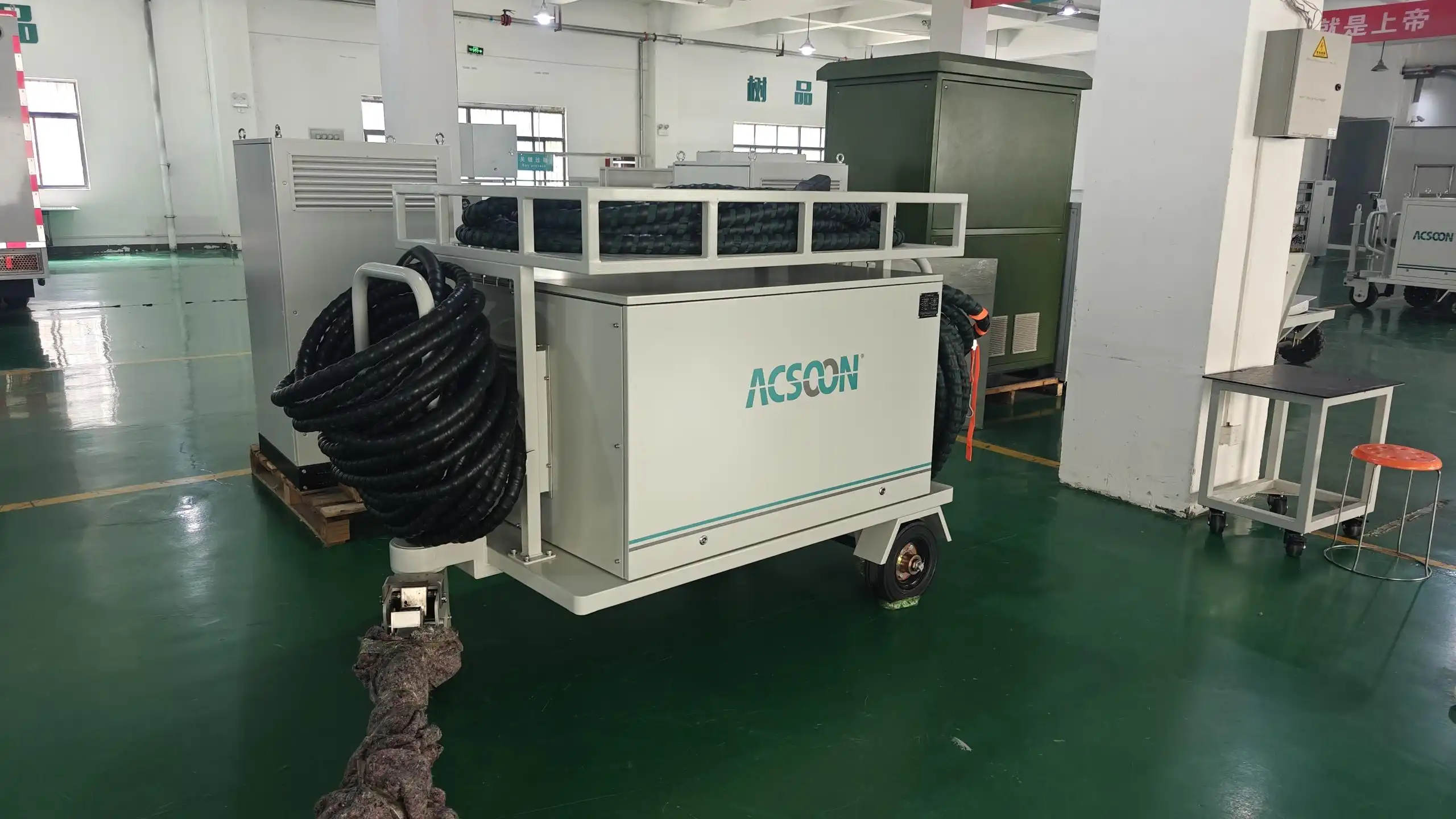
The power number, which is given in kilovolt-amperes (kVA), tells you how much power a 400Hz static frequency converter can handle. This type, ACSOON AF400M-330090, has a 90kVA rating and can be used for medium-sized radar systems, airplane repair, and test labs. When choosing the right size, you need to think about startup surge currents, which can temporarily be 150–200% higher than steady-state loads based on the equipment that is linked. When planning for capacity, you have to look at both the current load needs and the future growth needs. Undersized converters could trip overloaded and cause parts to fail early, while large units cost more and work less efficiently at partial loads. When you work with experienced sources like JERRYSTAR, it's easier to match converter specs to real-world working profiles instead of theoretical peak demands.
Input and Output Voltage Flexibility
Voltage compatibility tells you how well an adapter will work with your current electrical system. The AF400M-330090 can handle three-phase inputs from 208V to 480V at 50Hz or 60Hz standard grid frequencies. This means it can work with a wide range of foreign power standards and the different voltage levels that are common in industrial settings. This wide input range gives you options for how to place it and protects against changes in the grid power that could hurt sensitive loads. Adjustable output power is just as important. One converter platform can meet the needs of a wide range of tools because it can provide voltages from 208V to 480V at 400Hz. Different voltage levels are often needed for radar systems, aircraft ground power units, and test benches. Flexible output options make inventory management easier for places that serve a lot of different types of equipment.
Frequency Stability and Waveform Quality
Frequency precision has a direct effect on how well and how long something works. For precision motors, gyroscopes, and timing-dependent electronics to work right, the frequency must be stable within ±0.1%. High-quality static converters keep the output at 400Hz even if the input frequency changes, the load changes, or the temperature changes. This stability keeps motor speeds from changing and digital systems' time from going wrong. Total harmonic distortion (THD) measures how clean a signal is. To avoid electromagnetic interference and component stress, military and aircraft standards usually require THD to be less than 3%. Modern static converters have solid-state inverters that keep THD levels below 2% even when the load is at full. This is a lot better than rotary converters or motor-generator sets.
Efficiency Metrics and Operational Costs
How much energy is wasted and how much heat is made depends on the conversion rate. Premium static converters are 90–94% efficient across most load ranges, turning input power into useful output with very little loss. Higher efficiency means lower power costs and less cooling needs, which are important things to think about for sites that are enclosed or that are used all the time. To figure out how efficient something is, you need to know how performance curves change with load. Some converters only work at full efficiency when they're close to their rated capacity. Better designs work best from 25% load to 100% load. Facilities that need different amounts of power can benefit from converters with flat efficiency curves, which reduce waste when the load is low.
Environmental Durability and Protection Ratings
The operating setting affects the security requirements. The AF400M-330090 has an IP54 grade, which means it can defend itself against dust and water splashes from all directions. This works well for normal indoor setups in places like airplane hangars, shipping rooms, and factories where particles or moisture are sometimes present. Higher amounts of protection are needed in harsh settings. Marine sites near the coast have to deal with corrosion from salt spray, while activities in the desert have to deal with sand getting in and big changes in temperature. Converter enclosures, cooling systems, and component ratings must all meet the conditions at the spot to make sure they work reliably for a long time without breaking down too quickly.
Comparative Analysis: Static vs Rotary and Other Converter Types
The technology you choose has a big effect on performance, the amount of upkeep needed, and the prices over the life of the product. Knowing the pros and cons of various frequency exchange methods helps you make smart purchasing choices that are in line with your organization's needs.
Static Converters: Modern Advantages
For most uses, 400Hz static frequency converters are the best choice right now. Their solid-state design gets rid of brush wear, gear upkeep, and other mechanical problems that happen a lot with machines that spin. Since shaking and noise levels stay low, installation doesn't need much work on the base. Cooling needs are still low, and small volumes work better in tight areas than big rotary options.In dynamic applications, response speed is what sets static converters apart. When the load changes, solid-state switching responds in microseconds, keeping the voltage and frequency stable during equipment starting transients. This quick action keeps sensitive gadgets safe and stops trips that aren't needed, which stop important operations.
Rotary Converters: Legacy Technology Applications
Although they aren't as useful as they used to be, motor-generator sets and rotating frequency converters still have their uses. Applications that need to handle sudden surges will like that they can handle high overloads without damage right away. These systems' spinning inertia stores short-term energy that can be used even when the power goes out for a short time. This is hard to achieve in static designs without expensive battery backup systems. In the end, operational costs favor static technology. Rotary converters take up more floor space, make a lot of noise that needs to be muffled, and need regular upkeep like replacing brushes, lubricating bearings, and checking for vibrations. Energy efficiency is usually between 70 and 85%, which is much lower than steady options. This means that the equipment will cost more to run over its lifetime.
Variable Frequency Drives: Different Purpose Tools
Variable frequency drives (VFDs) change the output frequency to control the speed of a motor. They are fundamentally different from fixed-frequency converters, though. VFDs provide speed control that can be changed above frequency accuracy and output quality. Some VFDs can work at 400Hz, but most of the time they are used to control motor speed rather than running whole electrical systems with different types of loads. If you use VFDs instead of specialized 400Hz adapters, you might have problems with compatibility. VFDs might produce more harmonic distortion, not be able to handle enough pressure, or not be able to keep the frequency stable when the load changes. Built-to-order static frequency converters provide the accuracy and power quality needed for military and aircraft uses where equipment dependability can't be compromised.
Manufacturer Comparisons and Market Positioning
Top global brands like ABB, Siemens, and Schneider Electric make high-quality converters that have good names and large service networks. Their technology usually costs more, but it has a history of being reliable and offering a lot of third-party service options. These names work well for big buying plans that need to be standardized and have long-term support. Specialized companies like ACSOON focus on converting power for use in flight and the military. They can offer deep application knowledge and customization options that broad companies can't match. Their tech teams know how to make radar systems, aircraft ground support systems, and security systems work the way they do. This specialization makes it possible to provide customized solutions and quick technical help that makes integration easier and cuts down on the time needed to start up complex installs.
Procurement Considerations for B2B Buyers
A successful equipment purchase includes more than just technical specs. It also includes the supplier's abilities, the terms of the deal, and assistance throughout the lifecycle of the equipment. Strategic buying practices reduce risk as much as possible while also improving performance and lowering the total cost of ownership.
Pricing Structure and Budget Planning
Market pricing for 90kVA 400Hz static frequency converters usually costs between $15,000 and $35,000 on the market, but this depends on the manufacturer, specs, and amount of customization. At the low end are standard catalog units. At the high end are fully personalized solutions that come with extra safety grades, special control interfaces, or extra parts. Knowing this range helps you make reasonable budgets and assess quotes from suppliers. Customization changes both the price and the time it takes to send. Standard changes, like special fixing frames or different paint finishes, don't cost much and don't take long. Big changes in engineering, like custom control methods, strange voltage configurations, or built-in tracking systems, need more testing and development time, which could add 4 to 8 weeks to the delivery time.
Lead Times and Inventory Considerations
Standard frequency converter models usually ship 4 to 6 weeks after an order is placed. Custom setups, on the other hand, may take 8 to 12 weeks, based on how complicated they are. Installment dates must be taken into account during the planning stages of projects that have them. Working with providers that keep enough inventory on hand, like JERRYSTAR, speeds up shipping for urgent needs where faster production is worth the extra cost. Just-in-time shipping and the cost of keeping inventory should be balanced in procurement plans. Even though capital is being used to stock goods, it is necessary to keep critical extra parts for mission-critical systems on hand. For less important uses, longer repair timelines may be acceptable to keep working capital needs to a minimum. Manufacturers can keep consignment goods at customer sites or regional delivery centers through supplier warehousing programs, which are a middle ground.
Supplier Reliability and After-Sales Support
Warranty terms show that the company that made the product is confident in its quality. Standard guarantees last between 12 and 24 months, but you can usually negotiate for longer coverage when you buy something. Warranty length isn't the only thing that counts. Some makers don't cover wear-and-tear parts or only cover production flaws, leaving out things like installation mistakes or damage from the environment. Clear guarantee terms keep disagreements from happening when something fails. Long-term ownership experience depends on how well after-sales service works. Technical help that responds quickly fixes problems with setup and operations, reducing downtime. When spare parts are easy to get, fixes can be done quickly and without having to wait for parts for a long time. Because JERRYSTAR focuses on military and flight uses, their support teams know how important it is to act quickly in defense and aircraft operations. They give priority to mission-critical systems that need help right away.
OEM Customization and Project Requirements
When the government or military buys something, they often need features that aren't available on private products. Customized control interfaces work with management systems, enclosures that meet strict security or environmental standards, and paperwork packages that meet legal requirements. Manufacturers that work with OEMs, like JERRYSTAR's ACSOON brand goods, can meet these needs by using flexible engineering and production methods. Early on in the buying process, communicating clear specifications helps avoid confusion and costly rework. Accurate quotes and successful project completion depend on detailed requirement papers that include electrical factors, mechanical interfaces, environmental conditions, and paperwork needs. When buying teams and source engineers work together, they can find the best solutions that balance the best standards with real-world constraints and budget realities.
Maintenance, Troubleshooting, and Efficiency Optimization
Regular repair makes tools last longer and makes them more available for important tasks. Knowing what regular care needs to be done and how things usually go wrong helps with planning services and fixing problems quickly.
Preventive Maintenance Best Practices
Compared to mechanical options, 400Hz static frequency converters don't need as much regular care. However, they still need to be inspected every so often. Visual checks every three months find problems like loose connections, dust buildup, and blocked cooling systems before they break down. Thermal imaging scans done once a year find hot spots that are growing and showing signs of component stress or link degradation. These non-intrusive checks don't cost much, but they keep important processes from failing without warning. Maintenance on the cooling system should get extra attention since most converter breakdowns are caused by problems with heat. Cleaning the input screens once a month in dusty places keeps airflow from being slowed down, which raises the temperature inside. Checking to see if the fan is working and listening for strange noises or vibrations can help find worn bearings before the fan stops working completely. Keeping things cool properly keeps conversion efficiency high and extends the life of parts.
Common Fault Diagnostics and Resolution
Knowing the most common ways that things go wrong speeds up the fixing process when problems happen. Overvoltage or undervoltage faults usually mean that the power coming in isn't good enough, not that the converter is broken. Checking the grid voltage and upstream breaker conditions often shows what's wrong. Overtemperature faults are caused by problems with the cooling system, a heating that is too high, or overload conditions that are higher than the converter's values. Unstable voltage or frequency at the output suggests problems with the control circuit or power components that are wearing out. Modern converters have diagnostic screens and connection ports that show thorough information about faults and help with fixing. When an internal component fails, calling the manufacturer's expert help makes diagnosis and parts identification go more quickly. If you try to fix something without permission, you could cause more damage and usually lose your warranty. For complicated internal problems, it's best to get professional help.
Operational Practices Maximizing Performance
Following the right steps for running a converter will make it work better and last longer. To avoid heat stress and component aging, don't run the machine for long periods of time at more than 90% of its maximum capacity. Leaving enough space around converter boxes is important for proper cooling airflow—blocked vents force parts to work at high temperatures that speed up degradation. Lightning hits and switching transients can't damage converters if upstream surge protection devices protect them from voltage transients. How you handle loads affects how well they work and how much stress they put on parts. Starting up loads one at a time instead of all at once lowers the starting surge currents that stress power components. When you balance loads across three-phase outputs, you stop current mismatches that make losses and heat worse. These practical factors don't cost anything but make things more reliable and efficient.
Conclusion
To choose the right 400Hz static frequency converter specifications, you have to balance technical needs with budget and business needs. Specification choices are based on things like power rate, voltage compatibility, frequency accuracy, and protecting the environment. Understanding the benefits of one technology over another helps with choosing one, and thorough buying practices make sure that relationships with suppliers go well and projects are completed successfully. Modern static converters can handle tough aircraft, military, and industrial tasks, as shown by the ACSOON AF400M-330090, which has a 90kVA capacity, a wide voltage range, and IP54 security. Maintenance practices and operating discipline that work well together increase the life and performance of equipment, making sure that mission-critical systems can reliably convert power over longer periods of time.
FAQ
What industries commonly use 400Hz static frequency converters?
The biggest application area is aerospace operations, which include places that fix airplanes, power plants on the ground, and labs that test electronics. These 400Hz static frequency converters are used by the military for radar systems, power on navy ships, and mobile command centers. Facilities that make parts for airplanes need 400Hz power for checking and making sure the quality is good. For accurate trial results, research labs that simulate flight conditions need a frequency transfer that is stable.
How does a static frequency converter differ from a transformer?
Transformers change the amount of power, but they can't change the frequency. The frequency that goes from the input to the output is always the same. 400Hz static frequency converters perform complete power conversion, changing both voltage and frequency by turning input power into DC and then back to AC at the desired output frequency. This is what static frequency converters do. Because of this basic difference in how they work, converters can be used in situations where frequency change is needed, but transformers can't.
Can static frequency converters handle variable loads?
Modern static converters can handle changes in load from 0 to 100% of their maximum capacity while keeping the output voltage and frequency stable. When the load changes instantly, control circuits kick in and change how the inverter works within microseconds. This stops voltage drops or frequency changes. Overloads that last longer than the rated capacity set off safety circuits to keep parts from breaking. However, short surges can usually handle currents that are higher than the steady-state rates during startup.
Partner with JERRYSTAR for Your 400Hz Static Frequency Converter Needs
Choosing the right 400Hz static frequency converter provider has an effect on the success of the project and the reliability of its operations in the long run. JERRYSTAR focuses on power transfer products from the ACSOON brand that are made for use in laboratories, military bases, airplanes, and ships. Our engineering team has a lot of experience with radar systems, aircraft ground support, and military power needs. This means that they can make solutions that are tailored to your unique operational problems. We keep enough product on hand so that we can quickly deploy it when pressing project deadlines require it, and our OEM capabilities allow us to meet the unique needs that come up a lot when the government buys things. As a 400Hz static frequency converter manufacturer, we can provide full expert support throughout the entire lifetime of the equipment, from developing the original specifications to putting it together, starting it up, and helping with ongoing maintenance. Talk to our team at acpower@acsoonpower.com about your power conversion needs and find out how JERRYSTAR can help you with mission-critical frequency conversion solutions that meet the strict requirements of defense and aircraft uses.
References
1. Military Standard MIL-STD-704F: Aircraft Electric Power Characteristics. Department of Defense Interface Standard, 2016.
2. Rashid, M.H. Power Electronics Handbook: Devices, Circuits, and Applications. Fourth Edition. Butterworth-Heinemann, 2017.
3. International Electrotechnical Commission. IEC 61000-2-4: Electromagnetic Compatibility - Part 2-4: Environment - Compatibility Levels in Industrial Plants for Low-Frequency Conducted Disturbances. Geneva, Switzerland, 2002.
4. Chapman, D. Power Quality Application Guide: Frequency Converters. Copper Development Association, 2001.
5. IEEE Standard 519-2014: IEEE Recommended Practice and Requirements for Harmonic Control in Electric Power Systems. Institute of Electrical and Electronics Engineers, 2014.
6. Bollen, M.H.J. and Hassan, F. Integration of Distributed Generation in the Power System. IEEE Press Series on Power Engineering, Wiley-Blackwell, 2011.