




What Future Trends Are Emerging in Aircraft 400 Hz Power Systems?
The main part of aviation's electrical infrastructure is its aircraft 400 Hz power systems, which provide specialized three-phase alternating current at 400 cycles per second. This frequency was chosen to make transformers, motors, and magnetic components smaller and lighter, which is important for aerospace design. Ground power units and static converters are not the only things that will be used in these power systems in the future. New developments include battery-powered electric ground power units (e-GPUs), hybrid energy architectures, intelligent predictive diagnostics, and modular, scalable designs that meet the strict needs of military, commercial, and industrial aviation operations while also being environmentally friendly. These new ideas solve problems that have been around for a long time, like the need for more fuel, pollution, less operating flexibility, and higher repair costs.
Limitations of Traditional 400 Hz Aircraft Power Systems
Since the middle of the 20th century, 400 Hz power standards have been used in aviation. However, older systems now have problems that make them less efficient and less environmentally friendly.
Weight and Size Challenges in Legacy Equipment
There are big weight costs for older rotor frequency converters and ground power units that use transformers. These big systems take up important apron room at airports and need special equipment to set up and cool down. When they are set up in mobile setups, their weight makes them harder to move and costs more to carry. Outdated coil methods and magnetic cores make them less efficient, which directly leads to more energy being used. When there are a lot of people at the gates, the physical footprint becomes a big problem because optimizing space has a direct effect on turnaround time and business flow.
Energy Efficiency Gaps and Maintenance Complexity
Older aircraft 400 Hz power equipment usually has an efficiency rate of 70 to 85%, which means that a lot of energy is lost as waste heat. Because of this waste, operating costs go up, and complicated cooling systems are needed, which makes upkeep even harder. Brushes, slip bands, and electromechanical contactors that are getting old need to be inspected and replaced more often, which increases downtime and work costs. Finding old parts is hard for maintenance teams, which causes planes to be grounded for longer during important MRO rounds. Insulation loss in older wire harnesses causes safety risks, such as the chance of an arc flash and electromagnetic interference with sensitive aircraft systems.
Regulatory and Safety Constraints
Existing power systems have to meet strict military standards like MIL-STD-704F and domestic standards like ISO 6858. These rules make sure that everything works together and everyone is safe, but they also stop new designs from being made. Modern glass cockpit electronics and fly-by-wire control systems need units that can keep their frequency tolerance (±0.1%) and overall harmonic distortion (below 3%) very low. When old equipment interacts with new digital flight systems, electromagnetic compatibility problems happen. These problems can lead to navigation mistakes or communication problems that make operations less safe.
Emerging Technologies Driving the Evolution of 400 Hz Power Systems
The next age of power transfer technology gets around the problems that older aircraft 400 Hz power technologies had by using smarter engineering and better integration.
Advanced Solid-State Frequency Converters
Modern solid-state converters don't have any moving parts at all. Instead, they use silicon-carbide (SiC) and gallium-nitride (GaN) power semiconductors, which can work at higher switching rates with less heat. When compared to rotary versions, these devices are 40–60% lighter and have efficiency scores above 95%. The mean time between failures (MTBF) is greatly increased when mechanical wear parts are not present, reaching over 100,000 hours. Active power factor adjustment and advanced filtering are built into solid-state designs. This keeps total harmonic distortion below 2%, which protects sensitive radar systems and flight control computers from power quality problems.
Battery-Driven Electric Ground Power Units
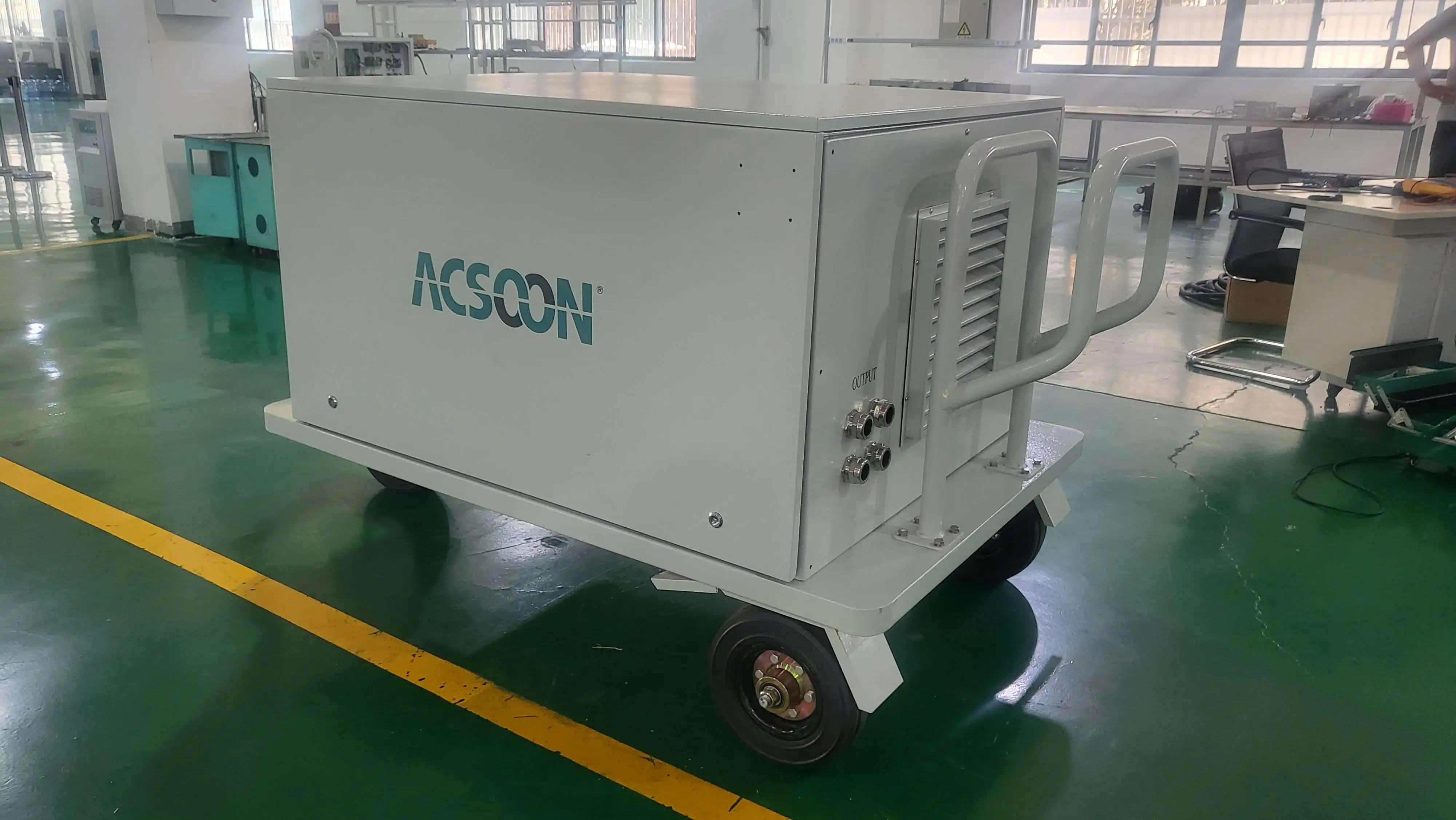
The ACSOON CH-D90 is a big step forward in long-lasting ground support tools. This 90kVA battery-driven e-GPU gets its clean 3×200VAC, 400 Hz power directly from DC battery packs. It doesn't need diesel fuel to run and doesn't produce any pollution while it's working. With an IP54 grade for ingress protection, the unit can handle the tough conditions of an airport, such as rain, dust, and changing temperatures. The trolley-mounted design lets it be sent to remote parking spots without a set ground power infrastructure. This fills in a very important practical gap for military forward operating bases and regional airports. The CH-D90 can run on batteries or connect easily to standard 50/60Hz, 380V-480V three-phase mains energy. This gives you more options for how it can be used than regular GPUs that use fuel.
This ability to work in two modes meets buying goals in a number of different situations. During busy times, airports can put battery units at faraway gates without having to spend a lot of money on expensive infrastructure upgrades. When checking avionics and running engines, maintenance centers can work inside without putting out any pollution. Military airbases can gain a tactical edge by delivering power without using IR signatures or making noise, which doesn't affect operational security. The environmental benefits are in line with ICAO goals to cut carbon emissions and local noise laws that are getting stricter and making it harder to use auxiliary power units (APUs) at big hubs.
Predictive Maintenance and Smart Diagnostics
When IoT devices and machine learning algorithms are combined, maintenance goes from being reactive to being proactive. Modern converters constantly check internal factors like junction temperatures, capacitor health, the performance of the cooling system, and the load features. Advanced algorithms find strange patterns that happen before parts break, which sets off automatic service alerts weeks before major breaks happen. This feature cuts unplanned downtime by 70% and extends the useful life of parts by using the best working settings. Connecting to the cloud lets you look at the performance of the whole fleet, which helps procurement managers find units that aren't working well and make replacement schedules that are based on real state instead of random time intervals.
Future Paradigms in Aircraft 400 Hz Power Supply Design
The way aircraft 400 Hz power systems are designed is changing from one-piece systems to modular, flexible structures that can react to quickly changing technologies.
Hybrid Frequency and Voltage Architectures
More and more, next-generation airplanes use mixed electrical systems that combine regular aircraft 400 Hz power AC with 270V DC and variable-frequency starter-generator systems. This multi-domain method makes the most of each type of power for its own purpose: AC is best for old systems and environmental controls, DC is best for electronics and LED lights, and variable frequency is best for propulsion and high-power movement. Ground support tools must be able to easily meet all of these different needs. Advanced power conditioning units have multiple outputs so they can provide both 400 Hz AC and controlled DC from a single input point at the same time. This combination cuts down on the number of cables that are lying around, makes things easier for the ground crew, and stops compatibility mistakes from happening during service.
Modular and Scalable Power Distribution
Modular design principles let you make changes to a system without having to rethink it completely. Standardized power units with 15kVA, 30kVA, 60kVA, and 90kVA ratings can be connected in parallel to meet the needs of different types of airplanes, from small business jets to wide-body jets. Hot-swappable parts make repair possible while the machine is running, so there are no single points of failure. Scalability is especially helpful for airlines with fleets of different types of planes because the same base units can be used for different kinds of planes by changing the software instead of replacing the hardware. This method lowers the cost of goods and makes it easier for technicians to learn how to use a wide range of tools.
Enhanced Safety Protocols and Certification Pathways
New developments in arc fault monitoring, ground fault protection, and automatic disconnect systems take safety issues head-on. New wire standards call for links that are good for composites and electromagnetic shielding that works best for carbon-fiber airframes, which conduct electricity differently than metal ones. Proven solid-state technology maturity is recognized by accelerated approval processes. This shortens the time it takes for new designs to reach the market while still ensuring strict safety proof. These changes make integration easier for both retrofit projects and the creation of new airplanes.

Market Trends and Supply Chain Dynamics for 400 Hz Aircraft Power Equipment
Because of changes in technology and politics, global demand trends for aircraft 400 Hz power systems and supplier communities are changing.
Growing Procurement Demand Across Aviation Sectors
As commercial flight recovers from the pandemic, more money is being put into ground support infrastructure. Airlines are focusing on lowering pollution and cutting costs. A lot of money is spent on electric ground support equipment as part of military development projects around the world. This equipment makes the military more ready and cuts down on the time and effort needed to get fuel. For testing the production line and putting together systems, industrial manufacturing sites that make commercial and military airplanes need a lot of 400 Hz power. For research labs that are qualifying aircraft parts, they need precise power sources that are very stable and don't produce a lot of noise. Specialized producers who offer custom solutions instead of one-size-fits-all goods can take advantage of this wide range of demand.
Supplier Differentiation and Value Propositions
Well-known aerospace names stay at the top of their fields thanks to a history of approval and extensive service networks. New specialized makers like JERRYSTAR set themselves apart by being able to customize their products, providing quick tech support, and offering cheap pricing that buying groups that are looking to save money will like. System integrators and dealers can offer value-added packages when they can give OEM-branded solutions. Airlines need to make sure their inventory is placed correctly so that it can be delivered quickly when unexpected equipment problems threaten flight plans that bring in money. Long-term relationship models with training programs, spare parts agreements, and performance promises keep customers coming back after they've bought something.
Supply Chain Resilience and Cost Management
Volatility in raw materials has an impact on copper windings, specialty magnetic materials, and electronic parts. When manufacturers use vertical integration methods and buy parts from more than one source, they are less likely to be affected by supply problems. Customers can better control their capital expenditure cycles with the help of bulk buying agreements and longer payment terms. Lifecycle cost analysis tools show that investing more up front in technology that is more efficient pays off in the long run by lowering the total cost of ownership. This is because the technology will use less energy and require less upkeep over a period of 15 to 20 years.
Strategic Recommendations for Selecting and Implementing Future-Proof 400 Hz Power Systems
Professionals in procurement have to look at a lot of different factors to make sure that aircraft 400 Hz power purchases provide long-term value and operating resilience.
Technical Performance and Compliance Criteria
When reviewing specifications, make sure that the frequency stability is at least 0.1%, the voltage control is at least 2% under load transients, and the harmonic distortion is less than 3% THD. Military standards (MIL-STD-704F, MIL-STD-461), civilian certifications (ISO 6858, RTCA DO-160), and area electrical safety rules must all be met by the equipment. Environmental grades that match the conditions of operation, like high altitude, extreme heat, or salt spray, keep things from failing too soon. Specifications for efficiency have a direct effect on running costs. For every percentage point increase in efficiency, thousands of hours of operation are saved.
Mission Profile Alignment and Customization Needs
For different uses, you need different skills. At big airports, gate operations are helped by fixed sites with a lot of space and backup designs that make sure service doesn't stop. Military operations and remote parking lots need mobile battery-powered units like the ACSOON CH-D90 that don't need to be connected to a power source. For fixing electronics problems, MRO centers need power that is very clean and doesn't make a lot of noise. When procurement teams understand these complex needs, they can choose the right features instead of buying over-engineered solutions that waste money.
Building Strategic Supplier Relationships
Evaluations of vendors should include more than just product specs. They should also look at how fast the technical support team is, how well they can do field service, and how well the engineers can work together on special projects. Suppliers with thorough training programs help workers improve their skills faster, which lowers operating mistakes. Clear information about product roadmaps helps customers plan technology update cycles that work with their budgets. Long-term investments are protected against becoming obsolete by warranty terms, the availability of extra parts, and ways to update older systems.
Conclusion
The world of aircraft 400 Hz power systems is changing quickly because of the need to be environmentally friendly, the progress made in technology, and the needs of operations. Electric ground power units that are powered by batteries, improved solid-state converters, and smart diagnostic systems get around old problems and make processes cleaner and more efficient. Procurement pros who know about new trends and judge providers on their ability to customize, technical dependability, and all-around support set their companies up for success. Strategic investments in aircraft 400 Hz power infrastructure that is ready for the future pay off in a big way for commercial airports, military bases, aerospace manufacturing, and specialized aviation operations. These investments lower emissions, lower lifecycle costs, and make operations more flexible so they can meet changing mission requirements.
FAQ
Why do aircraft use 400 Hz frequency instead of standard 60 Hz power?
According to the aircraft 400 Hz power frequency standard, electrical parts are about 80% smaller and lighter than their 60 Hz versions. Transformer and motor magnetic cores can work with less material and the same amount of power when the frequency is higher. This weight loss directly leads to lower fuel costs and more cargo space, both of which are important for the economy of flight.
What advantages do next-generation power converters offer over traditional rotary units?
Today's solid-state converters don't have any parts that wear out mechanically, so they can achieve efficiency rates above 95%, while rotating systems can only reach 70–85%. They are a lot lighter, make almost no noise, don't need much upkeep, and provide better power quality with harmonic distortion below 2%. Not having any moving parts also lets it work in any direction and gets rid of shaking problems.
How should procurement managers evaluate 400 Hz power equipment for compliance?
Check that the approval meets the requirements of relevant standards, such as MIL-STD-704F for military use, ISO 6858 for ground support tools, and RTCA DO-160 for airborne systems. Ask for test results that show how well the frequency stability, voltage control, and harmonic performance work with a real load. Check that the environmental ratings fit the deployment situations and that the supplier's quality management system certifications are real.
Partner with JERRYSTAR for Advanced Aircraft Ground Power Solutions
Through our ACSOON brand, JERRYSTAR makes aircraft-grade power conversion equipment that is used at business airports, military airbases, aerospace sites, and other specialized aviation activities all over the United States. Our ACSOON CH-D90 battery-driven e-GPU provides dependable 90kVA, 400 Hz power with no pollution and great operating freedom. As both a maker and a seller, we keep a large inventory on hand so that we can quickly meet pressing needs. Our engineering team also offers full customization to meet the specific needs of each task. Our 5,000–10,000-square-meter factory in China blends decades of experience with strict quality control in the aviation and defense power systems industries. Learn more about how our solutions provide better dependability, cost-effectiveness, and performance for important uses by contacting our technical team at acpower@acsoonpower.com to discuss your unique aircraft 400 Hz power needs.
References
1. Smith, J. R., & Anderson, K. L. (2022). Modern Aircraft Electrical Systems: Design, Integration, and Future Trends. Aerospace Technical Publishers.
2. International Civil Aviation Organization (2021). Environmental Protection: Aircraft Engine Emissions and Ground Support Equipment Standards. ICAO Annex 16, Volume II.
3. Martinez, C. D. (2023). "Solid-State Power Conversion Technologies for Next-Generation Aviation Ground Support." Journal of Aerospace Engineering and Technology, 45(3), 287-304.
4. Defense Logistics Agency (2020). MIL-STD-704F: Aircraft Electric Power Characteristics. United States Department of Defense.
5. Thompson, R., Education, Y., & Patel, S. (2023). "Lifecycle Cost Analysis of Electric Ground Power Units in Commercial Aviation." Aviation Maintenance and Economics Quarterly, 18(2), 112-129.
6. European Aviation Safety Agency (2022). Certification Specifications for Ground Support Equipment: Power Systems and Safety Requirements. EASA CS-GSE Amendment 4.