




Why Use a Variable AC Power Source in Industrial Applications?
Industrial testing, manufacturing, and R&D require stable and accurate power. Regular grid power often fails to meet these needs, with voltage fluctuations, frequency instability, and harmonic distortion. A variable AC power source solves these problems by converting grid power into clean, adjustable sine waves. Engineers can simulate conditions from around the world, protecting sensitive equipment during critical tests—from 400Hz aerospace electronics to consumer products meeting global voltage standards.
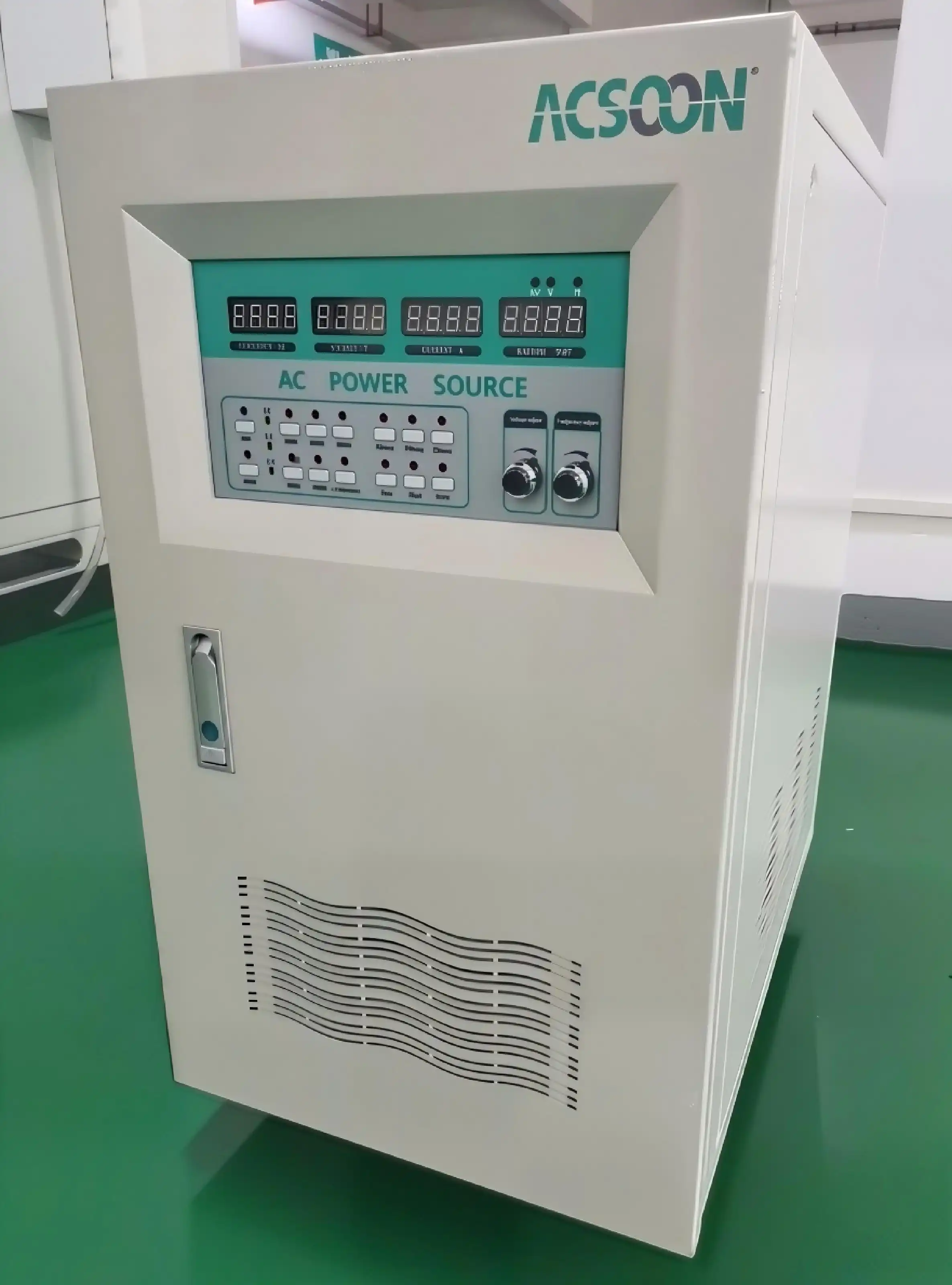
What Is a Variable AC Power Source?
Modern variable AC power sources use high-speed IGBT switches and PWM technology to convert utility power into precise outputs. Unlike simple transformers or variacs, they can adjust voltage and frequency automatically—for example, from 0–600V and 45–500Hz. Galvanic separation eliminates common-mode noise, keeping downstream devices safe from interference.
Key Features for Industrial Performance
| Parameter | Specification |
|---|---|
| Voltage Range | 0 – 300V / 0 – 600V |
| Frequency Range | 45Hz – 500Hz |
| Output Type | Pure sine wave |
| THD | <3% |
| Voltage Accuracy | ±0.1% |
| Frequency Stability | ±0.01Hz |
| Crest Factor | 3:1 |
| Power Factor | 0.8 – 1 (depends on load) |
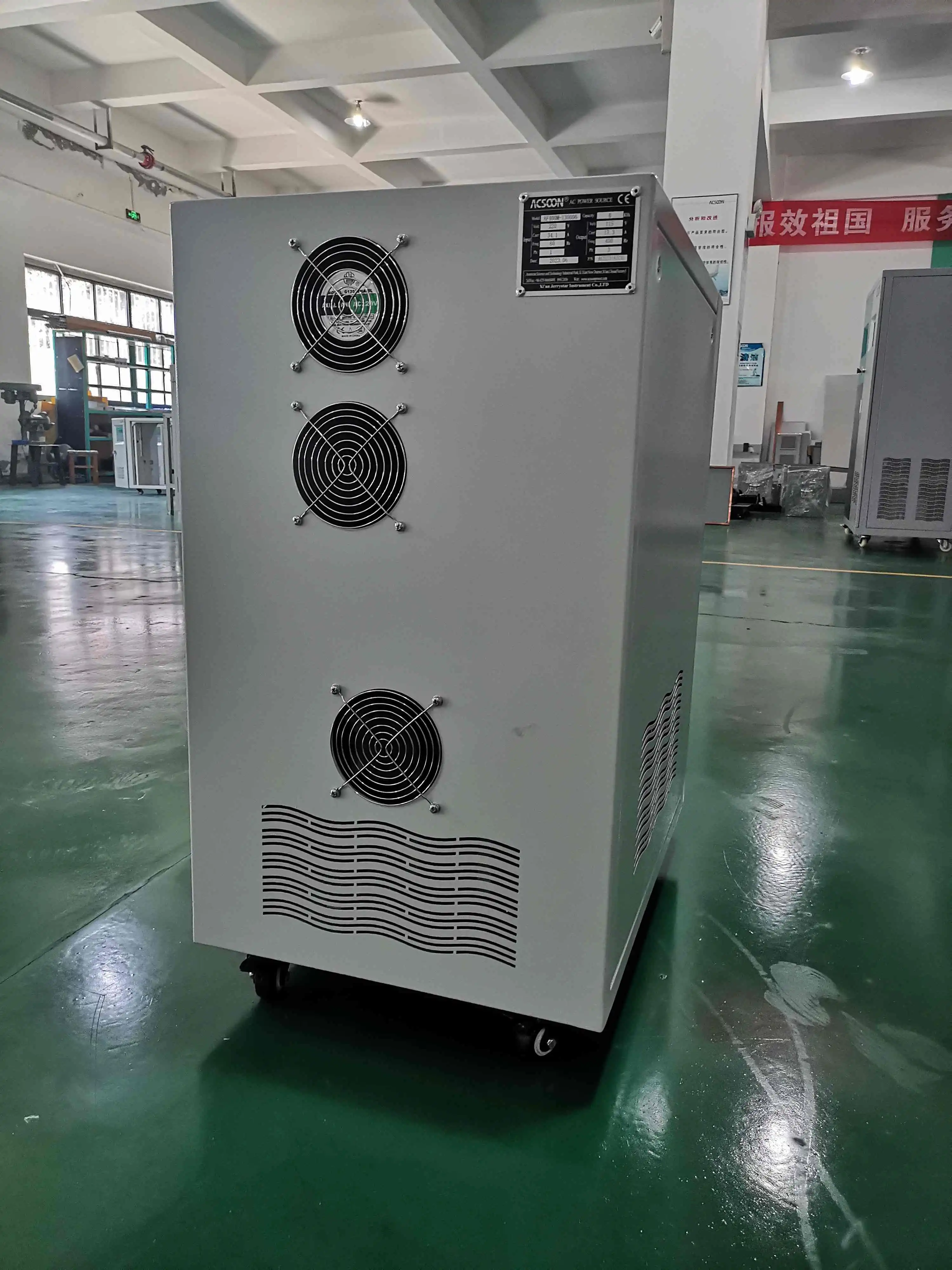
| Cooling Method | Forced air/fan cooling |
These specifications reduce the risk of test failures and costly rework in real industrial environments.
Types and Applications
| Type | Typical Use | Features |
|---|---|---|
| Tabletop / Benchtop | R&D labs | Programmable, compact, precise voltage/frequency control |
| Rack-mounted | Automated test equipment (ATE) | Integrates via RS232, GPIB, Ethernet; supports high-throughput testing |
| Floor-standing / High-power | Large industrial equipment/avionics systems | High power output, stable under heavy loads, supports automation |
Each type balances portability, capacity, and integration, depending on your operational needs.
Industrial Applications
Export Compliance and Global Market Readiness
Manufacturers exporting appliances face different voltage and frequency standards worldwide:
| Target Region / Application | Voltage | Frequency |
|---|---|---|
| Japan | 100V | 50Hz |
| North America | 120V | 60Hz |
| Europe | 230V | 50Hz |
| Aerospace / Avionics | 115V – 230V | 400Hz – 800Hz |
Variable AC power sources simulate these conditions in-house, eliminating expensive foreign testing centers. They help ensure control logic, heat performance, and safety interlocks meet CE, UL, or other certifications.
Aerospace and Defense Testing
Aircraft use 400Hz power, while military electronics may require up to 800Hz. Variable AC sources mimic grid disturbances, frequency drifts, and voltage fluctuations, meeting MIL-STD requirements and safeguarding mission-critical systems.
Automated Production Lines
Automated testing with variable AC sources simulates brown-outs, spikes, and outages. This improves consistency, speed, and repeatability, far beyond what human operators can achieve. IEC 61000-compliant stress tests, for example, verify EV chargers against real-world power events.
| Interface | Supported Protocols | Typical Use |
|---|---|---|
| RS232 | SCPI | Lab automation, remote control |
| USB | SCPI | PC-based test setups |
| Ethernet / LAN | SCPI, TCP/IP | Integration with LabVIEW / Python, remote monitoring |
Laboratory R&D
Research labs testing inverters, battery management systems, or green-energy devices need precise, programmable conditions. Variable AC sources allow engineers to inject harmonics, vary voltage/frequency, and monitor responses, streamlining development and compliance.
Choosing the Right Variable AC Power Source
Technical Considerations
- Voltage and frequency range to cover all target markets
- Power capacity with crest factor considerations
- Automation interfaces (LAN, RS232, SCPI for LabVIEW/Python)
- Integrated measurements for voltage, current, and harmonics
Commercial Considerations
- Total cost of ownership (warranty, support, lead time)
- Supplier reputation and inventory depth
- Scalability and modular design for future needs
Maintenance & Optimization
- Regular calibration with traceability to national standards (ISO 17025)
- Proper grounding and load setup prevent voltage drops and distortion
- Cooling and environmental controls extend device life
- Firmware updates improve speed, reliability, and accuracy
Future-Proof Solutions
Modular designs allow parallel operation for more power and easy integration with new automation systems. Trade-in programs reduce costs for obsolete units, ensuring your investment remains viable for years.
Conclusion
A variable AC power source ensures precise voltage and frequency control, helping manufacturers and labs simulate real-world conditions safely and efficiently. It reduces testing risks, improves accuracy, and supports compliance with global standards. Investing in a reliable, scalable source boosts productivity, minimizes failures, and keeps your operations competitive in international markets.
FAQ
1. What voltage/frequency ranges are needed for global testing?
100–240V and 50–60Hz cover most regions. Aircraft may need 400Hz.
2. Can these handle motor startup currents?
Yes. Crest factors of 3:1 allow high peak loads, with soft-start features.
3. How does low THD improve accuracy?
Reduces measurement errors and prevents equipment overheating, ensuring test reliability.
4. Can remote automation be done?
Yes. RS232, USB, Ethernet, and SCPI support LabVIEW, Python, and custom automation.
Partner with JERRYSTAR
Xi'an JERRYSTAR Instrument Co., Ltd. provides ACSOON variable AC power sources for labs, aviation, military, and industrial sectors.
- Customizable solutions for voltage, frequency, and integrated measurements
- Large inventory ensures fast delivery in urgent projects
- Manufacturer + distributor model ensures competitive pricing without sacrificing quality
Contact us: acpower@acsoonpower.com for quotes, technical consultations, and demo opportunities.
References
1. Institute of Electrical and Electronics Engineers (IEEE), "IEEE Standard 519-2014: Recommended Practice and Requirements for Harmonic Control in Electric Power Systems," IEEE Standards Association, 2014.
2. International Electrotechnical Commission, "IEC 61000-3-2:2018 Electromagnetic Compatibility (EMC) - Part 3-2: Limits for Harmonic Current Emissions," IEC Publications, Geneva, 2018.
3. Department of Defense, "MIL-STD-704F: Aircraft Electric Power Characteristics," Defense Standardization Program Office, U.S. Department of Defense, 2016.
4. Mohan, Ned, Undeland, Tore M., and Robbins, William P., "Power Electronics: Converters, Applications, and Design," 3rd Edition, John Wiley & Sons, 2003.
5. European Committee for Electrotechnical Standardization, "EN 50160:2010 Voltage Characteristics of Electricity Supplied by Public Distribution Networks," CENELEC, Brussels, 2010.
6. Rashid, Muhammad H., "Power Electronics Handbook: Devices, Circuits, and Applications," 4th Edition, Butterworth-Heinemann, 2017.
