



Singapore Customer Visit | WJF60W Partial Discharge Test Power Supply
Engineering Discussion on a Partial-Discharge-Free Power Supply: A Singapore Customer Visit
A customer visit focused on test requirements
ACSOON recently welcomed a customer from Singapore for a technical exchange on AC power sources used in high-voltage testing. During the visit, the customer reviewed the company’s partial-discharge-free power supply and gave positive feedback. The discussion also covered filtering requirements and related technical considerations.
The visit did not center on a single product specification in isolation. Instead, it addressed how a power source may fit into a broader test setup involving transformers, filters, measurement instruments, and the test object itself.
For engineering and procurement teams, this distinction matters. A static frequency converter for laboratory testing should be selected according to the complete test requirement, including voltage, frequency, load behavior, waveform quality, and interfaces with other equipment.
Why the power source matters in partial discharge testing
Partial discharge (PD) measurements are used to assess insulation behavior under electrical stress. In a test system, the power source and the rest of the test circuit work together. The source’s output characteristics, the test object, coupling and filtering arrangements, and measurement equipment can all affect the test setup.
A power supply described as “partial-discharge-free” should therefore be evaluated against the project’s actual requirements and the applicable test procedure. Buyers should confirm the required PD level, test voltage, frequency range, load profile, and system configuration with their engineering team and supplier before ordering.
The Singapore customer’s discussion of filtering reflects a practical engineering question: how should the source and filtering arrangement be considered together for the intended test? The answer depends on the test circuit and project conditions, so the configuration should be reviewed case by case.
WJF60W static frequency converter for high-voltage test systems
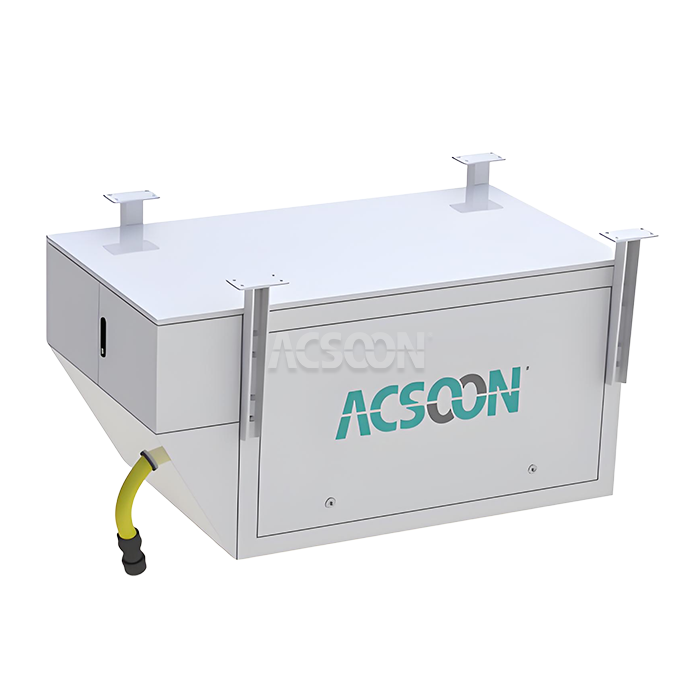
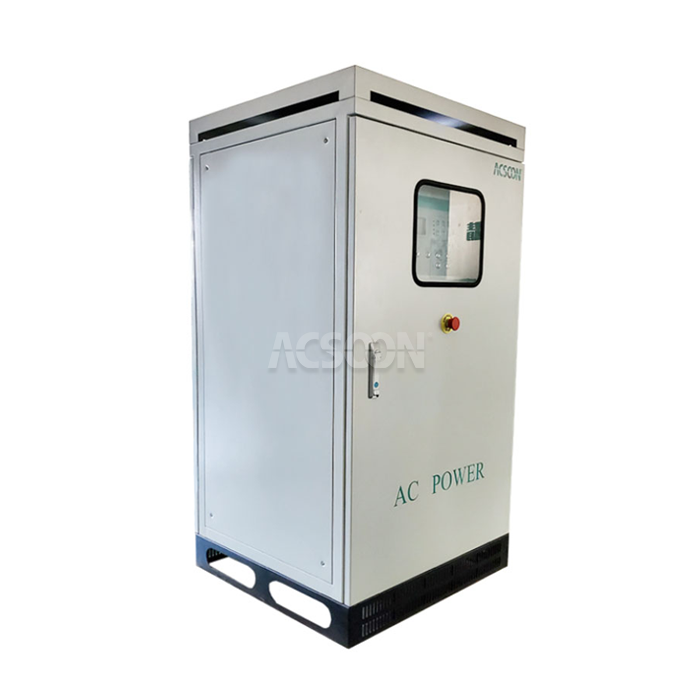
The ACSOON WJF60W series AC power supply / static frequency converter is designed for test applications that require adjustable AC voltage and frequency. According to the product specification, its intended applications include:
High-voltage cable withstand tests
Transformer induced-voltage tests
Transformer partial discharge tests
Current transformer, voltage transformer, and insulator tests
High-voltage insulation research
Depending on the selected configuration, WJF60W specifications include:
| Parameter | Specification |
|---|---|
| Input phases | Single-phase or three-phase |
| Nominal input voltage | 220V single-phase / 380V three-phase, or customized |
| Output phases | Single-phase or three-phase |
| Adjustable output voltage | 0.1–800V line-to-line, three-phase with grounding |
| Adjustable output frequency | 45–400Hz or customized |
| Voltage regulation and stability | ±1% FS |
| Frequency stability | ±0.1% FS |
| Output waveform distortion | THD <3% at linear loads |
| Partial discharge | ≤10pC |
| Communication | RS485 / RJ45 |
| Overload capacity | 125% for 30 seconds; 150% for 1 second |
Ratings and performance depend on configuration and operating conditions. Buyers should consult the technical datasheet and confirm the required model, output voltage, frequency, capacity, and environment before specifying the unit.
Questions procurement teams should confirm
When sourcing a static frequency converter for partial discharge testing, technical buyers can prepare the following information for a more useful review:
1. What is the test object?
Specify whether the system is for a power transformer, cable, current transformer, voltage transformer, insulator, or another high-voltage component.
2. What output is required?
Share the nominal and maximum voltage, frequency range, number of phases, and whether the output needs to be adjustable during the test.
3. What load will be connected?
Provide load type and relevant electrical characteristics. Transformer and capacitive test loads can require different considerations from a general linear load.
4. What are the waveform and PD requirements?
Identify the required waveform quality, target PD level, and the measurement method or standard used by the test team.
5. What filtering and interfaces are needed?
Describe any external filter, isolation transformer, inductor, PD instrument, or remote-control requirement. Include communication and site constraints where relevant.
This information helps the supplier assess whether the proposed AC power supply is suitable for the intended test system and whether customization or additional equipment needs to be considered.
From technical exchange to project review
The Singapore visit provided an opportunity to discuss the customer’s technical questions directly and review the WJF60W application. It also reinforced the value of discussing the complete test setup—not just the power rating—when evaluating a high-voltage test power supply.
ACSOON welcomes project discussions from test laboratories, transformer manufacturers, cable testing facilities, utilities, and engineering teams. To begin a technical review, share your test object, input supply, required output voltage and frequency, load characteristics, and any filtering or communication requirements.
Related product: ACSOON WJF60W Static Frequency Converter
Related topic: How to Select a Static Frequency Converter for High-Voltage Testing
Contact: sales1@acsoonpower.com;acpower@acsoonpower.com
Website: https://www.jrd-instrument.com/;https://acsoonpower.com/


1_1790735436221.webp)
_1790734797777.webp)