




50Hz vs 60Hz Frequency Conversion Explained: Differences, Applications and How to Choose the Right Frequency Converter
50Hz vs 60Hz Frequency Conversion Explained: Differences, Applications and How to Choose the Right Frequency Converter
Introduction
When purchasing electrical equipment for international projects, one of the most common technical challenges is power compatibility.
Although electricity is standardized worldwide, different countries and regions use different AC power frequencies.
Most countries operate on 50Hz power systems, while some regions, including the United States, Canada, parts of South America and some Asian countries, use 60Hz power systems.
For companies importing industrial machinery, testing equipment, aviation ground power systems, marine electrical equipment or specialized power supplies, the difference between 50Hz and 60Hz is not only a technical specification — it directly affects equipment performance, reliability and operational safety.
A 50Hz to 60Hz frequency converter or 60Hz to 50Hz frequency converter provides a stable solution by converting the input power frequency into the frequency required by the connected equipment.
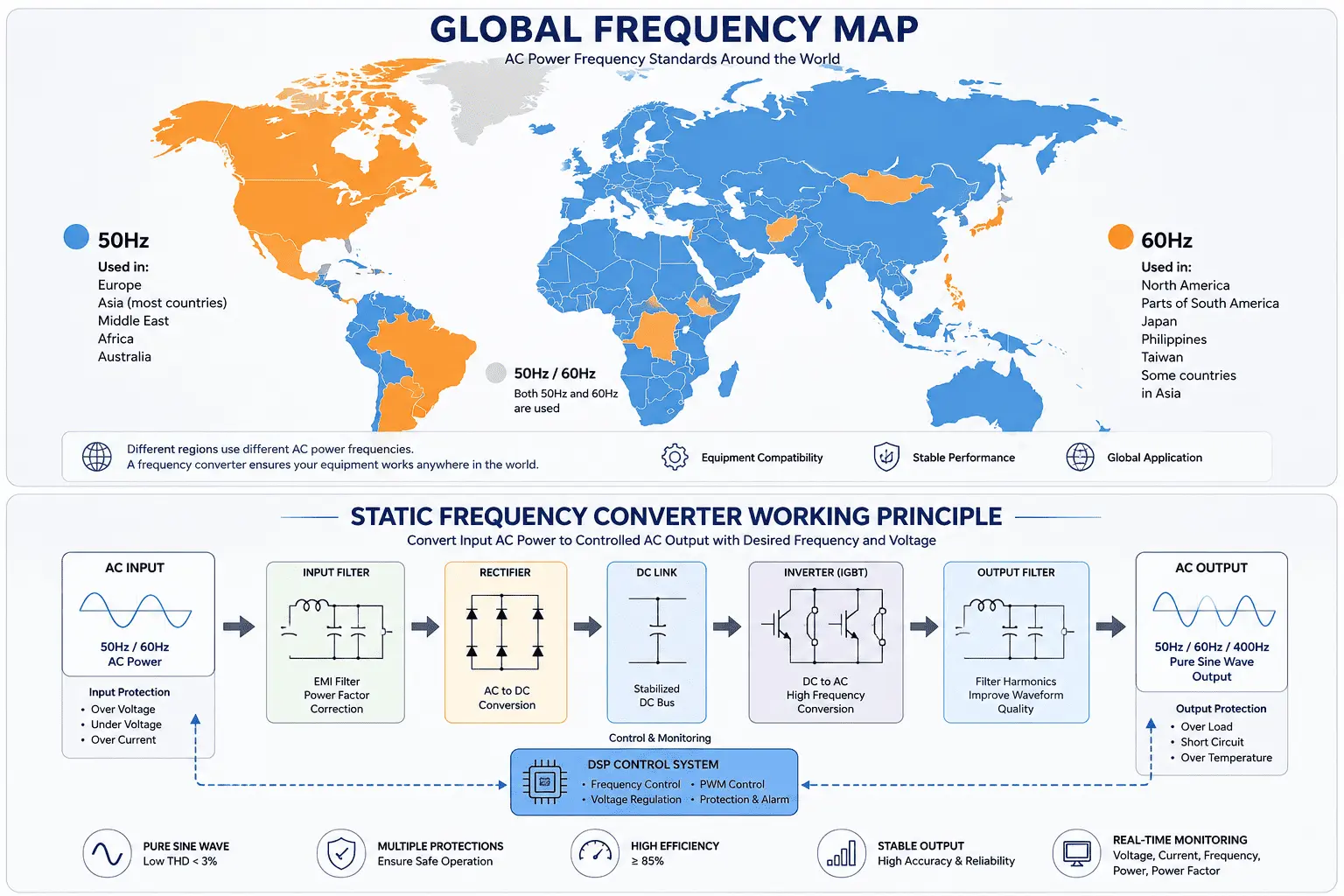
What Is the Difference Between 50Hz and 60Hz?
Frequency refers to the number of times alternating current changes direction per second.
50Hz means the AC waveform completes 50 cycles per second.
60Hz means the AC waveform completes 60 cycles per second.
Although the difference appears small, it significantly affects electrical equipment operation.
| Parameter | 50Hz System | 60Hz System |
|---|---|---|
| Frequency | 50 cycles/sec | 60 cycles/sec |
| Common Regions | Europe, Middle East, Africa, Asia-Pacific | USA, Canada, parts of Americas |
| Motor Speed | Lower | Higher |
| Transformer Design | Optimized for 50Hz | Optimized for 60Hz |
| Equipment Compatibility | Depends on design | Depends on design |
Why Does Frequency Matter?
Many people assume that electrical equipment only requires the correct voltage.
However, frequency is equally important.
Electrical equipment such as:
motors
transformers
pumps
compressors
laboratory equipment
aviation power systems
industrial automation equipment
are designed according to specific frequency requirements.
If a 50Hz machine operates on 60Hz power, or a 60Hz machine operates on 50Hz power, several problems may occur:
1. Motor Speed Changes
The speed of AC motors is related to supply frequency.
A motor designed for 60Hz operation will run approximately slower when connected to 50Hz power.
Possible effects:
reduced output performance
insufficient mechanical speed
overheating
increased operating stress
2. Transformer Performance Changes
Transformers are designed based on frequency, voltage and magnetic flux.
Using an incorrect frequency may cause:
higher magnetic saturation
increased temperature
reduced efficiency
shortened equipment lifespan
3. Electronic Equipment Stability Issues
Sensitive equipment may require precise frequency stability.
Applications such as:
testing laboratories
aerospace equipment
communication systems
industrial control systems
often require regulated frequency output.
What Is a 50Hz to 60Hz Frequency Converter?
A frequency converter is a power electronic device that changes the input AC frequency into a controlled AC output frequency.
Typical conversion examples:
50Hz Input → 60Hz Output
Used when:
European power supply is used for American equipment
imported machinery requires 60Hz operation
export products need North American compatibility
60Hz Input → 50Hz Output
Used when:
American equipment is installed in Europe
industrial systems are relocated internationally
manufacturers perform overseas equipment testing
Modern static frequency converters normally use power semiconductor technology such as IGBT inverter systems to provide:
stable frequency output
low harmonic distortion
high conversion efficiency
protection functions
digital monitoring
Static frequency converters are widely used where voltage, frequency or phase arrangement must match specific equipment requirements.
50Hz vs 60Hz: How Procurement Teams Should Evaluate
Professional buyers usually consider the following factors before selecting a frequency converter.
1. Input Power Specification
Confirm:
Input voltage
Input frequency
Single phase or three phase
Grid stability
Example:
Europe:
380V / 400V / 415V
50Hz
Three Phase
Middle East industrial projects:
380V / 415V
50Hz
USA:
480V
60Hz
Three Phase
2. Output Requirements
The converter must match:
equipment frequency
voltage level
phase requirement
continuous power rating
Common configurations:
Single Phase 50Hz → 60Hz
Three Phase 50Hz → 60Hz
Single Phase 60Hz → 50Hz
Three Phase 60Hz → 50Hz
3. Power Capacity Selection
Capacity is normally expressed in:
kVA
kW
Selection should consider:
continuous load
startup current
motor characteristics
power factor
duty cycle
For example:
A motor load may require a higher converter capacity than a purely resistive load.
50Hz/60Hz Frequency Conversion Applications
Industrial Manufacturing
Many factories import production equipment internationally.
Typical situations:
European factory:
50Hz facility
↓
Imported USA machinery:
60Hz requirement
↓
Need:
50Hz to 60Hz frequency converter
Aviation Ground Power
Aircraft electrical systems use different frequency standards from normal utility power.
Aircraft commonly require 400Hz AC power instead of standard 50Hz or 60Hz grid power.
Therefore airports use aircraft ground power frequency converters to convert available grid power into aircraft-compatible power.
Typical conversion:
50Hz / 60Hz Grid
↓
400Hz Static Frequency Converter
↓
Aircraft Ground Power Unit (GPU)
Marine and Ship Applications
International vessels often operate between different electrical standards.
Frequency converters allow:
shore power compatibility
shipyard testing
international port operation
50Hz and 60Hz conversion is commonly used in marine electrical systems.
Why Choose Static Frequency Converter Instead of Traditional Rotary Converter?
Traditional motor-generator systems have limitations:
larger size
mechanical wear
higher maintenance requirements
more noise
Modern static frequency converters provide:
compact structure
high efficiency
intelligent protection
easier maintenance
stable output quality
How to Select the Correct Frequency Converter?
Before purchasing, prepare:
Electrical Information
✓ Input voltage
✓ Input frequency
✓ Output voltage
✓ Output frequency
✓ Phase requirement
Load Information
✓ Equipment type
✓ Rated power
✓ Starting current
✓ Operating environment
Application Information
✓ Factory
✓ Airport
✓ Laboratory
✓ Marine
✓ Military
✓ Testing facility
Conclusion
50Hz and 60Hz are two major global power frequency standards.
For international equipment deployment, frequency compatibility is a critical factor affecting equipment reliability and operational efficiency.
A professional 50Hz to 60Hz frequency converter or 60Hz to 50Hz frequency converter provides a reliable solution by delivering precise and stable AC power for different applications.
From industrial machinery to aviation ground power systems, frequency conversion technology helps global equipment operate safely across different electrical environments.