



Pure Sine Wave Output Explained: THD, Loads and Selection
Pure Sine Wave Output Explained: Why Waveform Quality Matters
“Pure sine wave output” appears frequently in specifications for inverters, uninterruptible power supplies, static frequency converters and programmable AC power sources. It is often presented as a simple quality label, but professional equipment selection requires a more precise understanding.
A pure sine wave is not defined by appearance alone. Engineers need to consider harmonic distortion, voltage regulation, frequency stability, crest factor, load response and the conditions under which the output was tested.
This guide explains what pure sine wave output means, where it matters and what procurement teams should verify before selecting an industrial AC power source.
What Is a Pure Sine Wave?
Alternating current changes direction periodically. In an ideal sinusoidal waveform, voltage rises smoothly from zero to a positive peak, returns through zero, reaches a negative peak and then repeats the cycle.
The number of complete cycles per second is the frequency:
50 cycles per second equals 50Hz
60 cycles per second equals 60Hz
400 cycles per second equals 400Hz
A stable utility grid is normally expected to provide a waveform close to a sine wave. Industrial inverters and static frequency converters recreate this AC waveform through controlled power-electronic switching and filtering.
A practical power converter cannot produce a mathematically perfect waveform. Therefore, “pure sine wave” generally describes a low-distortion sinusoidal output that is suitable for loads designed to operate from standard AC power.
Pure Sine Wave Versus Modified Sine Wave
A modified sine wave does not follow a continuously changing curve. It normally uses a stepped output to approximate positive and negative portions of the AC cycle.
| Comparison | Pure sine wave output | Modified sine wave output |
|---|---|---|
| Waveform | Smooth sinusoidal form | Stepped approximation |
| Harmonic content | Generally lower | Generally higher |
| Motor operation | Usually smoother | May create additional noise or heat |
| Measurement applications | More suitable for precision work | May affect measurement accuracy |
| Sensitive electronics | Better compatibility | Compatibility depends on the equipment |
| Cost and complexity | Higher | Usually lower |
| Industrial testing | Commonly preferred | Limited application |
Modified sine wave power may be acceptable for some resistive or noncritical loads. It should not automatically be described as unsuitable for every electronic device. Compatibility depends on the input design of the connected equipment.
For professional applications, the decision should be based on the actual load rather than a general assumption.
What Is Total Harmonic Distortion?
A distorted waveform contains frequency components in addition to the fundamental frequency. These components are called harmonics.
For a 50Hz system, harmonic frequencies may include 100Hz, 150Hz, 200Hz and higher multiples. For a 60Hz system, they may include 120Hz, 180Hz and 240Hz.
Total harmonic distortion compares the combined RMS value of the harmonic components with the RMS value of the fundamental component:
THD = RMS value of all harmonic components ÷ RMS value of the fundamental component × 100%
A lower voltage THD usually means the output waveform is closer to an ideal sine wave.
However, a THD figure is meaningful only when the test conditions are known. Buyers should determine:
Whether the figure is voltage THD or current THD
Whether it was measured with a linear or nonlinear load
The percentage of rated load used during testing
Whether the value is typical or guaranteed
The frequency range included in the measurement
Whether the measurement was taken at the converter terminals or at the load
The ACSOON AF60W static frequency converter, for example, specifies output VTHD below 3% with a linear load. The load condition is an important part of that statement.
Related product:
ACSOON AF60W Static Frequency Converter with Pure Sine Wave Output
Why Can Waveform Distortion Affect Equipment?
1. Motors and pumps
Induction motors are designed around sinusoidal AC power. Harmonic voltage can produce additional harmonic currents, torque pulsation, audible noise and heat.
This does not mean that every distorted waveform will immediately damage a motor. The result depends on distortion level, loading, cooling, motor design and operating time. For continuous industrial operation, waveform quality and starting capacity should both be reviewed.
2. Transformers
Harmonic components may increase core and winding losses. A transformer can therefore run warmer even when an ordinary meter appears to show the correct RMS voltage.
Transformer magnetizing current and energization inrush must also be considered when sizing the source.
3. Laboratory and measurement equipment
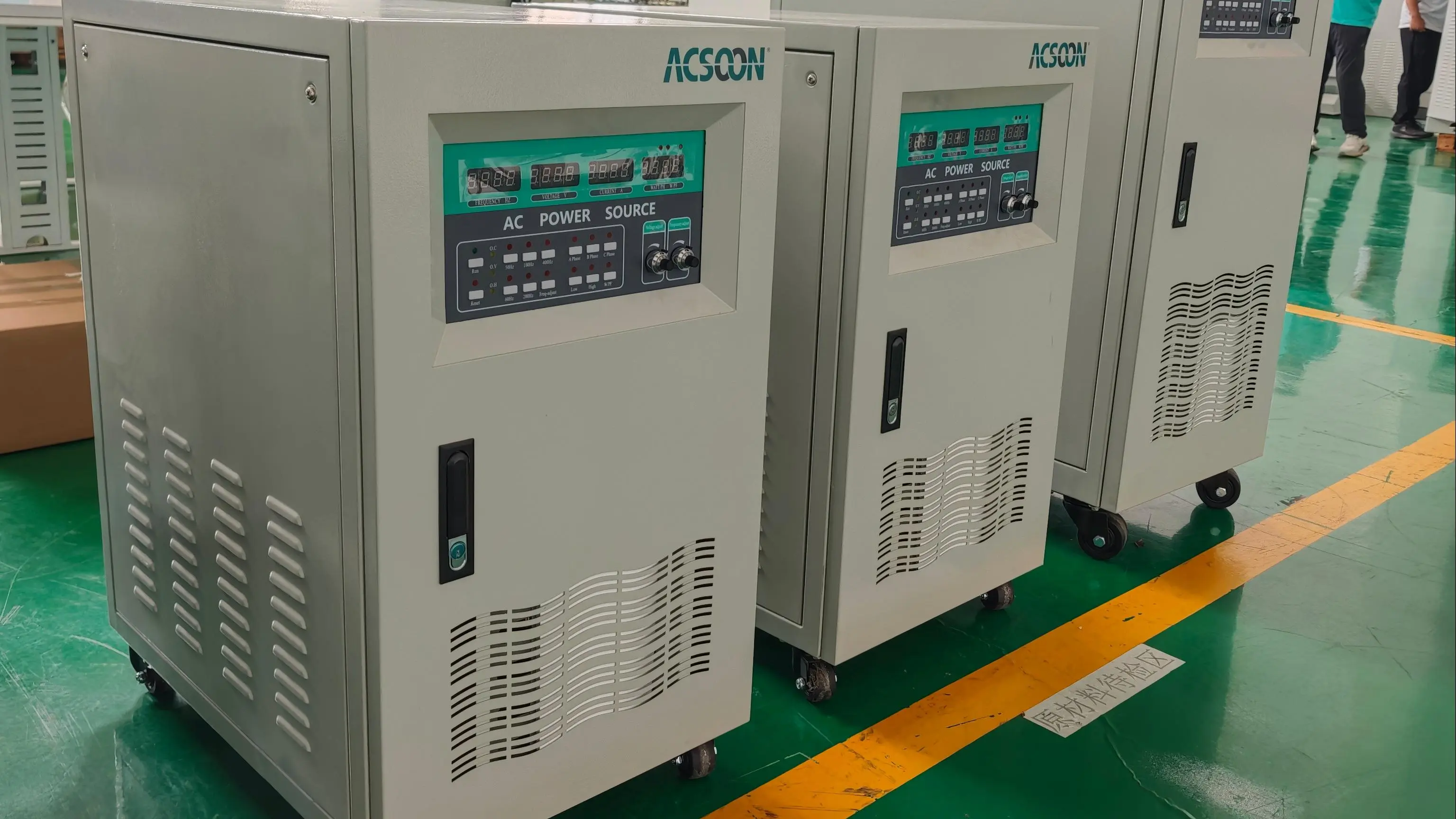
Test results are difficult to reproduce if the power source changes with the load. Laboratories may require low-distortion output, stable voltage, accurate frequency and remote control.
A programmable source may also be required when the test involves voltage steps, frequency changes or repeated operating sequences.
Related product:
Programmable AC Power Source 45–800Hz
4. Avionics and 400Hz equipment
Aircraft electrical equipment commonly operates from 115/200V, 400Hz AC power. Supplying the correct RMS voltage without controlling frequency, phase balance and distortion is not sufficient for professional avionics testing.
Maintenance facilities, component manufacturers and test laboratories should review the required aircraft power standard and the equipment manufacturer’s limits before selecting a source.
Related product:
Aircraft Power Supply 400Hz
5. Marine equipment
Vessels moving between regions may encounter different shore voltages and frequencies. The available dock supply can also vary with local loading conditions.
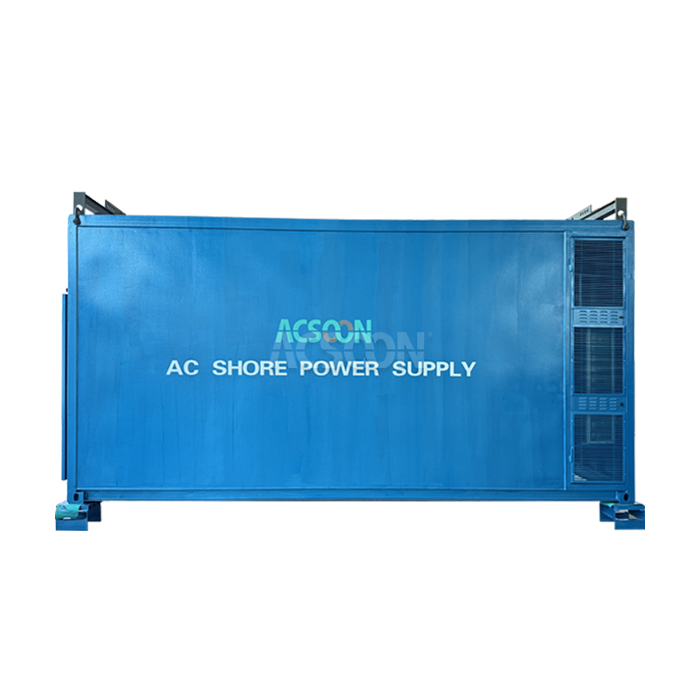
A marine frequency converter can separate the onboard distribution system from these variations and provide the required voltage and frequency. Procurement teams should additionally consider phase imbalance, enclosure protection, cooling, corrosion environment, bypass arrangements and classification requirements.
6. Military and communication systems
Communication, surveillance and control systems may require stable power during continuous operation. In these applications, pure sine wave output is only one part of the specification.
Isolation, redundancy, electromagnetic compatibility, environmental performance, maintainability and input-source changeover may be equally important.
Are All Electronic Loads Sensitive to Modified Waveforms?
No.
Many modern electronic products first rectify incoming AC into DC through a switch-mode power supply. Some can operate across a wide input-voltage and frequency range.
However, this does not prove compatibility with every inverter. Input filters, power-factor-correction circuits, peak current demand, leakage-current monitoring and internal timing circuits can respond differently to distorted power.
If the load is commercially or operationally critical, compatibility should be confirmed through:
The equipment manufacturer’s input-power specification
Review of inrush current and peak current
Full-load or representative-load testing
Waveform and THD measurement at the load terminals
Temperature and stability monitoring during extended operation
Pure Sine Wave Does Not Mean the Power Source Is Correctly Sized
A low-distortion waveform cannot compensate for insufficient capacity.
A source may produce an acceptable waveform at light load but reach current limiting when a compressor, transformer or motor starts. This can cause a voltage dip, shutdown or failure to start the load.
Before choosing the rated kVA, collect:
Continuous active power in kW
Apparent power in kVA
Power factor
Starting current
Peak current duration
Load sequence
Single-phase or three-phase connection
Degree of phase imbalance
Future expansion requirement
For nonlinear electronic loads, crest factor and peak-current capability may be more important than a simple wattage calculation.
How to Evaluate a Pure Sine Wave Power Source
A professional specification should include the following points.
Output waveform and THD
Request the voltage THD limit and its test conditions. Avoid comparing two figures if one was measured under a linear load and the other under a nonlinear load.
Voltage regulation
Voltage regulation describes how closely the source maintains the required output as input conditions or load levels change.
Frequency stability
Frequency stability is especially important for imported equipment, rotating loads, timing-dependent systems and 400Hz aviation applications.
Dynamic response
Ask how the output behaves when the load changes suddenly. A fast response can reduce the depth and duration of voltage deviations.
Overload and starting capability
Confirm both the overload percentage and permitted duration. A motor start lasting several seconds cannot be evaluated from a millisecond peak-current figure alone.
Isolation
A galvanically isolated output may improve system separation and support application-specific grounding arrangements. It does not eliminate the need for correct earthing and electrical protection.
Protection functions
Typical requirements include overvoltage, undervoltage, overcurrent, overload, short-circuit and overtemperature protection.
Installation environment
Temperature, altitude, humidity, dust, salt atmosphere, ventilation and IP rating can affect both selection and derating.
Which Type of Power Source Should Be Selected?
| Requirement | Suitable equipment category |
|---|---|
| Convert battery or DC-bus power into AC | DC to AC pure sine wave inverter |
| Convert 50Hz to 60Hz or 60Hz to 50Hz | Static frequency converter |
| Generate controlled test voltage and frequency | Programmable AC power supply |
| Supply 115/200V 400Hz aviation equipment | 400Hz static frequency converter or GPU |
| Condition worldwide shore power for a vessel | Marine frequency converter |
| Stabilize fluctuating voltage and frequency | Voltage and frequency stabilizer |
Information to Send With an Inquiry
To shorten the technical-selection process, provide:
Input voltage, frequency and phase
Output voltage, frequency and phase
Load name and operating function
Rated kW, kVA, current and power factor
Starting or inrush current
Required output THD
Linear, nonlinear, capacitive or inductive load type
Installation temperature, altitude and IP requirement
Communication interface
Applicable technical standards
Required redundancy or bypass arrangement
Site photos, nameplate photos or a single-line diagram
Frequently Asked Questions
Is pure sine wave output the same as utility power?
It is intended to reproduce a low-distortion sinusoidal AC waveform, but actual performance depends on the converter, load and operating condition. Compare measurable specifications rather than relying only on the product label.
Is lower THD always better?
Lower THD generally indicates a waveform closer to an ideal sine wave. The required limit should still be determined by the load, applicable standard and project risk.
Can a pure sine wave inverter run a motor?
It may be suitable if its continuous capacity, starting current, voltage stability and overload capability match the motor. “Pure sine wave” alone does not confirm correct sizing.
Does a frequency converter also regulate voltage?
A static AC–DC–AC frequency converter can generate a controlled output voltage and frequency, but the available adjustment range and regulation accuracy must be verified for the selected model.
How should THD be measured?
Use appropriate power-quality or waveform-measurement equipment and record the load type, load percentage, voltage, frequency and measurement point. A single unloaded oscilloscope image is not a complete performance test.
Conclusion
Pure sine wave output is important because connected equipment responds to the shape and quality of AC power, not only to the voltage shown on a display.
For industrial procurement, the most reliable approach is to treat waveform quality as part of a complete power specification. THD, voltage regulation, frequency stability, peak-current capability, load compatibility, protection and environmental conditions should be evaluated together.
Xi’an Jerrystar Instrument Co., Ltd. provides ACSOON frequency converters, programmable AC power sources, 400Hz aviation supplies and customized industrial power-conversion systems.