



How to Specify a Programmable AC Power Supply for Laboratory and Production Testing
Introduction
A programmable AC power supply should reproduce a defined electrical condition for a device under test. Capacity matters, but it is not the first or only selection variable. The source must match the available site power, the required output envelope, the load behavior and the sequence the engineer intends to run.
This distinction is important in laboratories, aerospace component testing, export-equipment validation and production lines. A buyer who specifies only kVA and maximum frequency may receive technically different quotations because each supplier has assumed a different test method, control interface or operating duty.
Start with the test objective
The first question is what the source must prove or reproduce. A production line may need one stable output condition for every unit. A research laboratory may need several voltage and frequency points. An imported-equipment test may require 50 Hz and 60 Hz operation. An aerospace component bench may require a controlled 400 Hz condition.
Write the objective in one sentence before listing parameters. For example: the source will power a three-phase device under test through a repeated sequence of voltage and frequency setpoints. That sentence gives the engineering team more context than a capacity value alone.
Define the available input
Record the actual supply at the installation point: voltage, frequency, phase system and available capacity. Do not infer this information only from the country. Factories, laboratories, ships and dedicated test facilities may use internal distribution systems that differ from the public grid.
The installation plan should also identify the upstream breaker, protective earth, cable route and ventilation. The ACSOON programmable AC power supply manual requires the correct input selection and a secure earth connection before operation. The approved model documentation governs the final wiring and protection arrangement.
Define the output envelope
List the minimum, nominal and maximum output voltage, the required frequency points or range, and the output phase configuration. State whether the test needs fixed 50 Hz, fixed 60 Hz, fixed 400 Hz, several discrete points or an adjustable range.
If the test requires a sequence, add the order of the setpoints, dwell time at each point, transition or rise-time expectation, number of cycles and pass/fail limits. A programmable source is selected around this sequence, not simply around its highest value.
Describe the load
Provide the load nameplate and describe whether the device is mainly resistive, inductive, rectifier-based, electronic or mixed. Rated watts, kVA, current and power factor are related but are not interchangeable without the rest of the electrical information.
Starting or inrush current should be included whenever motors, pumps, compressors, transformers or input rectifiers are involved. The ACSOON manual treats resistive, inductive, rectifier and hybrid loads differently when considering power capacity. The final capacity calculation should therefore be performed from the actual load data and the selected model specification.
Decide how the test will be controlled
Some applications only need local panel control. Others need computer control, repeated memory programs, loop testing or communication with a larger automated test system. State the required interface and the commands or data that must be exchanged.
Do not assume that every interface or software function is standard on every model. Ask the supplier to identify which functions are included, which are optional and which require project-specific engineering.
Set protection and measurement expectations
The requirement should identify overvoltage, overcurrent, overload, overtemperature and short-circuit protection expectations, together with the measurements the operator needs to view or record. If test accuracy is important, separate display resolution from measurement accuracy and define how results will be verified.
Where acceptance testing is required, agree on the input condition, load condition, instruments, measurement points and acceptance limits before production. This prevents a data-sheet value and a site test from being compared under different conditions.
Include operating duty and environment
State whether the source operates occasionally, for one shift or continuously. Add ambient temperature, humidity, altitude, dust, ventilation and indoor or outdoor conditions. A short laboratory test and a continuous production process may have the same nominal load but different thermal requirements.
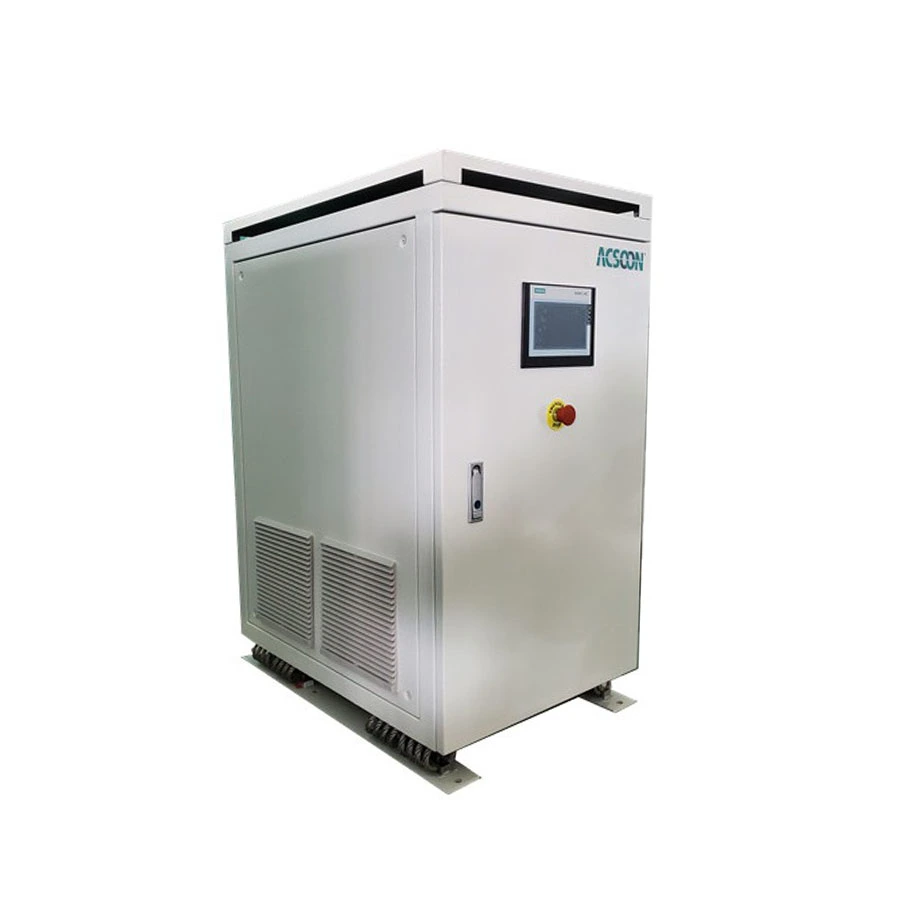
The final enclosure, cooling method, cable entry and maintenance clearance should be confirmed for the installation rather than assumed from a product photograph.
A practical RFQ structure
A useful RFQ contains nine groups: application, site input, required output, phase system, load data, inrush behavior, test sequence, control interface and environment. Attach the load nameplate, one representative test cycle and any system connection drawing.
If a value is unknown, mark it as pending confirmation. An explicit unknown is safer than an invented number because it tells both parties where engineering work is still required.
Conclusion
A programmable AC power supply should be selected from a written test profile. Capacity, voltage and frequency remain essential, but the load, sequence, control, protection, measurement, operating duty and installation conditions determine whether the system can perform the intended test.
Send the test profile and load information before requesting a final model recommendation. The supplier can then identify the applicable standard configuration, options and items that require engineering confirmation.