



What Is an Avionics Test Power Supply and How Does It Work?
Avionics systems are the electronic brains of modern aircraft, governing everything from navigation and communication to flight control and engine management. Testing these systems requires a power source that faithfully replicates the aircraft's onboard electrical environment — typically 115V AC at 400Hz. An avionics test power supply is a specialized frequency converter designed to deliver this precise power waveform in a laboratory, production line, or maintenance hangar setting. Without it, avionics manufacturers and MRO facilities cannot verify that their equipment will perform reliably once installed in an aircraft.
In this article, we examine what an avionics test power supply is, how it converts standard utility power into aircraft-grade 400Hz AC, the key specifications that matter for avionics certification, and how facilities select the right unit for their testing programs. Whether you operate an avionics repair shop, an aerospace R&D lab, or a flight line maintenance operation, understanding these power supplies is fundamental to ensuring that the equipment you test today will perform flawlessly in flight tomorrow.

What Does an Avionics Test Power Supply Do?
An avionics test power supply takes standard utility power — typically 50Hz or 60Hz at 220V, 380V, or 480V — and converts it into the 115V AC, 400Hz output that most commercial and military aircraft use for their onboard electrical systems. This conversion is not simply a matter of changing voltage. The output must also meet stringent requirements for frequency stability, harmonic distortion, and transient response that mirror the aircraft's own power bus characteristics.
The reason aircraft use 400Hz instead of the more common 50Hz or 60Hz is weight. At higher frequencies, transformers and motors can be built smaller and lighter for the same power rating — a critical advantage in aviation where every kilogram matters. However, this means that any ground-based or benchtop testing of avionics equipment requires a power source capable of producing that same 400Hz output with high fidelity. A standard utility-frequency power source simply will not work.
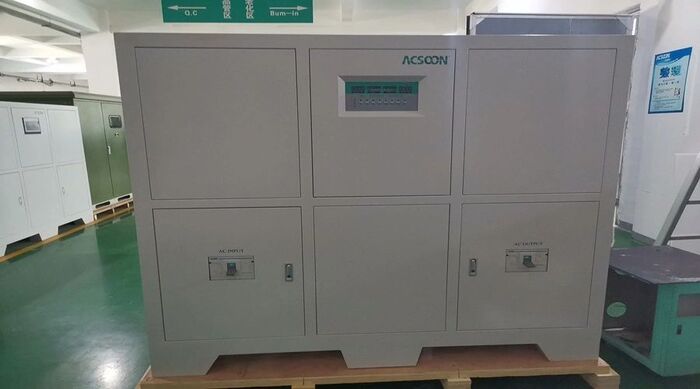
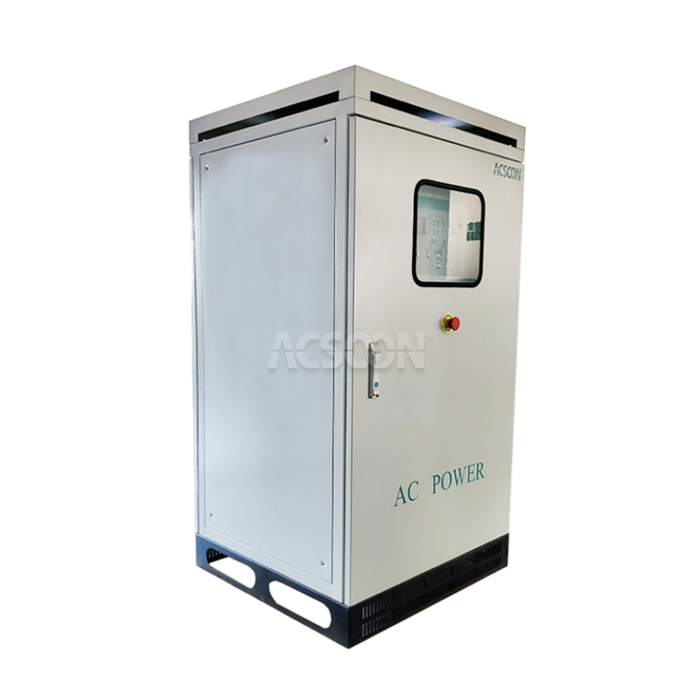
Modern avionics test power supplies, such as the ACSOON AF400M Series and ACP400 Series, use solid-state frequency conversion technology to achieve this. Unlike older rotary converters that relied on a motor-generator set, solid-state units have no moving parts, produce cleaner output waveforms, and offer precise digital control over voltage and frequency. This makes them ideal for the sensitive electronic equipment that comprises modern avionics suites.
Need a 115V 400Hz avionics test power supply? View Product Details → or contact us at acpower@acsoonpower.com for a quotation.
How Does a 400Hz Solid-State Frequency Converter Work?
The core of a solid-state avionics test power supply is the SPWM (Sinusoidal Pulse Width Modulation) technique combined with IGBT (Insulated Gate Bipolar Transistor) power modules. The conversion process works in several stages:
- Rectification stage: The input AC power (50Hz or 60Hz) is first rectified into DC through a multi-pulse rectifier. A 12-pulse rectifier is commonly used in larger units to reduce input harmonic distortion and improve power factor.
- DC bus: The rectified DC is smoothed by a capacitor bank, creating a stable DC bus voltage. Some designs include an active power factor correction (PFC) stage at this point to meet grid-side harmonic standards.
- Inversion stage: The DC bus voltage is then converted back to AC at the desired output frequency (400Hz) and voltage (115V) using IGBT-based H-bridge inverter modules controlled by SPWM. The pulse width modulation pattern is calculated to produce a clean sinusoidal output waveform.
- Output filtering: The raw SPWM output contains high-frequency switching harmonics that are removed by an LC output filter, leaving a clean sine wave with low total harmonic distortion (THD), typically below 2% to 3%.
- Control and monitoring: A digital control system continuously monitors output voltage, current, frequency, and power factor, adjusting the modulation in real time to maintain stability under varying load conditions.
This architecture allows the power supply to maintain tight tolerances — typically ±1% voltage regulation and ±0.1% frequency stability — which are essential for testing avionics equipment that may be sensitive to even small power fluctuations. The solid-state approach also provides fast transient response, meaning the output recovers quickly when a load is suddenly applied or removed, mimicking the dynamic conditions an avionics unit might experience in actual flight.

Key Specifications for Avionics Testing
When selecting an avionics test power supply, several specifications directly affect the validity and reliability of your test results. Here are the parameters that matter most:
| Specification | Typical Requirement | Why It Matters |
|---|---|---|
| Output voltage | 115V AC (phase-to-neutral), adjustable ±10% | Must match aircraft bus voltage; adjustability allows testing voltage tolerance margins |
| Output frequency | 400Hz, adjustable 300–500Hz | 400Hz is standard; adjustability allows testing frequency-sensitive equipment |
| Total harmonic distortion (THD) | < 2% to 3% | High THD can cause false test failures or mask real avionics issues |
| Voltage regulation | ±1% of full scale | Ensures stable output regardless of load changes |
| Frequency stability | ±0.1% of full scale | Critical for frequency-sensitive avionics like navigation receivers |
| Power capacity | 3–300 kVA depending on application | Must exceed the total power draw of all equipment under test |
| Phase configuration | 3-phase, 4-wire | Matches aircraft electrical bus topology |
| Protection features | OVP, OCP, OTP, short circuit | Protects valuable avionics equipment from damage during testing |
For avionics manufacturers pursuing certification under standards such as DO-160 (Environmental Conditions and Test Procedures for Airborne Equipment), the power supply must also be capable of producing specific voltage and frequency transients, dropouts, and surge conditions defined in the standard. This is where programmable AC power sources with sequence-generation capabilities become valuable, allowing test engineers to automate complex test profiles rather than manually adjusting settings.
Need a ACP400 Series 400Hz frequency converter? View Product Details → or contact us at acpower@acsoonpower.com for a quotation.
Where Are Avionics Test Power Supplies Used?
Avionics test power supplies are used across the entire aerospace lifecycle, from initial component development through ongoing maintenance. The primary application areas include:
Avionics manufacturing and production testing
Avionics OEMs use 400Hz power supplies on production lines to perform functional testing of each unit before it leaves the factory. Every navigation radio, transponder, flight management computer, and display system must be powered up and verified to meet performance specifications. Production test stations typically use mid-range units (10–30 kVA) that can power multiple units under test simultaneously while providing the clean, stable power needed for accurate measurements.
Aerospace R&D and certification laboratories
Engineering teams developing new avionics equipment need power supplies that can do more than simply provide 400Hz power. They require programmable AC power sources capable of simulating a wide range of aircraft electrical bus conditions — from nominal operation to abnormal events like voltage dips, frequency excursions, and power interruptions. These labs often use higher-end units with advanced sequencing and data logging capabilities to support DO-160 and similar certification test programs.
MRO facilities and flight line maintenance
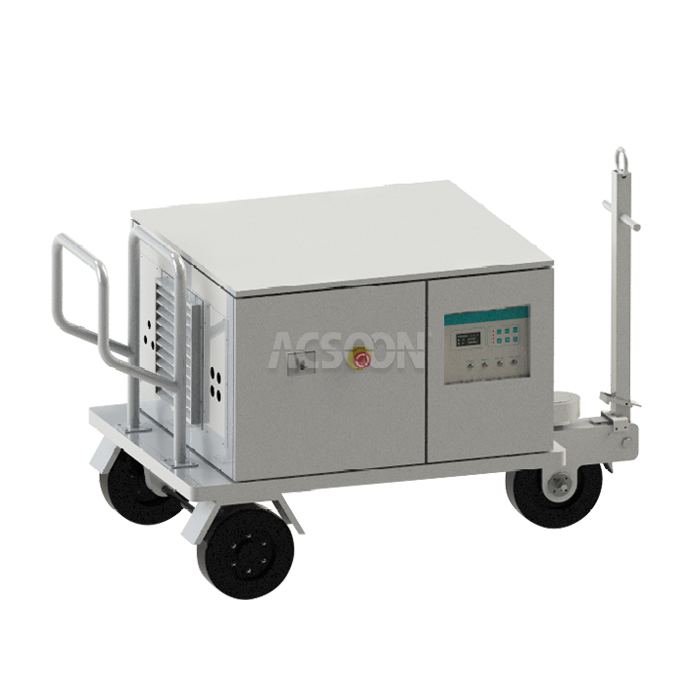
Maintenance, Repair, and Overhaul (MRO) facilities use avionics test power supplies to troubleshoot and verify repaired equipment before returning it to service. On the flight line, portable or towable 400Hz ground power units serve a dual purpose: they can power the aircraft directly for ground operations and, with appropriate output quality, support bench testing of avionics components removed from the aircraft. The ACSOON GPU400 Series is an example of a unit that bridges this gap, providing clean enough output for both aircraft ground power and avionics bench testing.
Aviation training and educational institutions
Aviation universities and training centers use compact 400Hz power sources to give students hands-on experience with the type of power system they will encounter in real aircraft. These educational applications typically use smaller units (3–10 kVA) that are safe, portable, and affordable, such as the AF400M/ACF400M Series compact 400Hz power sources. Students learn how to connect equipment, interpret power quality measurements, and understand the relationship between the aircraft power bus and avionics performance.
Need a precision 400Hz AC power source? View Product Details → or contact us at acpower@acsoonpower.com for a quotation.
Choosing Between Fixed and Portable Avionics Power Sources
The choice between a fixed installation and a portable unit depends largely on where and how the power will be used. Fixed units, typically rack-mounted or cabinet-style, are suited for permanent test bays and production lines where they can be integrated into a larger test infrastructure with automated control and data acquisition systems. They tend to offer higher power capacity and more advanced features.
Portable and towable units provide flexibility for flight line operations, field maintenance, and multi-site testing programs. They are built to withstand outdoor conditions, with IP-rated enclosures and rugged construction. For organizations that need both bench testing and aircraft ground power capability, a well-designed solid-state GPU can serve both functions, reducing equipment investment and training requirements.
For more information about ACSOON avionics test power solutions, including the ACP400 heavy-duty series and AF400M compact series, visit acsoonpower.com or contact the JERRYSTAR engineering team at acpower@acsoonpower.com.
FAQ
Can I use a standard 50Hz/60Hz power source to test avionics equipment?
No. Most avionics equipment is designed to operate at 400Hz and will either malfunction or be damaged if powered from a standard 50Hz/60Hz source. The higher frequency allows the internal transformers and power supplies in avionics equipment to be much smaller and lighter, which is essential for aircraft installation but means they cannot tolerate lower frequencies.
What is the difference between a 400Hz ground power unit and an avionics test power supply?
A 400Hz ground power unit is primarily designed to power the aircraft on the ground, supplying the aircraft's electrical bus so that onboard systems can operate without running the APU. An avionics test power supply is optimized for laboratory and bench testing, with tighter output tolerances, programmable features, and the ability to simulate abnormal conditions. However, high-quality solid-state GPUs like the ACSOON GPU400 can serve both roles when the output quality is sufficient for the testing being performed.
How much power capacity do I need for avionics testing?
It depends on what you are testing. A single avionics unit like a navigation receiver may draw only 50–200 watts, so a 3 kVA unit is sufficient. A full avionics suite for a regional aircraft might require 30–60 kVA. For wide-body aircraft ground power and system-level testing, units of 90–180 kVA are common. Always size the power supply to handle the peak load with at least 20% headroom.
Do I need a three-phase or single-phase output?
Most aircraft electrical systems are three-phase, so avionics equipment designed for direct aircraft bus connection typically requires three-phase 400Hz power. However, some avionics units operate on single-phase power derived from one phase of the aircraft bus. Check the equipment specification to determine the correct configuration.
What standards apply to avionics test power?
RTCA DO-160 (and its European equivalent, EUROCAE ED-14) defines the environmental test conditions for airborne equipment, including power input quality and transient test requirements. MIL-STD-704 defines similar requirements for military aircraft. ISO 6858 specifies requirements for 400Hz ground power units at airports. Your test power supply should be capable of producing the power quality and transient conditions defined in whichever standard applies to your equipment.
Conclusion
An avionics test power supply is the critical link between the laboratory and the flight line. By converting standard utility power into the precise 115V, 400Hz AC that aircraft electrical systems require, these units enable avionics manufacturers, certification labs, and MRO facilities to verify equipment performance under realistic conditions. Solid-state frequency converter technology has made these power supplies cleaner, more precise, and more versatile than ever before, with capabilities extending from simple power application to sophisticated programmable test sequence generation. Whether you are testing a single navigation receiver or powering an entire aircraft electrical system for ground testing, selecting a power supply with the right specifications — output quality, capacity, protection features, and compliance with relevant standards — is essential for ensuring that your test results are valid and your equipment will perform reliably in service. For more information about ACSOON 400Hz power solutions, visit acsoonpower.com.